Muren scheiden mensen, maar deuren maken het verschil
UpMuren scheiden mensen, maar deuren maken het verschil is a phrase that turns a literal hospital threshold into a compact account of separation and possibility. It follows Emma Nieuwenhuis’s encounter with a closed ward door and resonates elsewhere in her reflections on illness, responsibility, and the difficulty of understanding another person: a barrier may divide people, but what happens at its opening or closure can matter decisively.
The phrase and its immediate scene
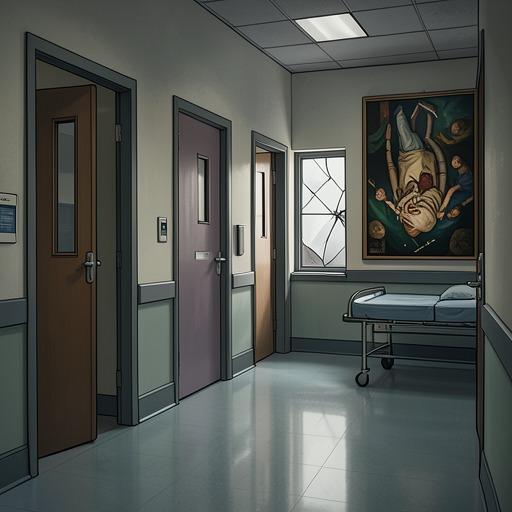
The phrase appears after Emma turns toward the door of the PAAZ locked ward. Gwen has disappeared; on the other side of the glass stands an older man leaning on a walker, his face marked by what Emma reads as intense hatred. Unsure whether he is staring at the door or at her, she decides that he is looking at the door. When he realizes it will remain closed, he mutters indistinctly and walks away, his walker squeaking behind him. Emma swallows and recognizes something of how he feels. The sentence follows this brief exchange, shifting attention from the wall-like separation to the door that might, or might not, allow passage.
Its force comes from the contrast between physical proximity and actual access. Emma and the man are close enough to see one another through glass, but the closed door still determines their separation. The phrase does not claim that a door will necessarily open or that the people divided by it will understand each other. In the scene, it stays shut. Instead, it makes the threshold itself consequential: the barrier is not simply a wall, because a door introduces the possibility of passage while also making refusal visible.
Separation inside and outside the self
The phrase also fits Emma’s account of states of mind that resist explanation. Asked how she feels now, she compares the task of describing her experience to explaining sight to someone blind: the familiar-looking moon is a huge body hurtling through space, the apparently blue sky is black, and a mist lifting from her mind seems to reveal how things really are. She then gives the psychiatrist a minimal answer: she feels good, clear. The contrast between what she experiences and what she can communicate marks a boundary between inner certainty and another person’s access to it.
That boundary is especially stark in Emma’s recollection of the depression that preceded her admission. During a night round, she manages a strained smile at the nurses and tries not to feel, think, or remember. The effort fails: she begins to cry as the memory returns, describing depression as leaving her with fragments of herself that cling desperately to life while being pulled downward. The image of the depth beyond the balcony makes the divide more than an intellectual one; memory and despair can return with a force that separates the person enduring them from ordinary contact.
Emma also describes how an overwhelming belief narrowed her capacity to respond to other people. When she learned that Doctor Visser’s husband had died, she felt nothing; even the discovery that the psychiatrist had children struck her as absurd rather than emotionally significant. Emma explains that her thoughts and feelings seemed absorbed by the idea that she had to die, which she experienced not as a plan carrying its ordinary emotional weight but as something that simply had to happen. The episode shows how illness can close off forms of feeling and shared understanding even when another person’s circumstances are known.
Doors as boundaries in relationships
In conversation with another patient, Emma describes a conflict with Sergei over the medication her psychiatrist had asked him to remove. He resisted for more than three weeks, and it took two conversations with the psychiatrist before he finally did so, still reluctantly. Emma worries that his resistance means he does not take her difficulties seriously. The other patient offers a different interpretation: perhaps Sergei’s reluctance is a form of self-protection, because accepting how life-threatening Emma’s problems were would mean facing the possibility of losing her. Their exchange does not settle what Sergei intended; it reveals instead how the same protective measure can be experienced as care by one person and disbelief by another.
The door image becomes a matter of personal limits when Emma recognizes how Sergei sees her: as his patient, someone for whom he feels responsible and whom he wants to keep safe from herself. She understands the weight of that perspective, but also insists that this is her life and that she must live it herself. She asks him to let her go. Sergei says he does not want things to go wrong or for her to deteriorate again; Emma replies that she will become worse again. Her request is not a claim that risk has disappeared. It is a demand that protection leave room for her own agency, even with the likelihood of future difficulty acknowledged.
Understanding without identical experience
The phrase’s concern with separation also extends to experiences that Emma cannot share firsthand. When Beatrice says she is afraid and no longer feels God, Emma recalls Michiel’s slogan T-shirt, which had made the others laugh; Beatrice had not laughed. Emma feels ashamed that she had never really tried to understand her. Beatrice explains that she had felt God throughout her life, including during depression and after losing her child, but that the feeling vanished three days after she first received medication. She stopped taking the pills in the hope that God would return, but the feeling did not return, and she eventually came back to the ward.
Emma cannot confirm Beatrice’s interpretation or claim the same faith. She says she does not know that feeling, while recognizing how comforting it must have been and how cruel it would be to lose it. She suggests that depression, rather than the medication, might have drained Beatrice’s energy to believe, just as depression can take away the energy to laugh, feel happy, or love. The exchange does not erase the distance between their experiences. It makes that distance visible while allowing Emma to respond with care rather than treating Beatrice’s account as interchangeable with her own.
Across these scenes, Muren scheiden mensen, maar deuren maken het verschil holds together two truths: separation can be real, and connection is not guaranteed, but the boundary between people still shapes what they can attempt, refuse, or understand. The closed ward door, Emma’s guarded disclosures, her request for room to act, and her listening to Beatrice give the image its range. A door matters not because it abolishes the wall, but because it makes the question of access—and of who may decide—impossible to ignore.