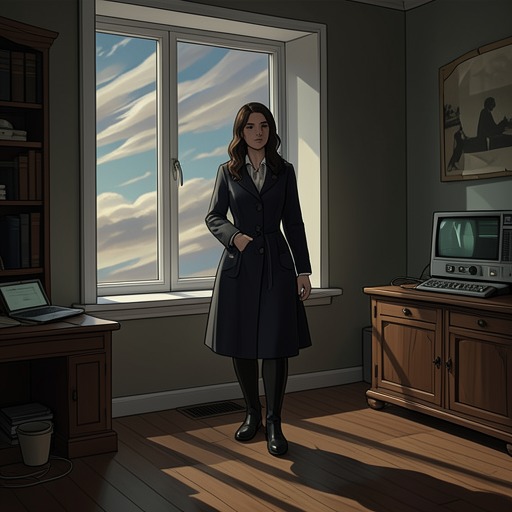
The Sound of Silence
UpThe Sound of Silence is both a song Emma plays on her final day at the PAAZ and an opening lyric that gives the narrative a language for darkness, memory, and the difficulty of speaking about inner experience. Its significance rests on a contrast: Emma leaves the hospital smiling and grateful, yet the darkness named by the song is not simply behind her. As the book considers depression, time, and the limits of explanation, the song’s words acquire a more unsettled resonance.
The song and its opening words
The book begins with lines from the song, including “Hello darkness, my old friend,” and “I’ve come to talk with you again.” The lyric addresses darkness not as a sudden stranger but as a familiar presence, and describes a vision whose seeds remain after sleep. The song is identified as The Sound of Silence and credited to Simon & Garfunkel. Before the narrative moves into its Friday scene, this opening establishes a tension between speech and silence: the speaker turns toward darkness to talk, even as the song’s title names an absence of sound.
That tension suits a narrative in which naming an internal state does not make it easy to communicate. The song supplies a compact, memorable image, but Emma’s experience elsewhere resists such compression. The lyrics can accompany her, and the book can return to their words, without resolving what darkness means for her or making it a finished chapter of the past.
A refrain on the last day at the PAAZ
On Friday, Emma stops the music and presses repeat. She bounds up the hospital stairs two at a time, smiling broadly. The quoted greeting to darkness is immediately made pointedly appropriate to the occasion: it is her last day at the PAAZ. She has reported to the secretary for the final time, is walking to the hospital pharmacy for her last pills, and expects to see her psychiatrist, Doctor Visser, in about fifteen minutes. The song is therefore not incidental background; Emma deliberately returns to it as she moves through the practical steps of departure.
The scene holds two registers together. Her rapid ascent and broad smile, followed by her sense of gratitude and happiness, make the day feel like a release. Yet the repeated lyric does not offer a simple declaration that darkness has ended. Its address to an old companion sits beside the concrete fact that Emma is leaving care and will still take medication and attend a final psychiatric appointment. The song makes the moment feel bright without turning departure into proof of cure.
Darkness, memory, and lived time
Elsewhere, Emma struggles to describe what feeling well means. She imagines the difference between seeing the sky as an ordinary blue and understanding the vast, dark universe beyond the atmosphere; she compares the lifting of a persistent fog with suddenly seeing things as they truly are. Even then, she wonders how such a change could be explained to a psychiatrist. The passage clarifies why a song can matter without functioning as a complete account: an image may approach an experience that ordinary explanation cannot adequately convey.
The book also gives darkness a bodily and remembered force. During a night in the hospital, Emma tries to resist feeling, thinking, and remembering. When the nurses’ flashlight passes over her face, she raises a hand and offers a strained smile; once the room is dark again, panic returns. She then begins to cry, recognizing that what she is resisting is not only thought or emotion but a memory associated with a lifelong feeling of being pulled downward. The recollection reaches back to the depth beyond the balcony. Against that scene, the song’s familiar darkness can be heard not only as an expressive image but as a reminder that painful material may return even when Emma is trying not to recall it.
A reflection while Emma waits outside Rajid’s office makes the song’s darkness temporal as well as emotional. She understands mania as a present that seems to detach itself from both past and future, while depression allows the past to swallow the future until time itself loses meaning. In that state, looking forward or backward offers no view beyond depression. The song’s return in the narrative thus sits within a larger contrast between a vivid, accelerating present and a depression that seems to erase the passage of time.
Speech, care, and what remains unresolved
The lyrics’ effort to speak to darkness also resonates with Emma’s difficulty communicating with the people responsible for her care. In the later conversation with Rajid, she recognizes the weight of being seen as a patient for whom he is responsible and who may need protection from herself. She accepts that this is part of how she appears to Sergei, her family, Rajid, Doctor Visser, the nursing staff, and the PAAZ. At the same time, she insists that this identity is also her life and that she must live it herself. She asks Rajid to let her go; he says he fears that things may go wrong, and she gently answers that they will get worse again.
That exchange keeps the song’s relationship to darkness from settling into a reassuring arc. Leaving the PAAZ matters, but it does not promise that future deterioration has been ruled out. The song’s opening address can therefore accompany both the happiness of departure and the recognition that darkness may return. Its role is not to diagnose Emma or explain away her experience, but to give the book a recurring verbal image for familiarity with suffering, the desire to speak across silence, and the uncertain work of living beyond a single hospital stay.