Conversion of the Utopians to Christianity
UtopiaThe Conversion of the Utopians to Christianity is a gradual, partial embrace of a new faith within a society already shaped by religious variety. As Raphael Hythloday tells it, many Utopians were drawn to Christianity after hearing about Christ and Christian life, but their baptism did not settle questions of religious authority or bring the island’s diverse beliefs to an end.
Religious Setting
Christianity entered a society where different towns and even people within the same town followed different religions. Some worshipped the sun, moon, or planets; others revered people celebrated for virtue or glory. Many of the wiser inhabitants, Raphael says, worshipped one eternal, invisible, and incomprehensible deity, whom the Utopians commonly called Mithras. Against this varied religious background, Christian teaching was not introduced to an unreceptive or uniformly opposed population.
The island’s policy of toleration had been established by Utopus after religious divisions among the original inhabitants had weakened their ability to resist conquest. His law allowed people to follow and advocate for their faith through argument and peaceful, modest persuasion, while forbidding reproach and violence. It protected the choice to convert, but did not license conduct that threatened public peace: the law distinguished religious disagreement from incitement to sedition.
The Conversion
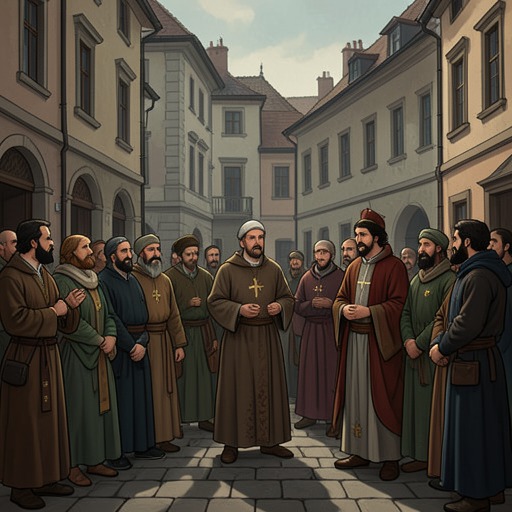
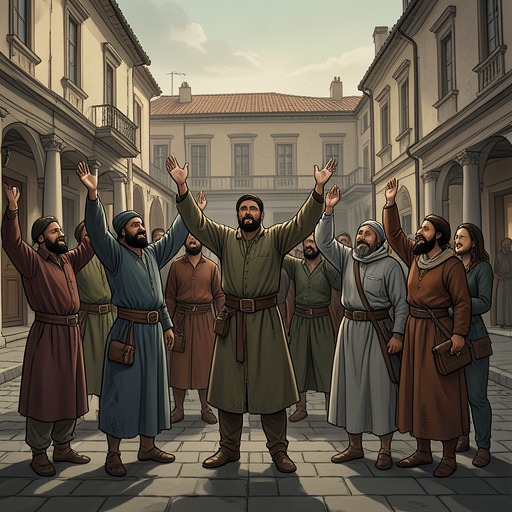
During Raphael’s stay in Utopia, he and his companions recounted the doctrine and way of life associated with Christ, described his miracles, and spoke of the constancy of the martyrs. Many listeners became Christian and received baptism. Raphael does not decide whether their response arose from divine inspiration or from the appeal of communal ownership. He notes that they understood Christ and his followers to have lived by common property, a principle especially dear to them and still observed in some Christian communities.
The account is rooted in Raphael’s experience as a traveller and observer. He had lived among the Utopians for five years, and had reached their society after a long journey through unfamiliar lands with other survivors of his party. His report makes conversion one encounter within a broader exchange of knowledge: travellers describe a religion, and their hosts assess it in relation to beliefs and social practices they already hold.
Limits and Unfinished Questions
The new converts could be baptized, but Raphael and the three other surviving members of his party were not priests. They therefore could not administer the other sacraments, which, as Raphael explains, required priests. The converts were instructed about those rites and strongly desired them, leaving their initiation incomplete in practical terms.
The Utopians considered whether someone they selected might be qualified to serve as a priest without authority derived from the Pope. They seemed prepared to choose such a person, but had not done so when Raphael departed. Conversion thus opens a question of religious governance that the account leaves unresolved: the community’s interest in Christian rites meets the absence of an authorized priest and uncertainty about where priestly authority must come from.
Toleration and Public Order
The account also shows that religious toleration did not mean that every form of religious advocacy was accepted. A newly baptized man repeatedly denounced the island’s other rites and condemned their adherents. After a trial, he was banished for inflaming the people to sedition, not for disparaging their religion. His case gives practical force to the distinction in Utopus’s law between persuasion and coercion or disorder.
The public temples reflect the same effort to accommodate religious difference. Although the Utopians held many beliefs, their public worship was arranged around what the different groups could share; each sect kept its distinctive rites for private settings. The temples contained no images of God, and prayers were framed so that people of differing beliefs could use them without violating their own convictions. Christianity’s arrival is therefore presented neither as an immediate replacement of other faiths nor as an exception to the island’s pluralism: it becomes one freely adopted religion within a system that seeks common ground while maintaining boundaries against religiously inflamed discord.