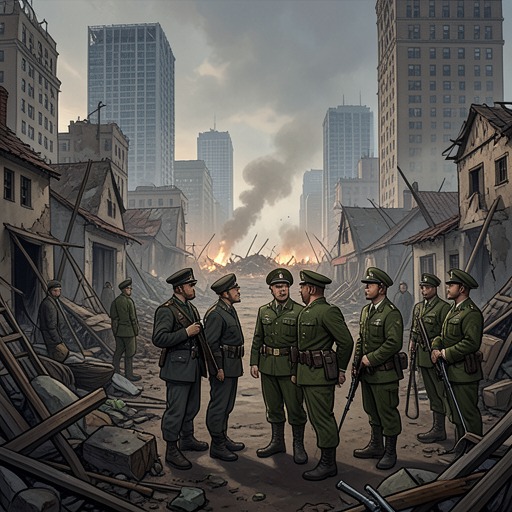
War between the Nephilogetes and the Aleopolitans
UtopiaThe War between the Nephilogetes and the Aleopolitans is Raphael Hythloday’s example of the Utopians entering a recent conflict on behalf of an ally. It arose from alleged injuries to Nephilogete merchants, expanded into a terrible war involving several neighboring states, and ended in the Aleopolitans’ conquest and enslavement. The Utopians claimed no share of the spoils, even though their intervention helped secure the victory.
Cause and Entry into the War
The Utopians profess to detest war as a brutal practice, but they allow themselves to fight in defense of their own people or friends against unjust aggressors. They may also help an oppressed nation shake off tyranny. Their assistance in this conflict was offensive rather than merely defensive: before supporting an ally in an offensive war, they require that they be consulted before hostilities begin, that the grounds for war satisfy them, and that demands for reparation have been rejected so that war appears unavoidable.
In this instance, the cause was the treatment of Nephilogete merchants in Aleopolitan territory. The Utopians believed those merchants had suffered grave injustice. Raphael qualifies the account, leaving open whether the alleged treatment was in fact just or unjust; what he identifies as decisive is the Utopians’ judgment of it. They regarded injuries inflicted on merchants under the appearance of law as a particularly compelling cause for war, because a government could use or distort legal rules to disguise an injustice.
Course and Consequences
The conflict was not confined to the two principal states. It became a terrible war in which many neighboring peoples were involved. Its effects extended beyond the belligerents: some flourishing states were shaken, while others suffered greatly. After a prolonged course of harm, the war ended in the complete conquest and enslavement of the Aleopolitans.
The result reversed the balance that had existed before the fighting. Raphael says the Aleopolitans had previously been superior to the Nephilogetes in every respect, yet they were ultimately subdued. Utopian assistance contributed to that outcome, but the Utopians claimed no share of the conquered wealth. Their abstention distinguishes participation in an ally’s war from a claim to profit by victory.
Utopian Principles and the War
The campaign exposes a tension within Utopian antiwar doctrine. The Utopians condemn the pursuit of martial glory and say that war is justified only by security, redress, or aid to the oppressed; here, alleged commercial injustice was sufficient to draw them into a large conflict with consequences for numerous states. Their account makes the stated threshold for intervention depend not only on direct violence but also on whether a grievance is judged serious, whether compensation has been refused, and whether peaceful remedy is considered exhausted.
Their rules also distinguish injuries to allies from commercial losses suffered by the Utopians themselves. If their own merchants faced fraud without personal violence, the Utopians would seek satisfaction and, if refused, cease trading rather than make war. They explain this restraint by the different stakes: private traders among neighboring peoples bear their own losses, whereas Utopian exports belong to the community, which expects little in return for goods it has in abundance. The contrast makes their intervention for the Nephilogetes notable: the reported injustice to an ally’s merchants could warrant war even though a comparable commercial loss to the Utopian public would not, by itself, do so.
The Utopians’ general methods of war sharpen the contrast between their principles and the conflict’s severe outcome, though Raphael does not identify which particular methods were used in this campaign. They say that victory without bloodshed, achieved through understanding and conduct rather than force, deserves the greatest honor. In general, they also try to shorten wars through rewards offered to enemies who betray or capture designated leaders, and by encouraging divisions within an opposing state or among its neighbors. Their stated purpose is to limit wider slaughter, but these methods rely on political subversion and large inducements, complicating the humane rationale they advance for them.
Narrative Significance
Raphael uses the conflict to show how Utopian principles operate when the alleged injury is committed against another people. The episode presents a community that treats unjust commercial rules as a possible cause of war, demands that peaceful claims for reparation first be refused, and then accepts the consequences of armed intervention—including the destruction of states and the subjection of a defeated population. Its refusal of spoils supports the distinction between intervention and conquest for gain, but does not erase the scale of the outcome. The war thus gives concrete form to the question at the center of the Utopian account: whether careful limits on the reasons for fighting and on the uses of victory can make war just without making its consequences less severe.