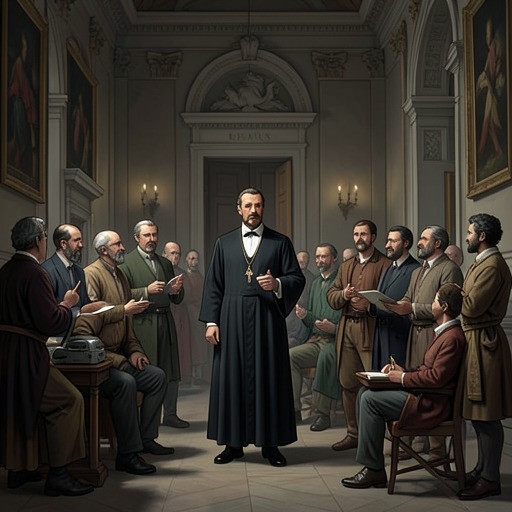
Thomas More’s 1515 mission to Flanders
UtopiaThomas More’s 1515 mission to the Low Countries is both a diplomatic undertaking and the narrative threshold of Utopia. Sent to negotiate a renewed alliance, More travels from Bruges to Antwerp; there, his friendship with Peter Giles brings him into conversation with Raphael Hythloday. The mission’s political business gives way to Raphael’s travel reports and, ultimately, to the imagined commonwealth whose institutions More presents with interest but not unqualified approval.
Diplomatic mandate and departure
In May 1515, Henry VIII appointed Thomas More to a commission with Cuthbert Tunstal and others, instructing them to confer with representatives of Charles V about renewing an alliance. Charles was then Archduke of Austria, not yet Emperor. More was about thirty-seven and had not yet been knighted. The mission took him away from England for six months, placing the opening encounter of the book within the practical world of royal diplomacy.
The political setting was one of concentrated authority. In 1515 Wolsey became a cardinal and Henry VIII made him Lord Chancellor; the King and the Cardinal ruled without calling a parliament until 1523. Against this background, More’s assignment to negotiate with Charles’s representatives establishes the kind of court and state business that will later become a subject of Raphael’s criticism.
Negotiations and the Antwerp meeting
The commissioners met Charles’s representatives at Bruges. The Margrave of Bruges headed the delegation, while George Temse, Provost of Casselsee, was regarded as its leading speaker: trained in law, experienced in affairs, and notably eloquent. The parties met several times without reaching agreement. The other delegation then went to Brussels to seek instructions, and More used the interval to travel to Antwerp.
There he formed a close friendship with Peter Giles, a learned and courteous secretary to the municipality. In the book’s account, Giles’s company helped ease More’s longing for his wife and children during an absence that had already lasted four months. The larger mission lasted six months, while this earlier duration marks the personal cost of being away from home within the Antwerp episode.
The encounter that redirects the narrative happens after More returns from mass at St. Mary’s, Antwerp’s principal church. He sees Giles in conversation with a weathered stranger whose beard and careless cloak make him appear to be a sailor. Giles presents him instead as Raphael Hythloday, a traveller and philosopher with an unusually wide knowledge of unfamiliar countries. The contrast between More’s first impression and Giles’s account turns an incidental meeting into the occasion for the book’s central testimony.
Raphael Hythloday and the opening of the dialogue
Raphael is introduced as Portuguese by birth and learned in Greek as well as Latin, with a particular devotion to philosophy. He had travelled with Amerigo Vespucci on three of the four voyages then published, but did not return with Vespucci from the last. Instead, he secured permission to remain with the twenty-four men left at the expedition’s farthest point in New Castile. After travelling through many countries with five Castilians, he reached Ceylon and then Calicut, where he found Portuguese ships that carried him home.
That history makes the meeting a hinge between More’s European diplomatic journey and Raphael’s accounts of distant societies. After the initial courtesies, More, Giles, and Raphael go to More’s house and sit together in the garden. Raphael’s experience supplies the grounds for comparing political customs: he can describe the institutions of places he has visited and identify practices that might correct the errors of the societies around him. The book’s introductory account explicitly moves from the embassy and the Antwerp friendship into the discovery of Raphael, so that reported fact opens onto philosophical fiction without a clean break.
From diplomatic encounter to political argument
Raphael’s observations prompt Peter Giles to ask why a man with such knowledge does not enter a king’s service. Raphael resists the suggestion. He has already distributed his estate among his relatives and friends, he says, and regards royal service as a form of enslavement rather than a useful application of his freedom. The disagreement establishes a recurring question of the dialogue: whether a philosopher can improve political life by serving rulers, or whether court service compromises the independence needed to speak honestly.
The conversation develops into a debate about laws, poverty, and punishment. Raphael recounts an English discussion in which a jester’s mock proposal to send beggars to monasteries is taken seriously by those present, while the jester’s attack on friars provokes an angry response from a friar. The comic exchange sharpens the book’s scrutiny of the gap between stated concern for the poor and the institutions or habits that leave them unsupported. The embassy has thus become the setting for a broader examination of how power responds to social problems.
The commonwealth and More’s reservation
Raphael eventually turns to the customs and laws of the Utopians. Their island, once part of the continent and formerly called Abraxa, was separated under Utopus by a channel fifteen miles long. Utopus made both the conquered inhabitants and his own soldiers work on the excavation, and the account presents the resulting separation as part of the transformation of the population and its government. The island has fifty-four cities, whose representatives meet annually at Amaurot to deliberate on shared concerns.
Raphael’s description also exposes tensions within the commonwealth’s claims to order and equality. Families are regulated in size, and population is redistributed between cities. When the island’s population exceeds its capacity, Utopians establish colonies on neighbouring land they consider insufficiently cultivated. They invite the inhabitants to join their society, but drive them out if they refuse to conform, using force if they resist. Raphael calls the seizure of unused land a just cause of war, linking the society’s carefully managed abundance to coercive territorial expansion.
At the close of the account, More’s first-person narration distinguishes his response from Raphael’s confidence. He notes objections to Utopian practices, especially its conduct of war, its religious ideas, and its common ownership without money, but postpones a fuller argument because Raphael is tired. More praises the constitution in general terms while admitting that he cannot agree with everything Raphael has related; he would rather see many Utopian institutions adopted than confidently expects that they will be. The mission’s decisive literary consequence is therefore not a settled endorsement, but a dialogue whose ideal proposals remain open to examination.