House of Commons
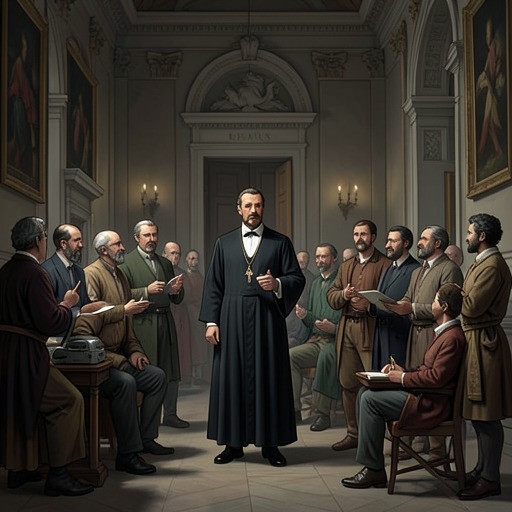
UtopiaThe House of Commons is presented as the arena of Thomas More’s early parliamentary opposition: in 1503, he argued against a royal subsidy and helped persuade the House to refuse it. The episode establishes public debate as part of More’s political life and shows that his willingness to challenge a proposal could carry personal consequences at court.
More’s Parliamentary Intervention
At twenty-one, More entered Parliament. In 1503, while serving as Under-Sheriff of London, he opposed Henry VII’s request for a subsidy to provide the marriage portion of his daughter Margaret. The account emphasizes the force of his opposition: the House of Commons refused the grant, and a report to the king described the result as the work of a beardless boy who had frustrated his expectations.
The episode gives the House a specific, consequential role in More’s biography. It is where an argument against a royal financial request became a refusal by the Commons, rather than merely a private objection. The account does not describe the debate’s procedure or the positions of other members; its focus is More’s intervention and the outcome.
Consequences for More
The refusal was followed by royal displeasure. During the final years of Henry VII’s reign, More remained out of favour and considered leaving the country. The narrative thus links his Commons opposition to a political cost: speaking effectively on a public question did not protect him from the king’s resentment.
More’s later advancement came after Henry VII’s death in April 1509. In the first years of Henry VIII’s reign, More developed a substantial practice in the law courts; the account also reports that he refused cases he considered unjust and took no fees from widows, orphans, or poor people. These details broaden the portrait of his public conduct, but the text does not claim that the House itself caused or shaped his later legal career.
Political Counsel and the Book’s Argument
The House episode belongs to the historical background against which Utopia presents questions of public service and political advice. The introductory account describes the book as a playful fiction carrying an earnest argument about the political and social evils of its time. It also notes that More sometimes speaks of France when he means England and uses ironic praise of Christian kings to avoid making the work appear to attack Henry VIII’s policy directly. This framing places More’s political writing within constraints that differ from the Commons confrontation: parliamentary opposition is recorded as a past action, while the book explores how criticism might be voiced under princely rule.
In the dialogue, Raphael Hythloday doubts that a philosopher can improve government by entering a prince’s service, describing courts as hostile to unwelcome advice. More’s interlocutor argues instead that a counsellor should adapt his counsel to circumstances and try to make public affairs less harmful when he cannot make them wholly good. The dispute helps illuminate the broader problem of political participation that the Commons episode raises in biographical form, but the dialogue does not identify the House of Commons as its subject.
Relation to Utopian Government
The account of Utopia offers a contrasting model of collective deliberation. Its fifty-four cities each send three senators to Amaurot annually to discuss shared concerns; within the cities, magistrates and councils deliberate under rules intended to prevent sudden decisions and secret efforts to enslave the people. These institutions are described as features of the imagined commonwealth, not as reforms proposed for the House of Commons.
That distinction matters to the entry’s significance. The Commons appears in the historical account through one concrete parliamentary decision, while Utopia supplies an extended fictional examination of how political communities might organize deliberation and public resources. The text supports a comparison between More’s documented experience of opposition and the book’s sustained interest in government, but it does not establish a direct institutional connection between the Commons and Utopian councils.