Council of the Whole Island
UtopiaThe Council of the Whole Island is the island-wide institution through which Utopia’s cities consult on common affairs and respond to needs that cross local boundaries. Meeting at Amaurot, it links political deliberation to the practical coordination of food and other resources, while procedures for referring major proposals to it are designed to limit rash decisions and prevent rulers from acting together against the people.
Composition and Meeting Place
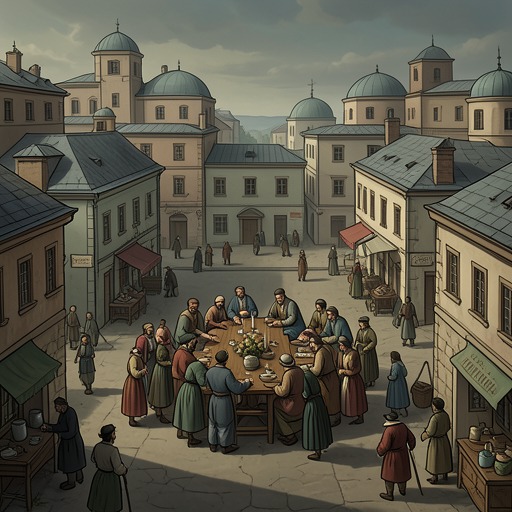
Utopia consists of fifty-four cities whose customs and laws are alike. Each city sends three of its wisest senators once a year to Amaurot, the island’s chief city near its centre, where they consult about common concerns. Amaurot’s central position makes it a convenient meeting place for representatives travelling from across the island. The account also describes a great council there, attended by three representatives from every town, which examines the relative abundance and scarcity of provisions.
The Council’s island-wide character complements a system of local government. Every city elects magistrates, while the Prince and senior magistrates conduct ordinary state business. The Council is not presented as a daily governing body: its annual meeting provides a forum for concerns that require consultation among the cities, and matters of particular importance may be referred to the council of the whole island.
Deliberation and Political Safeguards
The route to island-wide consideration is structured to widen discussion before a decision is made. When a matter of great importance arises, it is sent to the Syphogrants, who communicate it to the families in their divisions and consider it among themselves before reporting to the senate. On great occasions, the matter can then be referred to the Council of the Whole Island. This sequence brings family-level discussion into the political process rather than leaving a proposal solely in the hands of the highest magistrates.
Utopian rules also restrict informal political manoeuvring. The Prince and Tranibors may not conclude public business without prior debate, and a proposal cannot be debated on the same day it is first introduced. A matter must be discussed on three separate days before a conclusion is reached. The text presents such delays as protection against decisions made in the heat of debate and against officials persisting in their first opinions merely to avoid appearing mistaken. Political consultation outside the ordinary council or the assembly of the whole people is forbidden on pain of death; the prohibition is intended to prevent private meetings from becoming conspiracies to alter the government and enslave the population.
Island-Wide Provisioning
The Council’s practical importance is clearest in its review of supplies. At its annual meeting in Amaurot, representatives examine which towns have provisions in excess and which face scarcity. The well-supplied cities furnish those in need without payment or exchange, making the island function, in the narrator’s account, like one family rather than a collection of competing towns.
This coordination rests on a wider system of common provision. Goods produced by families are brought to public storehouses, where a family head may take what the household needs without paying or leaving anything in exchange. The annual review extends this principle between cities: local differences in supply are addressed through transfers rather than sale. The Council therefore coordinates the island-wide movement of goods without replacing the local distribution described in each city.
Representatives also oversee the preparation of stores sufficient for two years, a precaution against the consequences of an unfavourable season. Once those reserves have been provided for, the Council orders the export of surplus goods, including corn, honey, wool, flax, wood, wax, tallow, leather, and cattle. A seventh of the exported goods is given freely to poor people in the receiving countries; the rest is sold at moderate rates. The proceeds supply goods Utopia lacks and add to its public resources.
Scope and Significance
The Council’s authority is described through consultation, referral, and intercity coordination, not through a detailed account of its independent executive powers. Its annual deliberations join political representation to the management of common needs: the same island-wide gathering is associated both with common affairs and with balancing provisions among the cities. For serious proposals, referral to the Council of the Whole Island marks a further stage in a process intended to prevent decisions from being made precipitately or confined to the Prince and senior magistrates.
The institution’s work also reveals a tension within Utopia’s ordered commonwealth. Its internal transfers and reserve planning depend on collective provision across the island, while its account of colonization permits Utopians to occupy land on the neighbouring continent when they judge it insufficiently cultivated, absorbing willing inhabitants and using force against those who resist. The Council is not specifically said to direct that policy, but the contrast clarifies the limits of the commonwealth’s cooperative arrangements: they are most fully described among its own cities, while claims beyond the island can involve compulsion.