Utopus’s conquest and separation of Abraxa
UtopiaUtopus’s conquest and separation of Abraxa is the founding action through which the mainland territory became the island of Utopia: after subduing its inhabitants, Utopus ordered a channel cut between them and the continent. The episode makes the island’s distinctive geography a product of political power, while the labor imposed to create it complicates the orderly commonwealth that later developed there.
Conquest of Abraxa
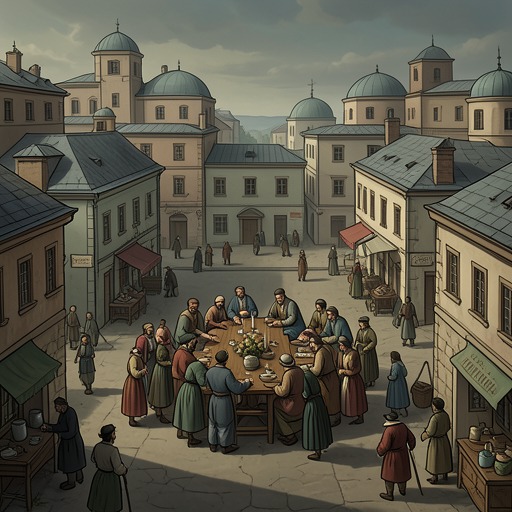
Raphael relates that the land was not originally an island but part of the continent, and that its first name was Abraxa. Utopus conquered it and brought its inhabitants, whom Raphael describes as rude and uncivilized, under a government and level of refinement said to surpass those of other peoples. The account thus joins territorial conquest to political transformation: Utopus is remembered not simply as a military victor, but as the ruler who remade the conquered society.
The Channel and Its Human Cost
Having subdued the inhabitants, Utopus set out to separate the territory from the mainland by digging a deep channel fifteen miles long. The work was undertaken by a vast number of laborers and, Raphael emphasizes, included both the native inhabitants and Utopus’s own soldiers. This shared compulsion is presented as a way of preventing the conquered people from being treated as slaves, but it does not make the undertaking voluntary: the channel was an order imposed by the conqueror on both populations. The scale of the workforce allowed the work to be completed with unexpected speed.
An Island Made Defensible
The channel’s completion changed Abraxa’s physical and strategic condition. Neighbors who had mocked the project as foolish were struck with admiration and terror when it succeeded. In Raphael’s account of Utopia as it later exists, the surrounding waters and coastline reinforce this separation: the main bay is entered through a dangerous passage of rocks and shallows, and its safe channel is known only to native pilots. Other harbors are protected by coasts shaped by nature and fortified by human effort, so that a small force can prevent a much larger army from landing. The island’s security is therefore not merely a natural gift; its defining separation began as a deliberate act of statecraft.
Legacy and the Politics of Land
The conquest also establishes the origin of the name Utopia: the island continues to bear Utopus’s name, while Abraxa survives in Raphael’s account as its former name. Its later commonwealth is described as a coordinated island of fifty-four cities, whose representatives meet annually at Amaurot to discuss shared concerns. These institutions belong to the society that followed the conquest, rather than to the digging itself, but they show the political world built upon Utopus’s territorial transformation.
The island’s later settlement policies echo the importance of cultivated land while exposing a tension in the founding story. When population growth leads Utopians to establish colonies on the neighboring continent, they admit local inhabitants who are willing to join their society and conform to its rules. If inhabitants refuse, the colonists drive them from the land they have marked out, using force if necessary; Utopians regard resistance to their occupation of unused soil as a just cause for war. This later policy is not identified as part of Utopus’s original conquest, but it resonates with it: both accounts present territorial control as a means of ordering land and society, while the founding channel itself was built through compelled labor.