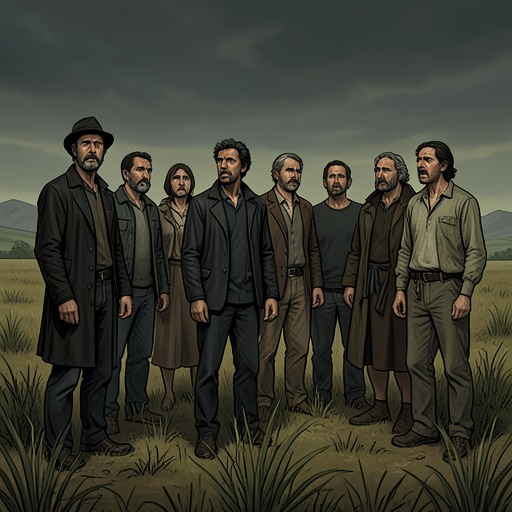
Post-Vietnam War period
VinelandThe Post-Vietnam War period in the novel is marked by a double movement: former countercultural travelers are absorbed into everyday work, while the political past remains available—unevenly and sometimes painfully—in archives and films. Its history reaches Prairie Wheeler not as firsthand memory but through the accumulated records and images of Frenesi Gates and the people who once worked alongside her.
After the War: Work and Resettlement
The end of the Vietnam War is associated with a substantial increase in the Thanatoid population. Thanatoid Village, a residential and commercial center a few miles from Shade Creek and higher up on the hill, provides day labor. Before dawn, workers gather in the square before the Vineland courthouse for a shape-up resembling casual labor hiring: buses wait in the dark with their engines idling, while signs in the windows silently list the work and pay on offer.
Zoyd Wheeler sometimes boards one of those buses with other newcomers. The workers include former artists and spiritual pilgrims who have become lumberjacks, servers, shop clerks and cashiers, truck drivers, picture framers, farmhands, and laborers. The transition is visible in small adjustments as well as changed occupations: long hippie hair proves impractical at work, so some cut it, while others tie it back or slick it behind their ears. Women who had once seemed ethereal become dishwashers or servers, or work as masseuses at the Shangri-La Sauna.
The former companions do not all settle into the same life. Some return South; others persist. Some attend evening classes at Vineland Community College or Humboldt State University. Others work for federal, state, county, clerical, or private welfare agencies, which, after the lumber companies, are among the region’s principal employers. The period thus turns a dispersed counterculture into a population making its way through the institutions and jobs of ordinary life.
The Past in Files and Photographs
That earlier political world reaches Prairie through Frenesi Gates’s dossier, assembled over many years from sources of very different kinds. Official documents carry stamps and file numbers; FBI memoranda bear marker underlining. Alongside them are clippings from underground newspapers that have since ceased publication, transcripts of Frenesi’s radio interviews on KPFK, and materials concerning 24fps, the film collective in which Frenesi and DL once worked together. The file is less a single authoritative account than a gathering of records whose different origins and purposes Prairie must read together.
Photographs make that history personal and public at once. Prairie can call up personal pictures as well as images published in newspapers and magazines, often showing her mother with a camera: at demonstrations, under arrest, or beside recognizable figures from the Movement. In one image, Frenesi looks toward a riot police officer beside a wire fence, her fingertips seeming to touch the barrel of an assault rifle. The photographs make the distance between mother and daughter newly tangible: Prairie recognizes the young woman as her mother, yet sees her in the unfamiliar dress and political circumstances of an earlier generation.
A photograph of DL and Frenesi together offers a different register of the past. They walk across what may be a university campus, their long shadows falling over the grass; a pedestrian overpass, stairs, a volleyball court, and windows fill the background. Prairie reads the California colors, easy movement, and unguarded expressions as signs of a quiet interval rather than a political confrontation. The image cannot explain everything the women shared, but its stillness distinguishes their private companionship from the public struggle recorded elsewhere.
Film as Inherited Experience
At night, reels from the 24fps archive carry Prairie into an America she knows only through fragments from television and old programs. The footage shows miniskirts, wire-frame glasses, love beads, hippie crowds, dogs, and rock bands, but it also records strikes against strikebreakers and police lining the fence of an artichoke field beneath passing storm clouds. Other images show police clearing a Texas commune, striking young people with batons, grabbing handcuffed women, scattering children, and killing animals. The political past arrives not as a smooth chronology but as a succession of scenes Prairie must bear witness to.
The camera also records farm laborers beneath the rising sun, buses with portable toilets in tow, and the harsh daylight over burning marijuana fields. It follows the sunset across school and university campuses converted into military parking grounds. Moments of beauty—a flowered field or a sunset—appear, but they do not cancel what the films show. The reels make looking itself a demand: Prairie deliberately steadies herself so she can keep watching.
As she views the footage, Prairie comes to understand that Frenesi was often behind the camera. She imagines absorbing her mother’s point of view: feeling the frame tremble with fatigue, fear, or nausea, and recognizing in the camera’s movement a choice to approach and record what was happening. The archive becomes a means of contact across generations, but not a complete substitute for conversation. Prairie imagines the screen as a place where a dead mother might receive a limited number of visits; the films offer closeness through images while leaving the gaps in the record intact.
A Counterculture Dispersed
The postwar aftermath is also a story of dispersal. Former companions and former lovers may find themselves communicating years later through computer terminals or from opposite sides of a desk, as if they had been quietly recruited by rival teams. The image links the changed conditions of work to the political divisions that outlast the movements themselves: people who once shared a countercultural world can reappear within institutions, separated by the jobs and positions they now occupy.
Set beside that dispersal, Prairie’s encounter with the archive makes the period more than a simple passage from protest to normal life. The former activists’ records remain—official files, defunct newspapers, radio transcripts, photographs, and reels—but they do not resolve into one uncontested account. Prairie must assemble a family history from those partial traces. The period is therefore both a social aftermath and a problem of inheritance: the past persists, but its next generation receives it through images, documents, and absences as well as through people.