Squilibrio karmico irrisolto
VinelandSquilibrio karmico irrisolto names the unsettled burden that prevents the Thanatoids from completing their movement toward death. It is at once a consequence of unresolved wrongs and the force that organizes their emotions, communities, and attempts at karmic correction. The state is not simply a past grievance awaiting an answer: it persists across generations, can be distorted by fading memory, and becomes an obstacle to any final settlement.
Meaning and Conditions
The Thanatoids are described as having a personality that is like death, but different from it. Their condition is sustained by karmic imbalances: unanswered blows, suffering that has not been redeemed, and wrongdoers who have escaped accountability. Such unfinished business obstructs their daily inward excursions toward Death. Shade Creek serves as a psychological point of departure for journeys toward less explored regions, where transient souls continue not so much to live as to persist, attached to slender hopes.
The imbalance also limits what the Thanatoids feel. They have learned to display emotions only when those emotions might help remove an obstacle to becoming fully dead. Resentment is the most common obstacle, and revenge is among the few feelings they are permitted, or compelled, to retain. Their emotional narrowness thus has a history: it follows from a world in which old injuries remain active and the rules of imbalance and restoration keep their consequences in circulation.
Traditional and Modern Correction
Traditional karmic correction proceeds at the pace of birth and death and may take centuries. Takeshi Fumimota explains the contrast through technological change: the memory capacity of a chip doubles every eighteen months, enabling rapid movement, while the older karmic process remains tied to slow mortal cycles. That slowness is unacceptable to those seeking a share of a market, so a modern system introduces payment deferrals and karmic mortgages, by analogy with futures contracts in the stock market. In this version of correction, death is removed from the process.
The innovation changes the timing and machinery of settlement, not the evidence that an imbalance exists. The system permits obligations to be carried forward rather than waiting for the long cycle of death to resolve them. Ortho Bob Dulang, who has a long list of grievances following damage suffered in Vietnam, would rather obtain revenge than money; Takeshi advises him that asking for money is easier. Their exchange makes the difference between a claim and its redress concrete: an account can be named, and possible targets supplied, without resolving what would count as justice or ending the underlying burden.
Collective Memory and the Great Roast
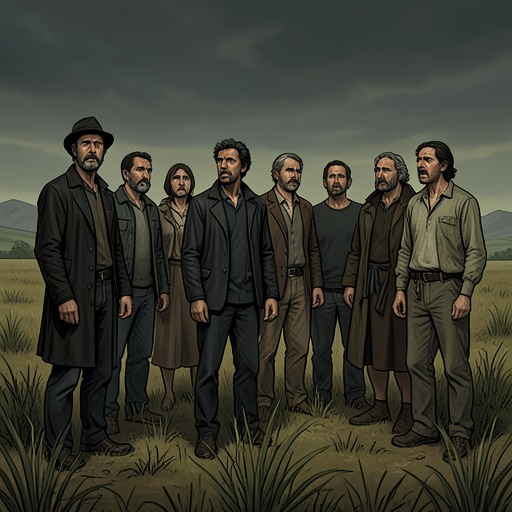
The Thanatoids give unresolved imbalance a public form in their annual Great Roast. At the tenth annual gathering, the 1984 Thanatoid Roast, Weed Atman is honored as the Roastee. Each year the community recognizes someone whose karma has maintained a steady rhythm of crime and countercrime across generations. The chain grows more complicated over time: original wrongs are forgotten or remembered imperfectly, and no solution appears even for its least complicated problems.
The celebration does not mean the Thanatoids enjoy these histories. Rather, the person honored becomes a community hero and model: a figure whose accumulated, unresolved history is recognized by others. At the gathering, people trade dark jokes, mock one another for spending too much terrestrial time on minor karmic business, and complicate already tangled domestic histories. The ritual converts private or inherited grievance into shared recognition, but recognition is not the same as repair. Its comedy and ceremony coexist with the admission that the disputes remain open.
Awakening and the Image of Passage
A collective change begins when the Thanatoids are awakened by the opening of Johann Sebastian Bach’s Wachet Auf, played in synchrony by watches, clocks, and personal computers. The sound comes from chips that had been distributed through obscure commercial battles secretly encouraged by Takeshi Fumimota under an arrangement with Tokkata & Fuji. In the unusual morning around Shade Creek and the Thanatoid Village, the Thanatoids have not only slept; they awaken to music that seems to recall something in their troubled souls. They blink, look around, and seek one another’s eyes, as if a case that had dragged through generations has suddenly ended. The narrative frames this as an unprecedented moment, but does not say that every imbalance has thereby been settled.
The awakening produces a long, repeated call over Radio Thanatoide, prompting Takeshi and DL to listen and DL to say they must answer. That response turns an inward condition into a summons that others can hear. The novel also places the state beside an older story of passage: Vato tells Brock Vond a Yurok tale about a man who follows his lost beloved toward the land of the dead and damages the ferryman’s boat, preventing deaths for ten years. The man returns without his beloved, then warns others about the Ghost Road to the land of death, from which there is no return. As Brock is carried onward across the river, the surrounding voices continue telling stories, cursing, and singing without pause. This image does not supply a neat account of karmic resolution; instead, it echoes a world in which passage is obstructed, the past remains audible, and unresolved claims persist beyond any single journey.