Thanatoid state
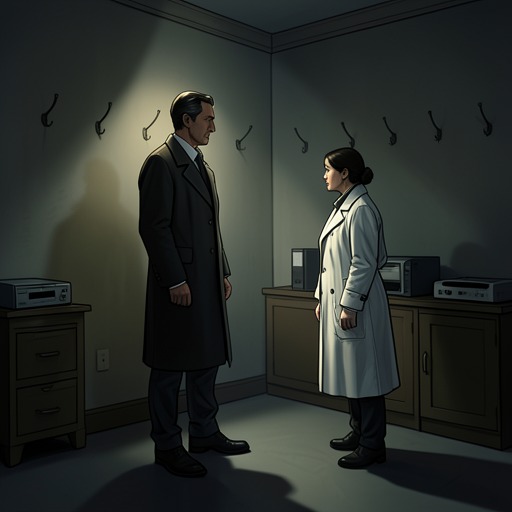
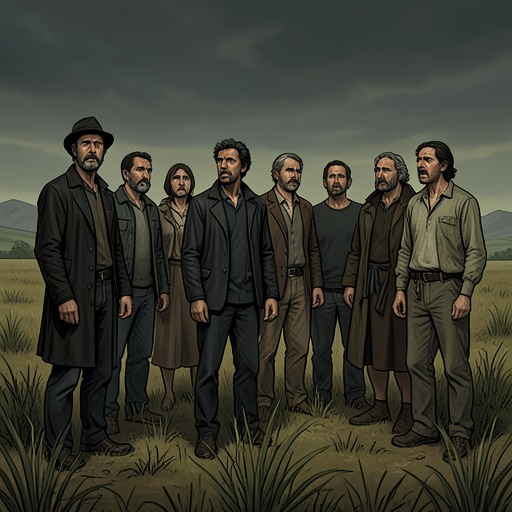
VinelandThe Thanatoid state is a condition of continued existence after death, suspended between ordinary life and whatever may follow it. Its inhabitants can move through the living world, remember their deaths, and sometimes press on the people who wronged them, but they cannot reliably secure justice or release. The state gives bodily and social form to an unresolved past: memory persists, while the power to act on it remains painfully incomplete.
Emergence and Social Setting
After the Vietnam War, the Thanatoid population grew substantially, and Thanatoid Village became a residential and commercial center for people living in this altered condition. The community lay on higher ground a few miles from Shade Creek rebuilt after the flood, a place once evacuated after a supposed flood and later unexpectedly repopulated by sleepless residents. To Frenesi Gates, who encountered the area alone as a child explorer, its abandoned industrial sites and strange inhabitants made the landscape frightening; she did not admit that fear to anyone.
The Thanatoids were also part of a changing regional economy. Day labor was recruited before dawn in the Vineland courthouse square through a shape-up system resembling casual labor contracting: buses waited in the dark, with signs displaying jobs and wages. Zoyd Wheeler sometimes boarded with other workers. Former artists and spiritual pilgrims took jobs as lumberjacks, servers, clerks, drivers, framers, and general laborers; some cut or tied back their long hair to work, while others studied at night or joined the public and private agencies that had become major local employers. Their presence is not presented as an abstract supernatural category alone: it belongs to a county where people displaced from earlier lives must find work, housing, and ways to get through the day.
A State Between Death and Rebirth
Weed Atman explains the Thanatoid condition through the Buddhist idea of the Bardo, the postmortem interval in which a dead person must find a new body within a limited time. In his account, the deceased search among people having sex for an ovum newly fertilized, trying to enter the world again through the exact moment of conception. The process is crowded and disorienting, likened to wandering through a shabby district of smoky theaters and pornographic cinemas with other souls seeking the same passage.
Weed says he made the common mistake of searching for Frenesi rather than seeking rebirth. He failed to find her before his allotted time ran out, and remained in the Thanatoid condition instead. His account makes continued existence neither a clean afterlife nor a simple return to the living: it is the consequence of a missed passage, with memory and attachment surviving when the body and its former possibilities do not.
Limited Agency, Karma, and Resentment
A Thanatoid can travel, observe how circumstances are unfolding, and try to nudge them along, but Weed describes this influence as fundamentally powerless. The condition can become depressing precisely because awareness remains intact while effective action does not. Takeshi Fumimota has computerized the reckoning of karmic debts, making the accounting easier to consult without making its moral consequences simple. Prairie Wheeler asks whether she herself might settle the account, but Weed answers that any balancing depends on what she has proved to be and on the karmic receipts she has accumulated.
That system does not prevent grievance from becoming fixation. Weed admits that he sometimes loses control, roams at night, and interferes with Frenesi, causing her to cry and quarrel with her husband. Yet these disruptions do not satisfy his sense of what is owed: she has not even paid interest on her debt to him. He has lately left her alone, but distinguishes forgetting from forgiveness. The state therefore permits a residue of agency—enough to disturb the living, not enough to resolve the injury—and shows how the persistence of memory can perpetuate conflict rather than repair it.
Awakening and the Music of Wachet Auf
For a long time, the Thanatoids around Shade Creek and Thanatoid Village are associated with sleeplessness and a familiar call that travels through the area. Then, in an exceptional morning, they have slept during the preceding night and are awakened by the same chiming, melodic music issuing in synchrony from watches, clocks, and personal computers. Its sound comes from chips once released amid obscure commercial battles fomented by Takeshi as part of an arrangement with the import-export company Tokkata & Fuji. The devices play the beginning of Johann Sebastian Bach’s Wachet Auf.
The music is not received as ordinary electronic sound. The Thanatoids recognize in it something with a soul, something their troubled souls can remember. They blink, roll their eyes, and perhaps for the first time try to meet one another’s gaze. The awakening is compared to the sudden conclusion of a legal dispute that has dragged on for generations: the past has not disappeared, but the shared event makes recognition possible. The scene treats the Thanatoid state as collective as well as individual, and turns a distributed network of commercial devices into an unlikely instrument of release.
What follows is not the usual call of the Thanatoids but a long, desolate howl, repeated across the dark valleys and reaching Takeshi and DL. They tune in to Radio Thanatoide and let Prairie hear the broadcast. DL concludes that they must answer the appeal and asks whether Prairie will come with them. The awakening thus changes the state from a condition observed at a distance into a summons that demands a response from the living.
The Unresolved Journey
Weed’s account of his own death remains bound to a recurring dream of a train journey. He lies supine on a bed of ice, while two companions travel with him and, at each stop, try to persuade a magistrate to order an autopsy that would establish he was murdered and expose his killer. He can never distinguish their faces. The train is always cold and it is always night; armed men in civilian clothes wait at each station, signal the train to move on, and later swear they never saw it.
The journey has lasted for years. Its two witnesses sustain themselves on coffee, cigarettes, and dining-car sandwiches, play whist, and argue over why Brock Vond wanted Weed dead: passion, politics, personal abuse of power, or obedience to a repressive regime founded on death. Their arguments do not settle the question, and official denial repeatedly blocks the recognition they seek. In Weed’s dream, the Thanatoid state is not only a limbo after death but an ongoing demand for testimony: the murdered person persists, accompanied by witnesses who remember him, while authority refuses to acknowledge either the journey or the crime. His loyalty to those two companions, faithful from city to city and station to station, becomes a counterweight to that refusal, even as the train continues toward another rejection.