Thanatoidi
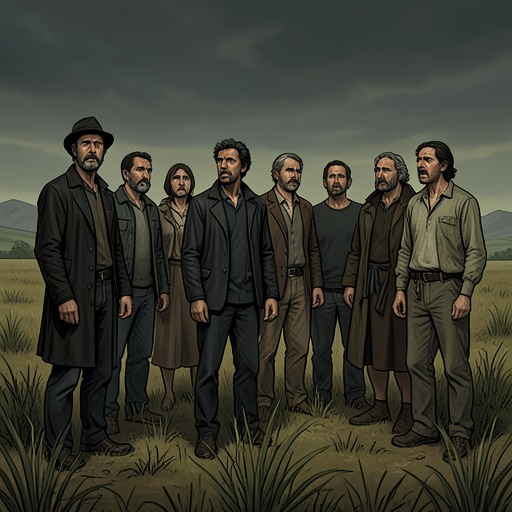
VinelandThanatoidi are people in a liminal condition described as like death, but not the same as death: they remain among the living, yet their lives are organized around unresolved karmic accounts and the possibility of moving onward. They inhabit modest settlements, watch television, and try to manage old grievances, but their constrained emotional existence leaves them with little power to change events. Their collective awakening to Bach’s Wachet Auf briefly alters that condition, turning a community defined by stalled memories into one capable of answering a call.
Definition and condition
The term Thanatoidi refers both to a shared personality and to a state between ordinary life and death. The distinction is important: these people are not simply described as the dead, but as occupying a condition in which unresolved history holds them in place. Their circumstances are shaped by what the narrative calls rules of imbalance and restoration. Past wrongs accumulate, are remembered imperfectly, and give rise to further wrongs; an end to the cycle is rarely in sight.
The Thanatoidi’s emotional lives are correspondingly restricted. They have learned to express chiefly those feelings that might help them remove whatever still prevents their passage toward being fully dead. Resentment is the most common obstacle, and revenge is among the few desires that remain prominent. Their condition is therefore not just an afterlife setting: it is a suspended existence organized around injuries that cannot be settled or forgotten cleanly.
Their relationship to television is one of the clearest signs of this suspension. While waiting to gather information and pursue their needs among the living, they spend at least part of each waking hour watching it. Ortho Bob Dulang observes that a Thanatoid sitcom would risk showing little beyond Thanatoidi watching television. The joke also points to a closed circuit: television occupies their attention, while their limited emotional expression offers little material for a conventional comedy. Their viewing habits are not presented as the origin of their condition, but as one of its defining routines.
Settlements and life among the living
Thanatoidi live together in settlements ranging from apartment blocks to small houses and villages. Their homes are generally prefabricated and sparsely furnished, with few appliances, stereos, or decorative objects. This material bareness accords with a population for whom ordinary domestic comfort seems to have little priority. Food, too, is not central to their way of life, though the living can still offer meals and hospitality.
One Thanatoid village lies near the confluence of Shade Creek and Seventh River in Vineland County. Thanatoid Village, a residential and commercial center a few miles from Shade Creek and higher in the hills, became part of the region’s changing social landscape after the Vietnam War, when the Thanatoid population increased considerably. The surrounding area also became a place where people in precarious circumstances could find day labor.
That labor was organized through a shape-up system: before dawn, buses waited outside the Vineland courthouse with signs showing the work and pay. Zoyd Wheeler sometimes joined the workers. Among them were former artists and spiritual pilgrims who had become loggers, servers, shop clerks, truck drivers, frame makers, or laborers. The shift from countercultural life to practical work did not erase old associations. Former companions and lovers could later find themselves communicating through computer terminals or across desks, apparently placed on opposing sides of institutions and workplaces.
Community, memory, and the Great Roast
The Thanatoidi’s communal customs give public form to the long, tangled histories that hold them in suspension. At their annual Great Roast, they honor one member whose karma has followed a sustained pattern of crime and countercrime across generations. The chain becomes increasingly complicated as its originating wrongs are forgotten or misremembered, while no clear resolution appears. The honoree is treated as a community celebrity and model—not because the Thanatoidi celebrate injustice, but because the person’s accumulated history embodies the condition they share.
At the tenth annual gathering in 1984, Weed Atman was the honored figure. He wore an aquamarine-and-gold checked formal jacket with lime-green sneakers. The occasion mixed ceremonial recognition with dark humor and conviviality: Thanatoidi told their own jokes, mocked one another for spending too much earthly time on minor karmic affairs, and drank and smoked together. The event’s title promised a roast, but the meal itself was inexpensive. The contrast suits a community whose real object of attention is not a feast but the persistent, unresolved record of wrongs.
Weed’s place in the community also shows that an individual’s standing in ordinary life does not necessarily translate into importance among the Thanatoidi. As a living person, he may have had considerable ability; as a Thanatoid, he was judged to be of little value by measures such as devotion to a cause or partisan commitment. Takeshi Fumimota and DL recognized his detachment during their first conversation with him, and later encounters did not remove the barriers between them. His history illustrates how the Thanatoid condition can make connection difficult even when people share the same broad predicament.
Awakening and response
A decisive change comes when the Thanatoidi in the Shade Creek area sleep through a night and are then awakened by a synchronized musical signal. Watches, clocks, and personal computers play the opening of Bach’s Wachet Auf, using sound chips that had reached the market through a commercial scheme involving Takeshi Fumimota. The music is distinguished from ordinary electronic sound by its association with something the troubled souls can remember.
As it plays, Thanatoidi blink, roll their eyes, and try to meet one another’s gaze. The narrative presents this as unprecedented: their shared response resembles the sudden end of a legal dispute prolonged across generations. The change is not described as a completed passage out of their condition, but as a collective interruption of its customary isolation. The signal reaches beyond the settlements, and the Thanatoidi broadcast a long, desolate cry on Radio Thanatoide. Takeshi Fumimota and DL hear it, play it for Prairie Wheeler, and decide they must answer. DL asks Prairie whether she will come with them.
Karmic limits and narrative significance
The Thanatoidi are capable of observing the living and trying to influence events, but their own account of their power is modest. Weed explains that a Thanatoid can wander, assess what is happening, and try to give circumstances a push when they seem to be moving too slowly; in substance, however, a Thanatoid is powerless. That limitation can itself be depressing. Even a possible settling of accounts depends on what the living person has become and on the karmic debts that person has accumulated.
The novel’s final movement brings this liminal world into contact with Brock Vond’s passage toward the land of the dead. After Vond’s car is gone, Vato drives him in a tow truck with Blood beside him, telling a Yurok story about a man who follows the woman he loves into the country of death. The road narrows toward a river beyond which voices continue without silence. Vond’s journey gives the Thanatoid world a mythic boundary, but the community’s response remains social rather than triumphant: word spreads, Takeshi Fumimota and DL are summoned, and a gathering is already underway at the Zero Inn. Weed drinks mango daiquiris and tries on hats; Ortho Bob Dulang plays and sings with the orchestra. The episode links unresolved history to communal memory, while leaving the central question of karmic settlement open. For the Thanatoidi, waking and gathering together are meaningful changes, but not proof that the long account has been closed.