woge
VinelandThe woge are small, humanlike beings in Yurok tradition who predate human inhabitants and withdraw into the landscape when people appear. Their stories give the country around the river a hidden population and a history of dispossession: some woge leave forever, while others remain concealed, conscious, and able to feel. The narrative presents them not simply as supernatural creatures but as a way of imagining the land as inhabited, remembered, and wounded by human arrival.
Identity and Origins
The Yurok describe the woge as beings who were already living in the region when the first humans appeared. Faced with the newcomers, they retreat. The tradition thus makes human settlement a turning point in an older history rather than the beginning of life in the place.
Some woge go away permanently, disappearing over the mountains to the east. Others leave by large redwood boats, singing songs of dispossession and exile as they gradually vanish into the open sea. Their departure gives the account a collective, sorrowful dimension: the arrival of humans entails not only a change of inhabitants but the loss of a world for those who had lived there first.
Concealment in the Landscape
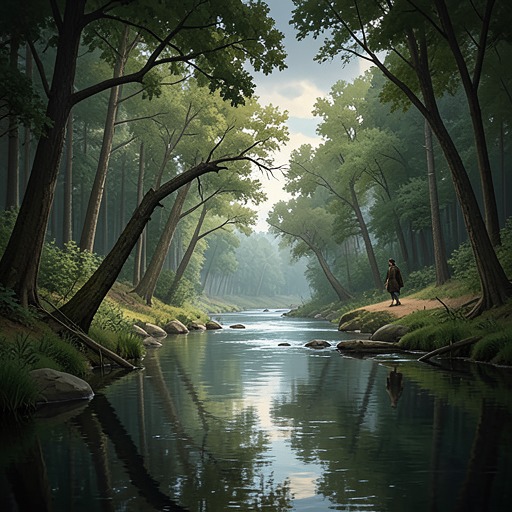
Not all the woge accept exile. Those who remain hide within features of the landscape, where they stay aware and remember better times. They are capable of pain and, as seasons pass, of other feelings as well. Their concealment does not amount to disappearance: the land becomes the means by which they endure, even as generations of Yurok walk across them, sit on them, fish from them, and rest in their shade.
This tradition treats the environment as more than a setting. Fishing and hunting places, oak groves, river stones, boulders, thickets, solitary trees, springs, pools, and meadows all have names and spirits. The woge are part of a world in which particular places are alive and locally known, so human use of the country takes place alongside presences that are not always visible.
The River and the World Beyond
For the Yurok, traveling upstream from the mouth of the Ghost River toward its source is also a journey beyond the immediate, familiar world. The surrounding country is associated with presences in coves, ferns crowding ravines, birds whose calls seem almost human, and paths that suddenly descend underground toward Tsorrek, the world of the dead. The woge belong to this larger geography of the unseen, in which a journey through a river landscape can also approach a realm beyond ordinary life.
Vato and Blood, though people of the city, adapt to this account of the country as though they themselves were returning from exile. Their response connects the tale's theme of displacement to their passage through the region: the landscape that holds the woge's memory does not remain remote from those who travel through it.
Later Interpretations
Some hippies offer Vato and Blood a different explanation. They suggest reincarnation and describe the region between the coast and the watershed as magical and sacred. In their version, the woge are actually porpoises that yielded their world to humans, then went to live underwater off Patrick's Point, where they wait to see how humanity manages the world.
That account gives the hidden beings a possible future as well as a past. If humans badly damage the world, the porpoises may return to teach people how to live rightly and save them. The explanation does not erase the older story of retreat and exile; it recasts concealed presence as patient observation and the possibility of return. Across these tellings, the woge make human conduct answerable to a world that preceded humanity and may yet outlast it.