Vineland REX 84 military operation
VinelandThe Vineland REX 84 military operation is the militarized occupation of Vineland Airport during a purported Reagan exercise, and its abrupt termination interrupts Brock Vond’s attempt to keep control of the people he is pursuing. The operation makes the machinery of emergency power visible in a place where returning passengers are stopped, questioned, and sorted. Its ending is equally revealing: the order to stand down strips Vond of his authority, but not of his will to act.
Background and intelligence
Before the operation appears at the airport, Flash obtains a telescript concerning himself and Frenesi Gates from Special Agent Roy Ibble. Roy says that no one he knows understands what Brock Vond is planning; the only apparent connection is to the so-called Reagan exercise, code-named REX 84. He allows that the approaching presidential election may have unsettled people, but offers no confirmed account of the operation’s purpose. The information establishes a limit as well as a lead: the exercise is identifiable, while the plans being made within or around it remain obscure.
That uncertainty matters when Flash and Frenesi approach Vineland. Flash has long understood that rescuing Frenesi would bring him into conflict with Vond, who had held her at a distance even through her marriage to Flash and the passage of years. Their return is therefore not simply a homecoming. It brings them into a landscape where the government’s ordinary presence has given way to military control, and where the formal label of an exercise coexists with actions whose full scope is not made public.
The military checkpoint at Vineland Airport
Vineland Airport lies south of town in a broad valley near the mouth of the Seventh River. During the descent, the aircraft passes low over U.S. Route 101. The scene below seems altered: the air traffic controllers are said to sound as they did in Vietnam, civilian voices are absent from the control towers, and military frequencies carry heavy traffic. These details register the operation before its personnel come into view. The familiar airport has become part of a military communications and transport environment.
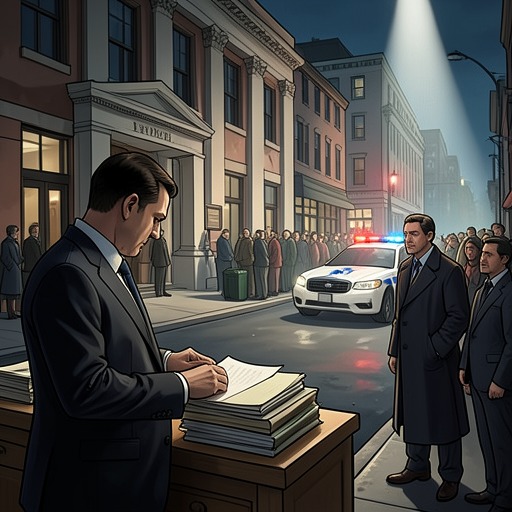
The plane passes the small harbor, domes, and antennas as evening lights begin to appear in town. Then the passengers arrive at an airport turned into a parade ground, with military vehicles everywhere. Each arriving passenger is stopped and questioned individually. An operator enters names and numbers at a keyboard; after that processing, some people are allowed through while others are told to wait inside an enclosure. The procedure reduces arrival to identification and disposition: a person is entered into a system, then either released onward or held apart from the flow of passengers.
The novel marks the moment with a double threshold. Flash arrives in Vineland for the first time, while Frenesi returns. Their different relationships to the place meet at a facility whose ordinary function has been overtaken by military screening. The airport’s position at the edge of town makes it the point where the operation can regulate who enters, but the evidence does not explain the criteria used to release or detain people. That gap leaves the checkpoint’s power visible while its decisions remain opaque.
Hector Zuñiga and the selective passage
Flash wonders whether Hector Zuñiga has set them up. Frenesi points out that Hector is present with a film crew, carrying the visible markers of a production: lights, a Panaflex, and portable Arri cameras. Hector reaches Frenesi, Flash, and Justin and takes them out of the queue. They cross the terminal past makeshift signs posted on doors and columns. Hector shows his badge and gives the guards a newly acquired businesslike smile; they are not required to remain in the passenger line or wait in the enclosure.
The contrast is not that the airport has ceased to screen them, but that access can be negotiated through an official-looking identity and a relationship to the production. Hector’s badge and film equipment distinguish his party from the other arrivals, whose individual questioning and possible confinement have already been described. The operation’s procedures therefore appear neither universal in effect nor self-explanatory: some passengers are processed through the queue, while Hector’s group is escorted past it.
Hector brings them to the Vineland Palace, where Triglyph Productions Inc. houses them for the duration of filming. Frenesi remains doubtful about his confidence and suspects that he has mistaken proximity to power for immunity. She compares his attraction to the Panaflex emblem with the earlier fate of Sid Liftoff, suggesting that the camera and the promise of a film may have drawn Hector into an arrangement he does not fully understand. At dinner in their room—hamburgers, fries, hot chocolate, and pitchers of Hefty Burgundy—she begins to accept that the film may actually be made. Justin, for his part, insists that Hector is not a fake. Their accommodation at the hotel does not explain the airport operation, but it shows how the production gains a privileged route through its controlled setting.
The exercise ends and Vond resists
The operation ends when Reagan officially calls off REX 84 and the concealed, undocumented, deniable activity contained within the exercise. The field headquarters at Vineland Airport relays the message to Vond by radio. The instructions are practical and immediate: take down the tents, return convoys to their bases, demobilize the action teams, and send special-unit personnel back to their regular assignments. Vond is included in the withdrawal, and all his authorizations are revoked.
Vond is physically removed from the operation aboard a helicopter despite protesting and gesturing against the order. Roscoe has taken control at the main panel, overriding Vond’s use of the remote control. During the flight back to Vineland Airport, Roscoe advises patience and obedience, while Vond argues that everyone is together and that they cannot be allowed to escape. His outburst exposes the urgency behind his resistance: the shutdown is not merely ending a deployment for him; it is preventing a single opportunity to act against the people he has gathered into one place.
After landing, Vond appears to settle. Then he draws his service pistol, boards the helicopter again, takes the pilot’s seat, and prepares to lift off. Roscoe calls after him and warns that Ed Meese may not accept what he is doing. Vond nevertheless flies away and disappears into the clouds above Vineland. The official order has ended the exercise and withdrawn his permissions, but it does not immediately stop him from making one last attempt to act independently.
Significance
The operation’s brief life is defined by the difference between administrative authority and coercive capacity. At the airport, military vehicles, individual questioning, data entry, and an enclosure make emergency control concrete. The shutdown then reverses that arrangement through orders that dismantle its visible apparatus and cancel Vond’s authorizations. Yet the helicopter’s departure shows the limit of a clean administrative ending: Vond can be stripped of command and still seize a means of flight.
The airport also joins two kinds of passage. Returning passengers are sorted by the operation, while Hector’s badge and film crew open a route out of the queue for Frenesi, Flash, and Justin. Against that uneven access, the later recall order marks a decisive change in the balance of power. REX 84 ends, Vond’s official authority is withdrawn, and his attempt to continue alone carries him out of sight rather than restoring his control.