Battle of the Ants
WaldenThe Battle of the Ants is a witnessed fight between red and black ants that the narrator discovers among the chips at his woodpile. What first appears to be a single contest grows into a battlefield covering the wood-yard; the narrator carries one contested chip indoors to watch the struggle more closely, but releases the surviving combatant without learning which side won or why the war began. The episode turns an exact, local observation into an unsettling comparison with human conflict, while preserving the small creatures’ lives as more than a mere allegory.
Discovery and Scale
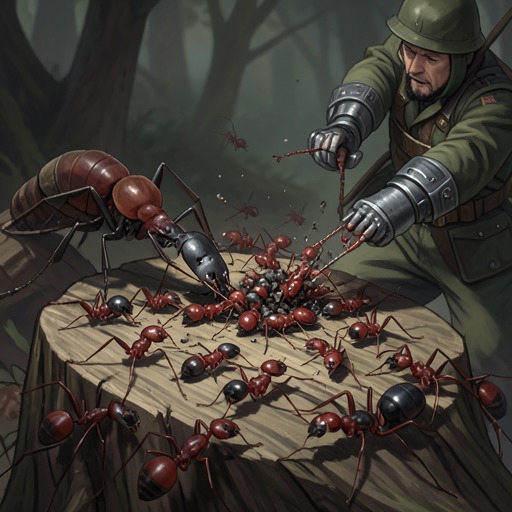
The encounter begins during an ordinary trip to the pile of stumps. The narrator notices two large ants locked together, one red and the other much larger and black. Looking beyond that pair, he sees that the chips are crowded with combatants. This is not an isolated duel: the ants are fighting across the wood-yard, red against black, sometimes with two red ants to one black. The ground is already strewn with dead and dying insects. The sudden change from a single skirmish to a field of battle gives the scene its expanding scale, while the woodpile remains the specific setting from which the narrator’s larger reflections arise.
The episode’s language makes that expansion explicit. The narrator distinguishes a duel from a war between two races, and calls the conflict internecine. The dead and wounded are not background decoration; they establish that the struggle has consequences for its participants, even as the observer cannot discern its cause. The ants’ tiny battlefield is vivid enough to command attention, but it does not yield the explanatory certainty that a human historian might seek from a named war and its known parties.
Human Comparison and the Observer’s Involvement
As the fighting continues, the narrator describes the ants’ exertions in terms that recall the organized spectacle of human battle, including the imagined sound of national airs meant to urge on the slow and dying combatants. The analogy does not make the insects simply stand-ins for people. Instead, it unsettles the distinction between the observer’s world and theirs: the more he considers the contest, the less decisive the difference seems. He says that he is excited as if the combatants were men, registering a genuine emotional response to creatures whose lives might otherwise be overlooked.
That response also complicates the narrator’s position. He is at once an attentive natural observer and a spectator who has entered the scene through interpretation. The ants are seen in their particular struggle, yet the language of nations, legions, and battlefields gives their actions a human historical frame. The comparison invites readers to consider the scale on which suffering is recognized: the smallness of the combatants does not make their losses unreal, and the human tendency to call one conflict memorable cannot establish that it matters more to those caught within another.
The Chip Under Glass
To follow the outcome of a particular fight, the narrator lifts the chip on which three ants have been struggling, carries it into his house, and places it beneath a tumbler on the windowsill. The gesture changes the conditions of observation. The battle is no longer only something glimpsed in the wood-yard; a fragment of its terrain has been brought into the domestic space, where the narrator can watch an individual combat more closely. The makeshift enclosure, however, offers no view of the larger war’s cause or course. It isolates a few fighters rather than making the conflict fully legible.
After further struggling, one ant manages to free himself from his opponents. He has lost his feelers and all but a remnant of one leg, and the narrator does not know how many other wounds he bears. After roughly half an hour more, the injured ant succeeds in freeing himself. The narrator raises the glass, and the ant goes off over the windowsill in his crippled state. The scene’s decisive movement is therefore not a captured victory but a release: the observer opens the boundary he had created, and the survivor leaves without becoming a specimen whose later fate can be known.
An Unresolved Ending
The ant’s escape does not settle what happened to him. The narrator wonders whether he survived and imagines, uncertainly, a future suited to an invalid, but admits that he does not know. Nor does he learn which party was victorious or what caused the war. His speculation about the wounded ant’s prospects ends in acknowledged uncertainty, not a claim to knowledge. The episode closes on the effect the spectacle had upon the observer: for the rest of the day, he feels as though his own feelings had been excited and harrowed by a human battle.
That ending keeps the comparison morally potent but factually limited. The narrator can describe the ants’ colors, numbers, fighting ground, visible wounds, and one survivor’s escape; he cannot explain the war or report its final result. His attention makes the insects’ suffering difficult to dismiss, while his admission of ignorance resists turning their lives into a tidy lesson. The Battle of the Ants thus joins precise observation to imaginative analogy: it enlarges a small event without pretending that enlargement has solved the mystery of what the combatants were doing or what became of them.