Walden Pond ice harvest of 1846–1847
WaldenThe 1846–1847 ice harvest on Walden Pond transformed a familiar winter landscape into a worksite for a hundred laborers and their teams. Watched from Henry David Thoreau’s window, the cutting and stacking of ice becomes both a spectacle of coordinated labor and a measure of how commercial use can alter a place: the harvest’s great heap failed to reach market, persisted through another winter, and did not quite melt until September 1848, when the pond recovered most of what had been taken.
The Harvest Arrives
In the winter of 1846–1847, a hundred men arrived at Walden Pond one morning with carloads of farming tools and equipment. The scene initially appears through the narrator’s comic, distanced description of the newcomers as men of Hyperborean extraction, but he then clarifies the practical facts: they were a hundred Irishmen from Cambridge, working under Yankee overseers. Their presence joined a distant labor force to the local pond, bringing organized commercial extraction into a landscape the narrator had known through sustained observation.
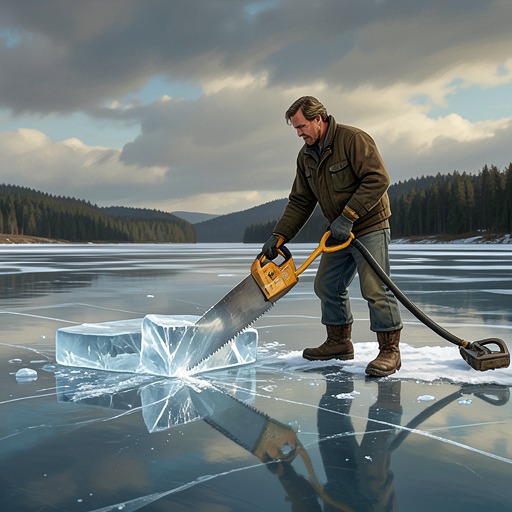
The workers divided the ice into cakes and sledded them to shore. There the blocks were hauled onto an ice platform and lifted with grappling irons and block and tackle, the lifting gear worked by horses. The process converted a frozen lake into a sequence of transport and handling operations, each dependent on people, animals, tools, and repeated movement between pond and shore. The harvest was not simply a moment of cutting: it was a temporary industrial system assembled on the ice.
A Winter Worksite
The scale of the operation is made tangible in the stack itself. The cakes were piled in the open air to a height of thirty-five feet on one side, across a base six or seven rods square. Hay was packed between the outer layers to keep air out. The dimensions give the harvest a presence that exceeds ordinary household use: the ice was accumulated in a vast store, organized for preservation and eventual sale.
For sixteen days, the narrator watched a hundred men working from his window. Their teams and horses, alongside the tools and the repeated labor, made the pond resemble a field under cultivation. The resemblance is sharpened by the harvest’s visual order: in winter, men moved across the frozen water as if tending a crop, turning ice into a product by coordinated effort. Yet the comparison also holds a quiet dissonance. The pond was not farmland, and the blocks being gathered from it were part of its own seasonal substance, not a crop planted for harvest.
The Failed Market and the Pond’s Return
The enterprise did not fulfill its commercial purpose. The ice may have contained more air than usual and therefore kept less well than expected, or some other cause may have intervened; the narrator does not claim certainty. Whatever the reason, the heap never reached market. Made in the winter of 1846–1847 and estimated at ten thousand tons, it was covered with hay and boards. The covering was removed the following July, and some of the ice was carried away, but the rest remained exposed to the sun.
The remainder endured through the summer and the following winter. It was not quite melted until September 1848, nearly two years after the harvest began. In the account’s final turn, the failed stock becomes a measure not only of commercial miscalculation but of the pond’s capacity to reclaim what was temporarily removed: Walden recovered the greater part. The episode does not describe a permanent draining of the lake; its consequence is a striking, prolonged disturbance followed by substantial natural return.
Observation, Memory, and Landscape
The harvest matters within a wider record of the changing landscape around Walden. The narrator’s attachment is built from close and repeated attention: he describes the pond’s humble but beautiful scale, its steep shores of smooth, rounded white stones, and its value to Concord as a natural jewel. He had surveyed its long-lost bottom before the ice broke in early 1846, using compass, chain, and sounding line. The commercial harvest thus takes place in a body of water he has also approached as something to be measured, remembered, and known through direct observation.
The contrast between use and value is especially pointed because the pond’s significance cannot be reduced to its marketable ice. Elsewhere, the narrator defines the cost of a thing as the amount of life exchanged for it, while describing Walden as a gem in Concord’s coronet. Those reflections do not turn the harvest into an explicit economic calculation, but they frame the difference between extracting a commodity and attending to a place whose worth is experiential as well as material. The ice has exchange value; the pond also holds a value that the calculation of tons and transport cannot exhaust.
The account’s time scale intensifies that contrast. The laborers are present for a concentrated stretch of sixteen days, then the scene empties; the stored ice remains as a temporary monument to their work before sunlight and time undo it. The narrator anticipates looking from the same window, about thirty days later, onto the pure sea-green water reflecting clouds and trees. His view places human activity and seasonal renewal within one frame: first the crowded worksite, then the cleared pond. The harvest is therefore narrated not as an isolated feat of production, but as a passing alteration within a recurrent cycle.
That cycle also intersects with a more troubling history of change. The narrator recalls the former occupants of the woods near his house, whose road once carried the sound of laughter and gossip. Later, he laments that woodcutters have further laid waste the woods by the pond: the trunks on the bottom, an old log canoe, and the dark surrounding woods are gone, leaving no more rambling through wooded aisles with glimpses of water. Against that longer loss, the ice heap’s eventual melting offers only partial reassurance. Walden recovers most of the harvested ice, but the broader landscape is not restored simply because a winter stockpile dissolves.
The Episode’s Significance
The harvest brings together two ways of seeing Walden Pond. As a source of ice, it can be divided into cakes, raised by machinery and horses, measured in tons, and intended for a market. As a landscape, it is apprehended through the narrator’s remembered walks, his survey, the details of its shore, and the changing colors of its water. The episode makes the two perspectives meet without pretending they are equivalent: extraction takes place visibly and on a large scale, while the pond’s noncommercial meanings emerge through attention and memory.
Its outcome complicates any simple story of industrial mastery. The workers build a great pile, but the intended sale never occurs; the mass survives the first summer and another winter, then nearly disappears by September 1848, with the pond recovering most of it. That reversal gives the harvest its distinctive shape: organized labor briefly imposes a new order on the frozen lake, yet the project’s material result is neither lasting possession nor successful commerce. The pond remains the larger presence, altered for a time, observed across seasons, and remembered as more than what could be carried away.