Thoreau’s Walden experiment
WaldenThoreau’s Walden experiment was Henry David Thoreau’s deliberate attempt to live independently and attend to the essential facts of life. For two years and two months he lived alone in a house he had built on the shore of Walden Pond, a mile from any neighbor, earning his living by the labor of his hands. He entered the woods on Independence Day, 1845, and left on September 6, 1847; the experiment was neither an exercise in living as cheaply as possible nor a permanent withdrawal, but a purposeful interval whose close observation of nature and its own ending became part of its meaning.
Purpose and beginnings
Thoreau describes the undertaking as a practical choice as well as a philosophical one. After finding that he had to shift for himself, he turned more exclusively toward the woods, where he felt better known, and decided to begin his own enterprise without waiting to acquire the usual capital. Walden Pond offered, in his account, a place to transact private business with the fewest obstacles. The project therefore did not begin with a simple ambition to minimize expense: he explicitly distinguishes its purpose from living either cheaply or dearly. The measure was whether he could arrange life so that a lack of money or customary provision would not prevent him from pursuing what mattered.
That practical independence served a larger inquiry. Thoreau says he went to the woods to live deliberately, to confront only the essential facts of life, and to discover what life could teach before death made the question too late. The solitude and manual labor were not incidental hardships but conditions of the test: they brought the arrangements of everyday existence within reach of direct examination. The experiment asked what a life might become when it was less obstructed by convention and more deliberately chosen.
A life made by hand
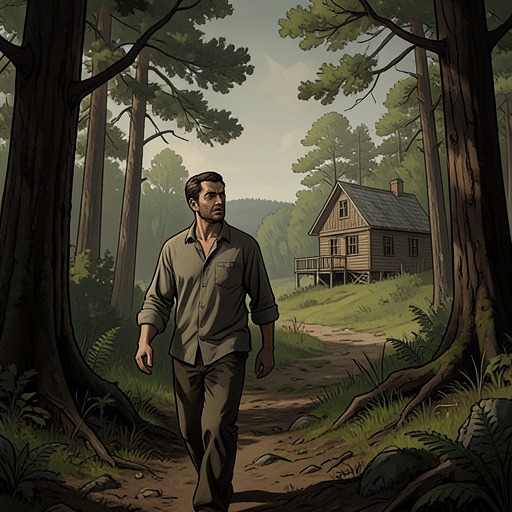
The residence began on the Fourth of July, 1845, but the house was not yet prepared for a New England winter. It was a shelter against rain, unfinished, without plaster or chimney, and built with rough walls. That beginning makes the experiment concrete: its independence was not an idealized condition already secured, but a way of living assembled with limited means and continued through changing seasons. Thoreau lived there alone, a mile from a neighbor, and supported himself through manual labor.
Solitude did not mean that the place lacked human history or activity. Thoreau recalls that, within the memory of townspeople, the road near his house had resounded with the laughter and gossip of inhabitants. The woods he entered thus held traces of earlier lives even as his own stay made them the setting for a chosen separation from ordinary society. His residence was private, but the landscape was not outside human history.
Attention to landscape and time
A major attraction of living in the woods, Thoreau says, was having the leisure and opportunity to see spring arrive. The seasons register the experiment’s time differently from a schedule of tasks: the pond’s ice becomes honeycombed, and the thawing earth offers forms to watch closely. He describes the shapes assumed by sand and clay as they flow down the sides of a deep railroad cut, finding delight in a process that makes seasonal change visible in altered ground. Observation here moves between natural phenomena and the human-made cut through which he passes; the landscape is neither untouched wilderness nor merely scenery.
His attention extends from seasonal change to the material character of the pond’s shore and bottom. Walden’s scenery, he notes, is modest in scale: beautiful, but not grand, and not equally compelling to someone who has not spent time there or lived beside it. The shore is a belt of smooth, rounded white stones, with only one or two short sandy beaches, and in many places it drops steeply enough that a single leap would carry a person into the water. These particulars give the experiment a setting known through repeated presence rather than distant admiration.
Thoreau also tries to recover what cannot be seen from the surface. Desiring to find Walden Pond’s long-lost bottom, he surveys it carefully before the ice breaks up, early in 1846, using a compass, chain, and sounding line. Measurement joins his reflective attention: the pond is both a landscape to experience and a body of water to investigate. Elsewhere, he describes thawing sand and clay as a phenomenon that gives him unusual delight, then interprets the forms as evidence of the earth’s vitality. The description and the metaphor belong together, but the latter is his imaginative reading of what he observes, not a separate measurement of the earth’s interior.
Work, change, and the limits of solitude
The experiment unfolds amid other people’s uses of the land. In the winter of 1846–47, a hundred men arrived at the pond with teams and farming implements. For sixteen days, Thoreau watched a hundred men at work from his window, their activity recalling the opening image of a book about husbandry. The scene places his solitary residence beside a large, organized labor operation: the pond is not only the setting for a private experiment but also a resource and workplace for others.
Human alteration also changes what Thoreau remembers. After he leaves the shore, woodchoppers further lay waste the woods, and he anticipates that many years will pass before rambling among the wooded aisles and occasional views of the water is possible again. He describes the trunks on the bottom, the old log canoe, and the dark surrounding woods as gone. In place of the earlier landscape, villagers who scarcely know where the pond lies go there to bathe. The contrast is not simply between solitude and society: it records the disappearance of particular features and practices, and the changed relation of the village to the place.
Other forms of seasonal life persist within the altered setting. Even in midwinter, Thoreau finds a warm, springlike swamp where skunk cabbage remains verdant, and occasionally sees a hardier bird awaiting spring. Such observations give his account a scale beyond the duration of his own residence. Natural recurrence continues beside human change, while the attention required to notice it distinguishes the experiment’s daily practice from the hurried use of the landscape.
Completion and significance
Thoreau calls the first year’s life in the woods completed and says that the second was similar. He finally left Walden on September 6, 1847. The departure closes a defined experiment rather than contradicting its aims: the account presents the stay as a deliberate interval in a life, not as a vow to remain permanently outside civilization. At the opening, Thoreau likewise says that he is again a sojourner in civilized life, framing the woodland residence retrospectively as a completed trial.
In looking back, Thoreau says that the experiment taught him at least this: if a person advances confidently in the direction of dreams and endeavors to live the life imagined, that person will meet with a success unexpected in ordinary terms. The conclusion is presented as the lesson of his own attempt, not as a guarantee that every aspiration will be fulfilled in the same way. Its force lies in the experiment’s combination of choice and contact: a self-built shelter, labor, distance from a neighbor, close study of the pond and seasons, and eventual return make a particular life the means by which the claim is tested. The changing woods also qualify any notion of retreat. Walden remains a place shaped by memory, work, and alteration, even as Thoreau’s stay makes deliberate attention to it a form of independence.