Thoreau’s Walden cabin
WaldenThoreau’s Walden cabin is the modest dwelling Henry David Thoreau built beside Walden Pond and the material center of his experiment in independent living. Its construction began with a borrowed axe and a stand of white pines; its finished form measured ten by fifteen feet. More than shelter, the cabin gives physical shape to a way of life measured against expense, labor, and dependence, while placing its occupant close to the lake and the changing landscape he observes.
Construction and Form
Near the end of March 1845, Thoreau borrowed an axe and went into the woods by Walden Pond, near the intended building site. He began by cutting tall, straight white pines. The cabin thus started not as a finished retreat but as an act of work in the landscape: trees were felled, timber shaped, and a dwelling made through practical effort.
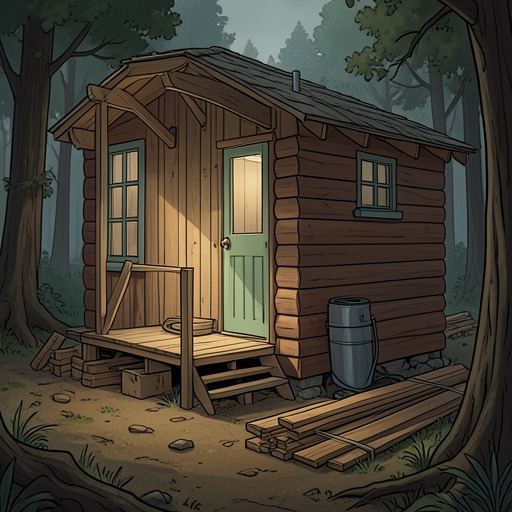
At the beginning of May, acquaintances helped raise its frame. Thoreau presents their assistance as an occasion for neighborliness rather than a necessity, making the building’s communal moment part of its history even as the finished house represents independence. He began occupying it on July 4, 1845, once it was boarded and roofed. The boards were feather-edged and lapped, a construction detail that made the structure tight against the weather.
The completed cabin was ten feet wide and fifteen feet long, with eight-foot posts, a garret, a closet, a large window on each side, two trapdoors, and a door at one end. Its plain, compact arrangement gives the ideal of simplicity a measurable form: this is not a grand house but a workable shelter with defined spaces and openings onto its surroundings.
Cost and Independence
Thoreau evaluates the cabin not only as a building but as an economic choice. He sets its expense, $25.21¾, against the leisure, independence, and health it secured, as well as the prospect of a comfortable house for as long as he chose to occupy it. The arithmetic makes the shelter’s value depend on more than its price: what it provides is time and freedom from the demands of a more costly way of living.
That calculation also gives the cabin a practical rather than merely symbolic force. It is a house one can inhabit, built from local materials and on a scale suited to limited needs. Its comfort is not presented as luxury. Instead, a deliberately small investment makes room for the independence that the narrator treats as one of the most important returns of the experiment.
A Dwelling Beside the Lake
The cabin’s meaning develops through its location. The scene of Thoreau’s first nights there begins, by accident, on Independence Day, the Fourth of July, 1845. The date links personal residence to a public calendar of independence, while the house itself gives that independence an everyday setting: a place to sleep, work, and attend to the land.
Walden’s scenery, the narrator observes, is humble in scale. Its beauty may not approach grandeur, and it may mean less to someone who has not lived by its shore. The cabin matters in part because residence changes the terms of seeing. From a settled place beside the water, the lake and its surroundings become more than a view; they are the familiar environment of sustained observation.
Landscape, Memory, and Significance
The shore near the cabin is described as a belt of smooth, rounded white stones, like paving stones, with one or two short sand beaches. In many places it is steep enough that a single leap would carry a person into the water. Such concrete features give the dwelling a specific relation to the lake: it stands not in an abstract wilderness but beside a sharply formed, accessible shoreline.
The cabin also belongs to a landscape that carries traces of other lives and earlier uses. Nearby, John Field, an Irishman, lived with his wife and several children in a cabin; east of the bean-field, Cato Ingraham had lived in a house built for him by the man who enslaved him; and Brister Freeman had lived on Brister’s Hill, where apple trees he planted still grew. These accounts complicate any simple picture of the woods as empty refuge. The surrounding ground bears histories of poverty, enslavement, work, and settlement as well as the narrator’s chosen experiment.
From this dwelling, the narrative repeatedly shifts between close physical observation and larger reflections on nature. Early in 1846, before the ice broke up, Thoreau surveyed Walden Pond’s long-lost bottom with compass, chain, and sounding line. Later, he delights in the forms made by thawing sand and clay flowing down the sides of a deep railroad cut, and interprets the fresh patterns as if the earth were still at work shaping itself. The cabin is not the subject of these observations so much as their fixed point of habitation: it places a human life close enough to the lake, the seasonal change, and the altered ground for attention to become part of daily experience.
The cabin’s significance lies in this combination of practical shelter and chosen vantage. Its compact plan and recorded cost make independence concrete, while its site draws the narrative into encounters with both natural processes and the human history of the surrounding landscape. It is a home by choice, but not a world apart: the woods, shore, railroad cut, and neighbors remain within the same field of attention.