Walden Pond–Fitchburg Railroad conflict
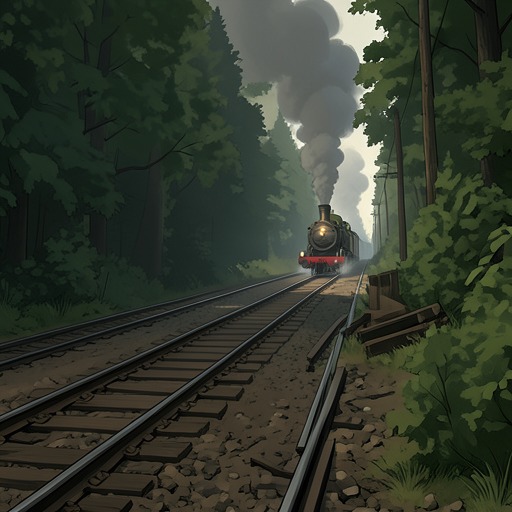
WaldenThe Walden Pond–Fitchburg Railroad conflict sets a useful human connection against the railroad’s physical and ecological intrusion into the landscape. The line brings the narrator toward Concord, yet the same railway becomes the “Iron Horse” whose noise and material reach accompany the destruction of the wooded shore; Walden’s persistence makes the contrast sharper, since the water endures while its surroundings and the narrator’s memories change.
A Link to Society
The Fitchburg Railroad passes about a hundred rods south of the narrator’s dwelling. He usually walks to the village along its causeway and describes himself as connected to society by this link. The railway is therefore not simply an outside force opposed to solitary life: it serves as a route between the pond and the town, making contact possible even for someone who has chosen to dwell apart.
That practical connection does not dissolve the distance between the railroad’s movement and the pond’s quiet. The line approaches close enough to make Walden part of its daily passage, but its travelers do not stop to look. The narrator imagines that engineers, firemen, brakemen, and season-ticket passengers who see the lake repeatedly may nevertheless be improved by the sight. The encounter is fleeting, almost incidental to their work and travel, but the lake’s serenity is presented as something that can remain with them after the train has gone.
The Iron Horse and the Shore
In the narrator’s later account, the railway’s presence takes on a harsher aspect. He personifies it as a “devilish Iron Horse,” giving the machine a neigh that can be heard throughout the town. The image turns industrial noise into an animal force, but one whose power is not natural: it is carried into the landscape by machinery and commerce.
The railroad is associated with the muddying of the Boiling Spring and the removal of woods from the Walden shore. The narrator develops the horse image into that of a Trojan horse, a bloated intruder with a thousand men in its belly. The allusion makes the railway more than a nearby track: it figures as an invasion that brings destructive human activity inside the apparent peace of the countryside. The imagined champion poised to meet it at the Deep Cut gives the complaint the scale of a heroic confrontation, though the scene remains a rhetorical vision rather than an account of an actual battle.
The conflict belongs to a wider sequence of human alterations. Woodchoppers have laid bare one shore and then another; Irish residents have built sties by the water; the railroad has infringed on the lake’s border; and ice-men have skimmed it. These distinct pressures accumulate around Walden rather than arriving as one isolated disruption. The railway is especially conspicuous because its passage joins physical encroachment to an audible, recurring sign of modern transport.
Memory, Loss, and Persistence
The remembered landscape is already marked by loss. Since the narrator left the shore, woodchoppers have further laid waste the woods; the trunks on the bottom, the old log canoe, and the surrounding dark woods are gone. He anticipates that the former paths through the wooded aisles, with glimpses of water between the trees, will no longer be available. The railroad’s impact thus appears within a larger change in which familiar objects and routes disappear, diminishing the conditions that once made the shore a place for wandering and attentive observation.
Against these changes, the narrator insists on a difference between the lake and its surroundings. Walden has been cut back, bordered, and used, yet the water itself remains the same as when he first saw it; the change, he says, is in him. Its enduring purity does not erase the altered shore. Instead, it makes the contrast between the lake’s continuity and human disturbance more visible, while turning the narrator’s remembered landscape into evidence of what has been lost.
A Passing Vision of Serenity
The train’s relation to the pond is not exclusively destructive in the narrator’s account. Cars pass without pausing to look, but he supposes that those who see Walden regularly are better for the view. Even a single sight of the lake’s serenity may, he imagines, wash some of the soot from the engine and the commercial world associated with State Street. Someone proposes calling it “God’s Drop,” a name that recasts the pond as a small, restorative presence glimpsed amid industrial travel.
That possibility remains tentative: the passengers do not stop, and the narrator can only imagine what the view does for them. The name gives a counter-image to the Iron Horse. Where the railway carries noise, labor, and intrusion past the water, the lake offers an interval of purity that may affect even those who encounter it only from a moving train. The conflict therefore holds together two claims: the railroad alters and threatens the landscape, but its route also makes the sight of Walden available to people passing through a world of soot and speed.