Jaimec's Wartime Crackdown and Security Lockdown
WaspJaimec's Wartime Crackdown and Security Lockdown is a widening system of political and physical control: the government demands that organizations disclose their members, police spring unpredictable street searches, and Pertane is placed under martial law with movement out of the city restricted. The measures are presented as wartime security, but they also create a trap for dissent. A clandestine movement can be forced into the open by registration rules, while a movement whose supposed members do not even know they belong to it can frustrate the very process meant to expose it.
Registration and the Construction of Internal Threat
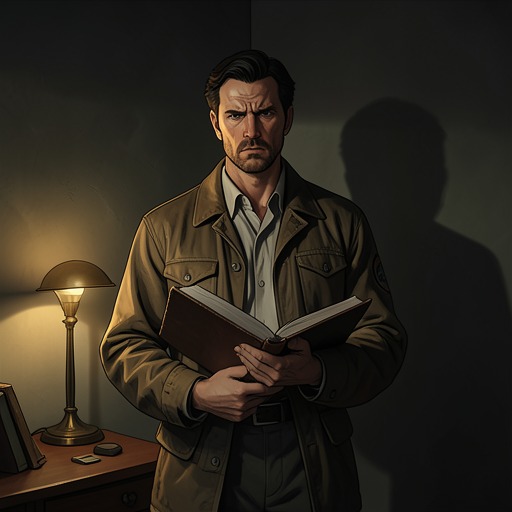
The legal countermove appears in a newspaper that Mowry reads over breakfast. Issued under the War Emergency Powers Act by the Jaimec Ministry of Defence, the order requires organizations, societies, parties, and other corporate bodies to register. They must identify their habitual meeting places and submit a complete list of members. The requirement makes ordinary organizational facts—where people meet, and who is involved—available for official scrutiny. The deadline sharpens the order into a threat. After the twentieth of the month, continued activity outside the prescribed registration framework is associated with a treasonable offence punishable by death. For D.A.G., this presents a lethal choice: disclose its structure to the authorities or risk being treated as a treasonous movement. The law’s force therefore lies not only in the prospect of punishment, but in its power to make membership itself dangerous. That danger meets a peculiar obstacle in Mowry’s design. D.A.G. has members who are unaware of their own status; the organization functions as a phantom army rather than as a conventional group whose participants knowingly gather and coordinate. As Mowry observes, an uninformed membership cannot readily supply informers. Butin Arhava is identified as a fully paid-up member, illustrating the gulf between an official or fabricated designation and a person’s conscious participation. The crackdown seeks to make an organization legible to the state, while the phantom structure makes that legibility unreliable.
Snap-Searches and Unpredictable Policing
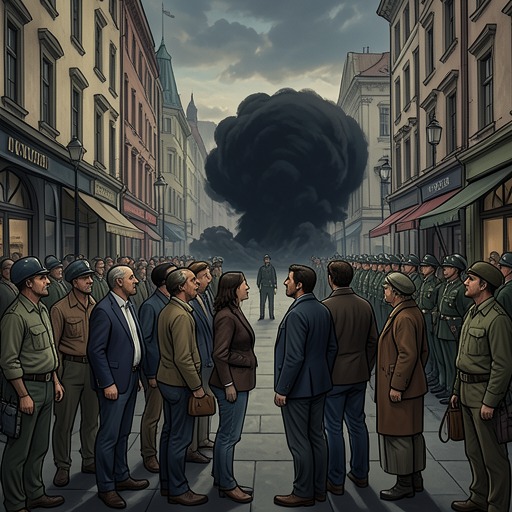
Registration is accompanied by a more immediate instrument of control: the snap-search. The method is dangerous partly because its timing and location cannot be anticipated. Mowry is heading to a rendezvous when a line of uniformed police suddenly stretches across the street; another line forms at the same time, four hundred yards farther on. The simultaneous barriers make the street itself a temporary trap rather than a predictable checkpoint. The search almost catches Mowry. The account stresses that escaping one deployment does not provide reassurance, because there is no way to know when or where the next blow will fall. A later image of him standing with his arms above his head marks the intensity of the danger, even as the available account does not establish that this particular trap results in his arrest. The method’s effectiveness comes from uncertainty: people must reckon not only with searches they can see, but with the possibility that any ordinary journey may abruptly become an encounter with police. This is a different kind of pressure from the registration decree. The decree demands names and addresses through a formal legal procedure; the snap-search interrupts movement in the street, without warning. Together, they extend state attention from organizational identity to everyday passage through public space. The narrative presents the unpredictable search as a deliberate technique, not a single exceptional incident.
Martial Law in Pertane
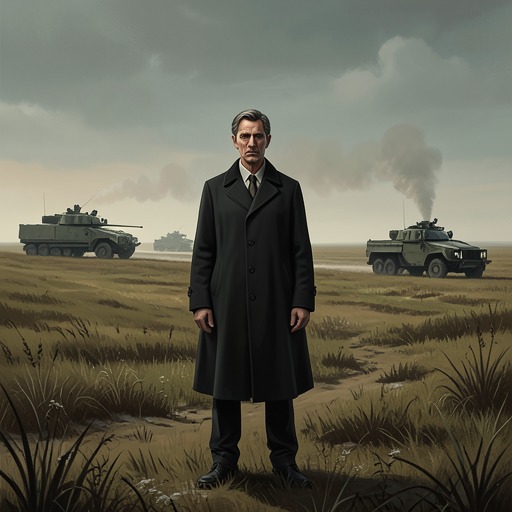
The crackdown becomes explicit in the headlines announcing that Pertane is under martial law, that travel is banned, and that the mayor has declared the population will stand firm. The same display advertises drastic action against Dirac Angestun Gesept. These notices make the emergency visible as public policy: movement is restricted, opposition is named as a target, and the city is described through the language of collective resolve. For anyone trying to leave Pertane, the perimeter presents a practical problem as well as a legal one. About sixty routes radiate from the city. The broad, well-used roads to Shugruma and Radine are expected to be more heavily guarded, so the geography of escape is also a geography of surveillance. A traveller approaching a checkpoint is asked whether he has an exit permit. Mowry answers that he does not need one, speaking with the authority of a four-star general. The exchange shows how the restrictions are enforced face to face, and how an assumed command presence can be used to challenge the checkpoint’s demand; it does not make the travel ban disappear. The government’s pressure also sits within a wider atmosphere of arrests and uncertainty. A newspaper reports that forty-eight members of the Sirian Freedom Party have been seized and will be dealt with by the authorities. The narration withholds certainty about the report: it may be an officially concocted lie, but the forty-eight people—whoever they are or are believed to be—are described as doomed. The uncertainty itself is consequential. Public claims of arrests can spread fear even when their truth cannot be verified, while the threat of secret or lethal punishment makes verification difficult.
Administrative Power and Its Limits
The state’s methods depend on classifications, deadlines, documents, and police decisions. Elsewhere in the wartime machinery, an official scrutinizes a prisoner-requisition form, calls it irregular while acknowledging that the form is in order, and prepares a receipt by copying details from the requisition. Such paperwork shows how authority moves through recorded procedures, but also how a procedure can be approached through its formal requirements. Mowry’s use of official status at the Pertane checkpoint belongs to the same contest over who can command, document, and authorize movement. The account also places this bureaucratic control beside another system of comprehensive record-keeping: William Wolf explains that Terran Intelligence keeps a punched card for every Terran in existence, describing such scrutiny as part of the price of survival. This is not the Jaimec government’s registration order, but it gives the novel a useful contrast. Both security systems make people administratively knowable; on Jaimec, that capacity is turned toward compulsory political disclosure and street-level restriction. The crackdown’s central contradiction is that its effort to identify a hidden enemy can help produce one. Mowry’s taught method begins by establishing the existence of internal opposition, whether real or imaginary, until the enemy believes it is real. Against that strategy, a registration law and a public story about traitors can intensify the appearance of a vast, organized threat. Yet D.A.G.’s unaware members frustrate the expected chain from membership to confession to informant. The resulting lockdown is both coercive policy and a contest over what counts as proof: the state can impose grave consequences through its labels, even when the organization those labels describe is partly a fabrication.