Mowry breaks through the Pertane blockade
WaspMowry breaks through the Pertane blockade when his identity card and composed performance of authority persuade the soldiers at a roadblock to let his car pass. The encounter turns an exit-permit check into a brief act of military deference: the troops open a way through, and Mowry continues beyond the checkpoint toward the Pertane–Valapan track.
The Roadblock and Its Demand
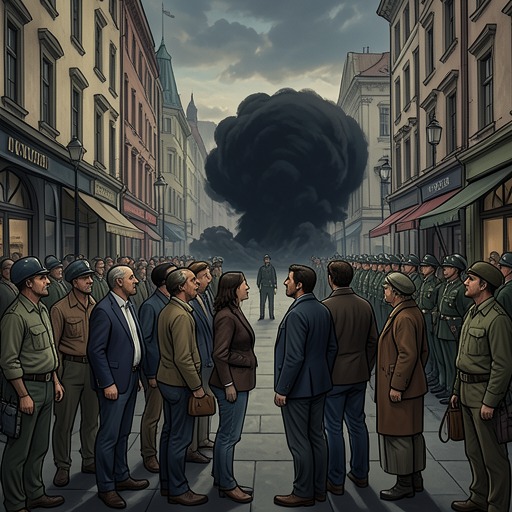
Five minutes after rounding a blind corner, Mowry finds a roadblock two hundred yards ahead. Army trucks stand sideways across the road, making the obstruction unmistakable. The pause in the journey is abrupt: the road beyond the corner is no longer open, and a vehicle attempting to leave must answer to the soldiers controlling the crossing.
A broad, squat sergeant approaches from the nearest truck and asks whether Mowry has an exit permit. Mowry answers that he does not need one, speaking with the authority of a four-star general. Rather than produce a permit, he opens his wallet and displays his identity card. The choice shifts the exchange from a question about permission to a test of who, in the soldiers’ eyes, has the right to pass.
Authority in Place of a Permit
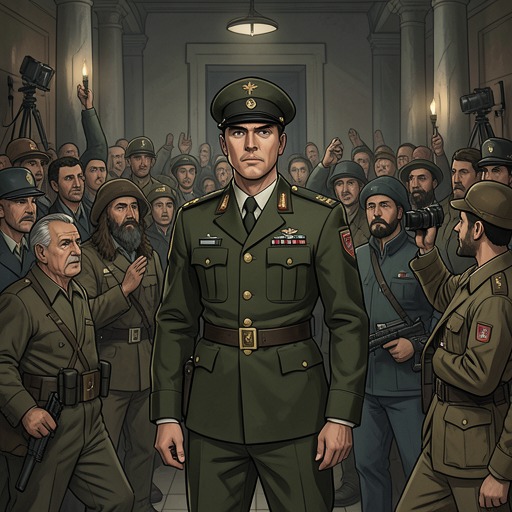
As he shows the card, Mowry fears that its sight might provoke a triumphant outcry. It does not. The sergeant looks at it, stiffens, and salutes; nearby troops straighten and adopt expressions of military alertness. Their response transforms the scene. A moment earlier, the sergeant was enforcing a barrier; now his posture and the soldiers’ attention mark Mowry as someone to whom they must defer.
The sergeant apologetically explains that he must report to the officer in charge when anyone claims the right to go through. The procedure does not immediately end the delay, but it reveals the checkpoint’s vulnerability: passage depends not only on the physical trucks but on a chain of authority and the soldiers’ interpretation of credentials. Mowry’s card has already changed how they treat him, buying him the respectful hearing that an ordinary demand to proceed might not have earned.
When the card is requested again as a formality, Mowry displays it once more. He answers the assurance that everything will be all right with confidence, as though offering a fatherly warning to someone young and inexperienced. The performance sustains the impression established by his first reply. He does not argue over the rules or explain his circumstances; he behaves as if the soldiers’ hesitation is a minor matter that will naturally resolve in his favor.
Passage Through the Trucks
The lieutenant gives the order to pass one, bringing the waiting exchange to its decisive turn. The troops obediently open the way. Mowry’s car crawls through the gap, curving around the tail of the first truck and twisting in the opposite direction around the second. The obstacle is not removed; he is permitted to thread his vehicle through it. The careful, constrained movement makes the passage a physical consequence of the soldiers’ deference, not a disappearance of the blockade.
The episode’s tension rests on how little separates detention from passage. Mowry has no exit permit to show, yet the identity card, his confident manner, and the soldiers’ response are enough to carry him across the line. The checkpoint’s authority is real—the trucks block the road, and the sergeant initially stops him—but its enforcement yields when the men interpret his claim as one they should honor.
Beyond the Checkpoint
After getting through, Mowry drives through small, sleepy Palmare, expecting local vigilantes to fire on him. No shots come. A few faces glance out of windows as his car passes, but nobody sees him turn off the road beyond the village onto the crude track leading to Pertane and Valapan. The successful crossing therefore continues into a quieter escape from observation: he passes the visible town, then leaves the road without attracting notice.
The blockade breach is a narrow, practical success rather than a public confrontation. Mowry relies on a card that prompts a salute, on the soldiers’ obedience to the lieutenant’s order, and on a turn beyond Palmare that goes unseen. The sequence carries him from a road physically closed by army trucks onto a less conspicuous route, while leaving the danger of the journey evident in his expectation of gunfire and the guarded passage that precedes it.