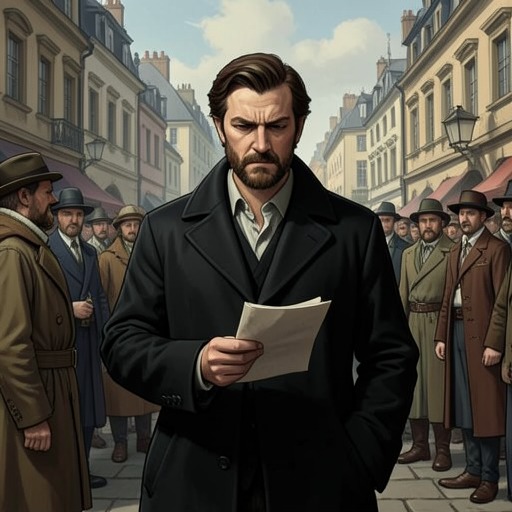
Mowry launches the D.A.G. propaganda campaign on Jaimec
WaspJames Mowry launches the D.A.G. propaganda campaign on Jaimec by giving scattered opposition to the war the appearance of a single clandestine movement. The organization, Dirac Angestun Gesept, is invented; its strategic value lies in making the government and the public react as though a coherent opposition already exists. When the press is muzzled, Mowry reads the censorship as evidence that this fiction has begun to exert real pressure.
Invention of the Opposition
While lying in bed and waiting to fall asleep, Mowry mentally enrolled the whole of the secret opposition in a mythical organization called Dirac Angestun Gesept. The movement is not presented as an established body whose members he has found. It is a name and an organizing fiction, imposed on opposition that already exists in secret. That distinction is central to the operation: Mowry does not need to demonstrate that D.A.G. has a visible structure before using the name to make dissent seem coordinated.
The invented organization gives separate grievances a shared identity and a prospective purpose. By attributing a common cause to the opposition, Mowry creates the impression of a movement capable of acting against the government and military caucus. Its apparent organization is itself part of the propaganda: the name allows a reader to imagine a collective force beyond any one sticker or individual act.
The Sticker's Message
A D.A.G. sticker announces, “War makes wealth for the few, misery for the many.” It then promises that, at the right time, the organization will punish those who profit and bring aid to those who suffer. The surviving wording makes the contrast plain: the war enriches a minority while imposing misery on the many, and the invented movement claims both a future power to punish and a capacity to help. The pledge gives an otherwise unseen organization a political program and a projected role in public life.
Mowry’s calculation depends on Jaimec’s wartime conditions. With a substantial increase in the war tax, he expects people to feel aggrieved enough not to tear down the sticker in patriotic anger. He also expects them to pass on news of the mysterious movement challenging the government and military caucus. In this design, the sticker does more than state an objection to the war: it can provoke discussion and transmit the movement’s name through the very population whose discontent the message invokes.
Censorship as a Response
At first Mowry is disappointed when the subject receives no mention in the press. On reflection, the silence heartens him. Opposition to the war and open defiance of the government would ordinarily make a compelling front-page story, he reasons; no reporter or editor would willingly pass it up. The absence of coverage therefore suggests interference rather than a lack of newsworthiness.
Mowry concludes that someone with considerable power has compelled a weak countermove. He regards that intervention as the campaign’s first success: its initial, wasp-like buzzings have forced authority to interfere with the press, yet the attempt to suppress the story is, in his assessment, feeble and ineffective. Censorship does not prove that the public has accepted D.A.G. as real, but it gives Mowry evidence that the authorities consider the challenge worth containing.
Significance
The campaign turns an invented organization into a test of political pressure. Mowry supplies the name, the public message, and the promise of future action; the authorities’ response supplies an unintended confirmation that open antiwar dissent can alarm those in power. The sequence shifts the operation from a private invention to a contest over what may appear in the press. Its early result is therefore double-edged: censorship limits public reporting, while revealing to Mowry that the state has been made to react.