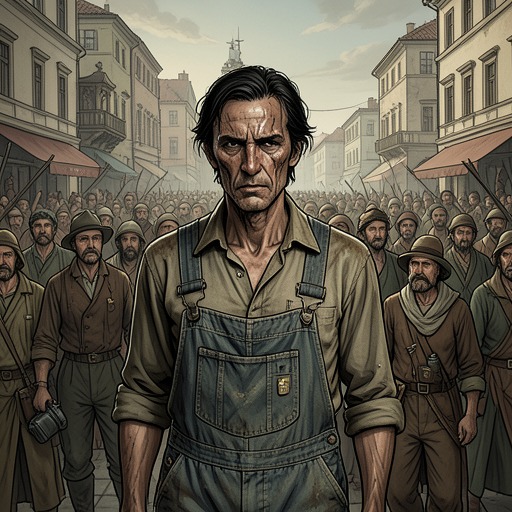
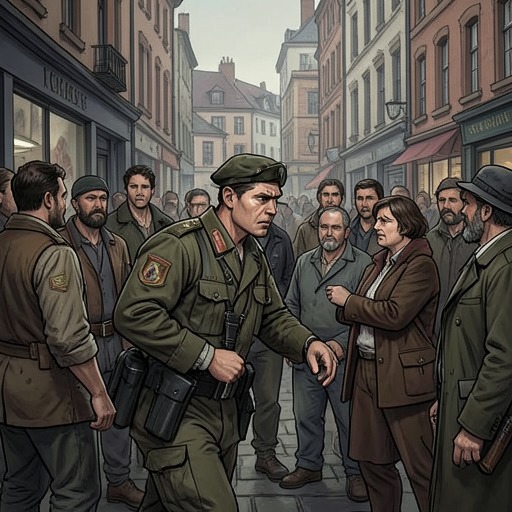
Phase Five
WaspPhase Five is the fifth step in Mowry’s campaign to unsettle the Sirian war effort: after a bombing has shaken the public, he seeds rumors that magnify fear into a wider expectation of catastrophe. The tactic depends less on proving a story than on giving anxious listeners something alarming and plausible enough to repeat—and on recognizing that each retelling can enlarge it.
Position in the Strategy
The fifth step follows the bombing of Shugruma, which has already left people shaken. Mowry’s instructions make the sequence explicit: first comes the shock, then rumors find listeners ready to absorb and circulate them. He warns that choosing the target matters. A fanatical patriot may react dangerously, so the rumor campaign must exploit susceptibility without provoking someone likely to turn against its source.
The method rests on a broader view of wartime authority. Even a powerful government cannot command absolute obedience, and no supposedly righteous war mobilizes everyone completely. Mowry sees those who will not answer the bugle or march to the drum as potential resources: people whose distance from official enthusiasm might make them receptive to dissent. His aim is not necessarily to identify and recruit every such person. First he needs to establish that a usable minority exists.
A Manufactured Opposition
In Pertane, Mowry gathers fragments of conversation on buses and in bars and concludes that the city contains enough potential scapegoats. While lying awake, he mentally enrolls this imagined opposition in a fictitious organization, Dirac Angestun Gesept. The invented group gives scattered discontent a name and an apparent shape, though the evidence does not establish that its supposed members have actually joined or even know of it.
The propaganda campaign uses more than rumor alone. A sticker presents war as a source of wealth for the few and misery for the many, promising that Dirac Angestun Gesept will punish profiteers and help the suffering. Mowry distributes eighty stickers in five and a half hours without being caught placing them. When no report of the message appears, his first disappointment gives way to encouragement: open opposition to the war would be front-page news, so the silence suggests that the work has not yet produced the conspicuous response that would draw attention.
Mowry also uses formal channels. One evening he posts more than two hundred letters to newspaper editors, radio announcers, military leaders, senior civil servants, police chiefs, and other prominent recipients. Alongside these organized attempts to inject dissent into public life, he prepares to use the less controlled network of everyday conversation, where a story can travel without a visible author.
The Rumors and Their Spread
The planted talk centers on alleged disasters at Shugruma and Gooma, then escalates to claims of bacteriological warfare and still worse horrors. A speaker attributes the news to a brother who supposedly came home that morning. Another person adds an apparently personal confirmation: a bomb supposedly made two windows collapse and sent a bottle of zith off a table. Such details lend the account the texture of direct experience, even as the tale accumulates claims that exceed what any one witness could verify.
The reported growth is strikingly rapid. By mid-afternoon, thirty people have heard the disaster stories and the warnings of what may come next. The narration projects that a thousand will know by early evening, ten thousand by midnight, and a hundred thousand by morning. These figures describe the campaign’s accelerating reach, not independent confirmation that the alleged attacks or biological threat occurred. The rumor’s force comes from repetition and embellishment: listeners pass it on, and the story is expected to lose nothing as it travels.
Function and Limits
Phase Five turns an actual shock—the bombing of Shugruma—into a platform for claims about further destruction. The contrast is central to the tactic: a real event makes invented extensions easier to believe, while the dispersal of responsibility through gossip makes the resulting alarm difficult to trace to a single source. Mowry’s strategy treats public communication as a contest between official channels and informal circulation, and treats war’s incomplete hold over the population as an opening for psychological pressure.
The evidence presents the rumor campaign as deliberate manipulation, not as reliable reporting about conditions at Shugruma or Gooma. Its intended effect is to spread despondency across a wide area by making danger seem both immediate and capable of multiplying. The warning to avoid fanatical patriots marks the tactic’s practical limit: fear may be useful, but its targets cannot be chosen indiscriminately.