Sirians
WaspThe Sirians are the species associated with Jaimec’s population, secret judicial system, and distinctive physical markers. In the novel, those markers are not merely descriptive: James Mowry imitates them to pass as a local farmer, while a Terran voice uses the name Blowfly for him as he is finally identified. The Sirians’ portrayal also connects their society’s coercive justice to Jaimec’s unusual vulnerability when fear is deliberately carried from land to water.
Identity and Physical Markers
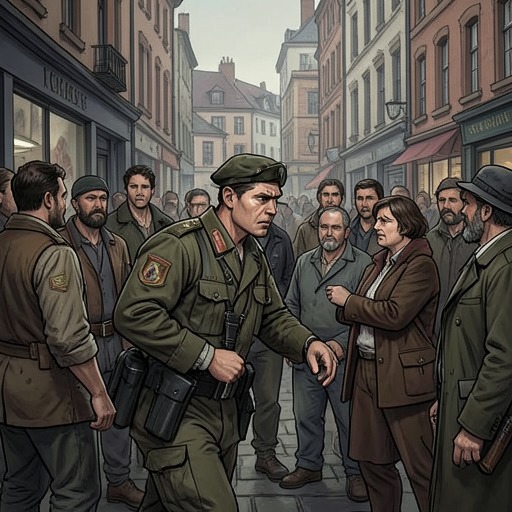
The evidence presents the Sirians through features that can be recognized and imitated. To alter his appearance, James Mowry gives his face a mottled look with purple dye, then injects himself beside the right nostril. The injection is intended to produce, within two hours, a faint orange-colored blemish described as one occasionally seen on Sirian features. His disguise is completed as that of a middle-aged, coarse-looking, somewhat overfed farmer, backed by documents identifying him as Rathan Gusulkin, a grain-grower. The transformation depends on more than a forged name: Mowry deliberately assembles a face and body that will be read as plausibly Sirian.
The disguise also reveals a distinction between features that can be simulated and a bodily marker the narration treats as broadly characteristic. When Terrans confront Mowry near the end of the supplied evidence, one calls him Blowfly, a tag tied to the purple backside attributed to every Sirian. Mowry does not resent the insult, even though he is himself a Terran in disguise. The contrast gives the label a double edge: it is a species-based slur, but in this moment it also recognizes the appearance Mowry has adopted and the danger that appearance has helped him negotiate.
Society and Justice
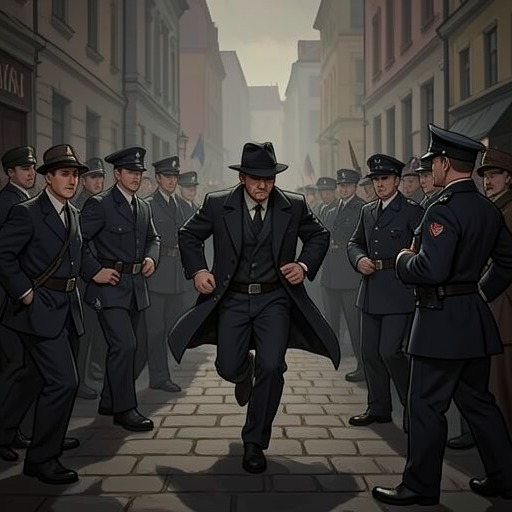
The Sirians are linked to a secret judicial system in which a suspect may be seized from the street and never seen again. The account stresses the system’s opacity: authorities can invoke law and order without giving details, naming a suspect, or stating charges. It also says there are no judges. Rather than presenting justice as a visible public procedure, this description makes its absence of explanation part of the machinery of control. A person’s disappearance can be treated as an ordinary possibility, while the public is given no account against which to test the state’s claim that the matter is being handled appropriately.
This is a broad statement about a species and its worlds, not a detailed portrait of an individual Sirian judge, official, or citizen. The evidence does not describe how every case proceeds or establish that every Sirian personally supports the system. Its emphasis is instead on the environment such a system creates: suspects can vanish, charges may remain unstated, and the institutions that would ordinarily make judgment legible are absent. That political setting gives Mowry’s need for convincing papers and a convincing appearance additional force. His false identity is useful in a society where official power can be difficult to question openly, but the same opacity makes exposure potentially dangerous.
Jaimec and Vulnerability
Jaimec is described as a colonial world populated by one race of one species, without national or international rivalries, local wars, or a developed navy. The novel connects those absences to the planet’s particular susceptibility to a strategy that carries panic from land to water. The point is not simply that the Sirians lack ships; it is that a society without rival naval traditions or local conflicts has not developed the same framework for interpreting a maritime threat. A disturbance at sea can therefore unsettle a population for which naval danger is unfamiliar.
This account makes the Sirians’ social and military circumstances part of the mechanics of the plot. The population’s relative uniformity and Jaimec’s lack of naval experience do not prove that its inhabitants are inherently credulous. Instead, the stated vulnerability arises from what the world has not experienced or built: no local wars, no competing national groups, and no navy. The attempt to spread panic outward from land exploits that specific absence. The species is thus represented not only through bodily traits but also through a shared historical and strategic environment that shapes how the population may respond to danger.
Narrative Role and Representation
The Sirians appear in the evidence mainly through three connected frames: the body that Mowry imitates, the political order described as normal, and the population whose unfamiliarity with naval danger can be exploited. These frames make species identity consequential without offering a full account of Sirian culture or individual lives. The narrative supplies precise signals of physical appearance and a stark description of justice, but it does not establish how Sirians understand those features, how they debate their institutions, or how varied their experiences are.
That limited perspective matters. Mowry’s disguise treats Sirian appearance as a set of recognizable details that can be copied closely enough to support a false identity; the Blowfly label likewise reduces a person to a supposedly defining bodily feature. At the same time, the description of Jaimec ties vulnerability to concrete historical conditions rather than to an innate defect in its people. Together, these details place the Sirians at the intersection of disguise, wartime contempt, and political susceptibility. When the Terran voice calls Mowry Blowfly, he responds by identifying himself as James Mowry and declaring that he is a Terran. The exchange exposes the gap between the identity his appearance has projected and the identity he claims, bringing the novel’s recurring concern with passing and recognition into a final, sharply physical image.