Imperial Development Plan 400R
WatchmenImperial Development Plan 400R is the Terran Empire’s framework for directing development on underindustrialized worlds, and its application to Shinar becomes a decisive instrument of imperial rule. On paper, the plan identifies a practical response to population pressure and declining food exports; in lived experience, its industrial measures remove farmers from their land, expose the weakness of imperial communication, and help turn economic reform into rebellion.
Classification and Imperial Purpose
Imperial Development Plan 400R appears in the imperial survey of Oran VI, the planet whose native name is Shinar. The survey describes a world with a radius of 1.04, density of 0.91, gravity of 1.025, and an atmosphere nearly identical to Earth’s. Shinar is 80 percent sea-covered, has three major continents, and contains an estimated native human population of 3.4 billion. Its economy is predominantly rural and agricultural, while its industrial base is underdeveloped; within the plan, Shinar receives the priority classification 3C.
The classification places Shinar inside a wider imperial system of managed development rather than treating it as a self-determining society. Shinar had formerly been a colony of the Masters and was incorporated into the Terran Empire immediately after the Galactic War. The Star Watch, the Empire’s interstellar military arm, controlled the space routes, while the Imperial Marines handled fighting on planetary surfaces. Development therefore operates within an imperial structure backed by military power: economic planning and political pacification are not separate functions.
Industrialization and the Food Problem
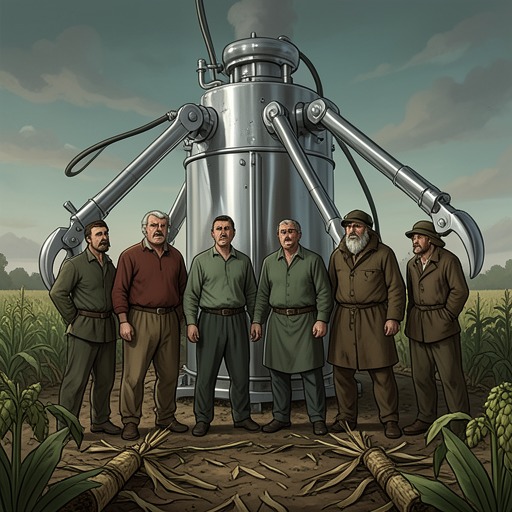
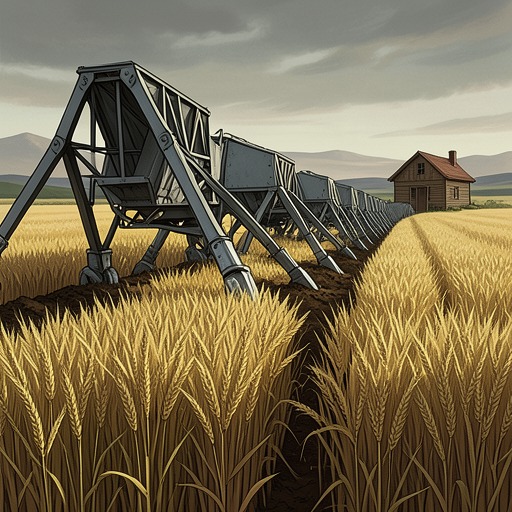
The plan’s most consequential measure on Shinar is the installation of nutrient processors. About a year before the rebellion, farmers began arriving in Katan after Terran authorities had driven them from their land to make room for factories producing synthetic foodstuffs. The policy was presented to Clanthas, whose business depended on buying and selling farm produce, as necessary and even vital. From the imperial perspective, the processors were intended to multiply food output and eventually restore trade with neighboring worlds.
The underlying crisis was demographic and economic. Under the Masters, Shinar’s population had been held at about 500 million, and the planet had fed itself and the worlds within fifteen light-years. After the Terrans defeated the Masters and left Shinar to develop on its own, the population expanded rapidly. When Clanthas was Merdon’s age, Shinar had two billion people; by the time of the rebellion, it had three billion, with the broader imperial estimate reaching 3.4 billion. The planet was not yet unable to feed itself, but its food production was increasingly consumed at home. Little remained for export, surrounding worlds were going hungry, and Shinar was becoming economically bankrupt.
Plan 400R thus responds to a genuine material constraint, but its solution transfers the immediate cost to the rural population. Farms are cleared before the displaced farmers understand how the new system will work, and the new factories become visible symbols of alien control. The plan’s technological promise cannot easily compete with the physical fact of eviction. What the Empire defines as modernization, Shinarian farmers experience as the seizure of the basis of their lives.
Communication Failure and Rebellion
The governor issued a proclamation explaining that the nutrient plants would increase food production and reopen interplanetary trade, but little effort was made to explain the policy to the farmers. They knew only that they were being moved off their farms to make room for Terran factories. The failure was not simply administrative; it deprived the development plan of legitimacy. A policy designed to avert famine became evidence that imperial authorities valued production targets over the people expected to bear the transition.
Clanthas appealed to the Terran governor on behalf of the farmers, but the response that the processors were necessary did not resolve the political conflict. Instead, Clanthas organized the farmers and held a demonstration in Katan, followed by similar demonstrations in the major cities. Larger demonstrations turned into riots, troops were called in, and unarmed civilians were killed. Violence escalated, the Terran governor was murdered, the Imperial Marines arrived, and Komani warriors landed on Shinar. The development program therefore acts as the immediate trigger for a rebellion whose deeper causes include overcrowding, impoverishment, the collapse of agricultural exports, and resentment of imperial domination.
The policy also exposes a conflict between imperial time and human time. Imperial officials regard the transformation of Shinar’s entire way of life as urgent because neighboring worlds need its food, while Clanthas acknowledges that the change may be necessary but rejects the idea that necessity makes it desirable. The plan demands rapid adaptation from a population whose social order was built around farming; the rebellion begins when that demand is imposed without consent, preparation, or trust.
Political and Military Consequences
Once rebellion has begun, Plan 400R is inseparable from the struggle over Shinar’s political future. Clanthas becomes the acting leader of the Shinarian people, caught between Terrans seeking to pacify the planet and restore it as a docile colony, Komani forces pursuing their own plans, and local militants beyond his control. The economic program has helped create the conditions in which several competing powers can claim to speak for Shinar.
The conflict later divides between Okatar Kang’s strategy of systematic raiding and Emil Vorgens’s concept of Shinarian self-defense directed and supported by the Terrans. After a celebration at Katan, six weeks of nearly uninterrupted fighting spread across the planet. Okatar Kang’s forces raid districts and towns, taking food, weapons, equipment, and ammunition; the fighting consists largely of skirmishes, feints, sudden attacks, and ambushes rather than battles between massed armies. The food question that motivated the development plan consequently becomes a military resource question: control of agricultural production and stored supplies determines who can sustain the war.
Vorgens eventually argues that Terran-held garrisons should transfer stocks from their arsenals to the natives. His plan depends on trust between imperial forces and Shinarian defenders, a sharp contrast with the earlier displacement of farmers under the development program. The proposed transfer treats local participation as a strategic necessity, suggesting that the Empire can no longer govern Shinar effectively through orders and industrial installations alone.
Significance in the Narrative
Imperial Development Plan 400R functions as both policy and political diagnosis. It identifies a real population-and-food imbalance, yet the novel shows that technical correction cannot be separated from land, memory, dignity, and political agency. Shinar’s crisis is not presented as a simple refusal of progress: its people remember a stable equilibrium under the Masters, resent the poverty and overcrowding that followed liberation, and object to being displaced by a solution imposed from above.
The plan’s failure is therefore a failure of translation between material necessity and social legitimacy. The Empire sees nutrient processors as the answer to a quantifiable food shortage; farmers see factories occupying their fields. Because the authorities do not explain the transition or allow the population meaningful control over it, the plan becomes the visible face of imperial power. Its intended function is development, but its narrative consequence is mobilization: it helps convert structural economic anxiety into organized resistance, military intervention, and a wider contest over whether Shinar will remain an imperial colony or move toward self-government.