Star Watch jurisdiction over the Imperial Marines
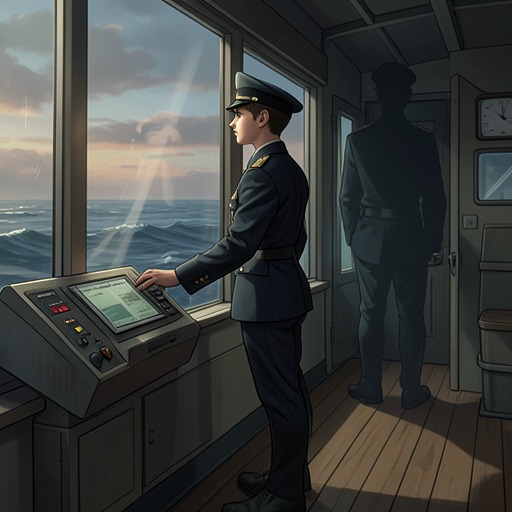
WatchmenStar Watch jurisdiction over the Imperial Marines is the rule that converts the Star Watch from a coordinator of interstellar routes into a possible supervising authority over the Empire’s planetary combat arm. Its importance emerges during the crisis on Shinar, where the regulation gives Emil Vorgens a lawful basis—though not an uncontested one—for replacing Brigadier Aikens and directing the Mobile Force against both the Komani offensive and the danger of a wider war.
Definition and Institutional Background
The rule belongs to the constitutional history of the Terran Empire’s military system. The Star Watch was the Empire’s interstellar military arm, but it had existed before the Empire, during the earlier Confederation, more than a century before the events on Shinar. It had fought the successful war against the Masters, a victory that transformed the Terran Confederation into the dominant power over much of the galaxy and helped make the creation of the Empire necessary as a means of governing that enormous territory.
Under the imperial arrangement, the Star Watch controlled the interstellar space routes, while the Imperial Marines served as the branch responsible for fighting on planetary surfaces. The separation appears clear in ordinary circumstances: the Marines conduct ground operations, while the Star Watch represents the larger interstellar command structure. Yet the novel establishes that the division is not absolute. The Imperial Marines remain subject to Star Watch jurisdiction, and that dormant legal relationship becomes critical when the local military command fails to serve the broader imperial objective.
Interpretation During the Shinar Crisis
The rule is first tested against the difference between written orders and battlefield reality. Emil Vorgens arrives on Oran VI with instructions to assist the Imperial Governor in dealing with dissident elements of the native population. Once he reaches the Mobile Force, he explains that his orders require him to negotiate with the chief of the Komani raiders, offer the Komani a peaceful return to their homeworld if they immediately stop raiding Oran VI, remind them that Komani clan chieftains have pledged loyalty to the Terran Council, and invoke the old alliance between the Komani and the Terrans during the Galactic War.
Brigadier Aikens insists that such orders cannot foresee the details of a rapidly changing campaign. He asks Vorgens to interpret them rather than merely repeat them, arguing that a Star Watch order processed at headquarters could not anticipate the local situation. Vorgens answers that the instructions are explicit, but the exchange exposes the rule’s practical problem: jurisdiction is formal and general, whereas command decisions must be made amid siege conditions, unreliable communications, competing authorities, and shifting alliances.
The same uncertainty appears in the Mobile Force itself. Sergeant McIntyre asks why a Star Watch officer is leading the mission and points out that the Imperial Marines, including the Mobile Force, are a branch of the Star Watch. Vorgens acknowledges the institutional connection but distinguishes jurisdiction from ordinary rank. A Star Watch junior officer cannot normally order a full brigadier merely by virtue of belonging to the higher organization. The regulation therefore does not erase hierarchy; it creates an exceptional channel through which hierarchy can be overridden when the Star Watch officer is acting as the sole representative of Star Watch Headquarters on the planet.
Invocation and Exercise of Authority
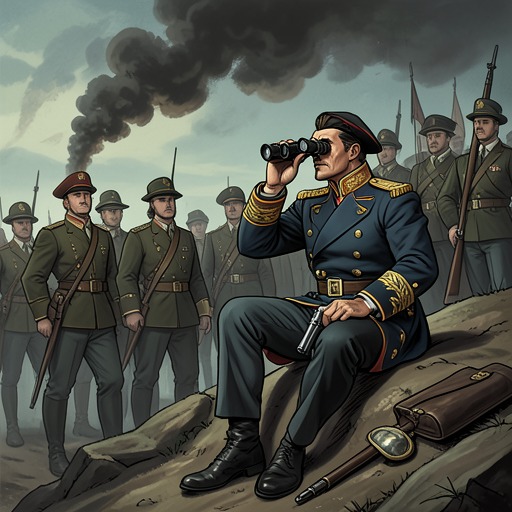
Emil Vorgens finally activates the rule in a direct confrontation with Aikens. Aikens is preparing for action in full-dress uniform, with ornate pistols buckled across his middle, when Vorgens enters with the executive officer and declares that Aikens is relieved of duty and that Vorgens is assuming command of the Mobile Force. The declaration shocks Aikens into silence, while the executive officer immediately objects that a junior officer cannot take command from a full brigadier.
Vorgens answers that the standard regulations clearly state that all Imperial Marine personnel are subject to Star Watch jurisdiction. He further argues that the regulations contain no provision prohibiting such an action. Because he is the only Star Watch officer on Shinar and represents Star Watch Headquarters, he concludes that he is authorized to remove Aikens if he finds the brigadier’s handling of the situation unsatisfactory. The legal argument depends on a gap as much as on an explicit command: the regulation grants jurisdiction, the emergency supplies the occasion, and the absence of another Star Watch officer leaves Vorgens as the only available replacement.
Aikens treats the decision as a personal assault on his career, describing it as an attempt to destroy a record of fifty-five years of service. Vorgens rejects that interpretation. He explains that he had been moved from place to place by Aikens, the Komani, and the Shinarians; forced into killing people with whom he had been sent to negotiate; used as a messenger; captured; and brought before a firing squad. In his view, the issue is not glory but the preservation of peace and the prevention of a new galactic war. The rule therefore becomes effective through an argument that combines bureaucratic legality with emergency necessity.
Its immediate consequence is that command of the Mobile Force passes from the experienced brigadier to the Star Watch officer whose original mission was diplomatic. Vorgens does not claim that the transfer is comfortable or ordinary. He presents it as the only remaining institutional remedy after the local command structure has become incompatible with the strategic purpose of avoiding a wider conflict.
Competing Legal Orders and Limits
The rule does not operate in an empty legal field. On Shinar, imperial regulation encounters Komani custom, Shinarian resistance, local religious protection, and the practical authority of armed groups. Okatar Kang invokes Komani tradition when he identifies Emil Vorgens as a prisoner who attempted escape and states that prisoners who reject Komani hospitality are traditionally executed. The claim demonstrates that the Komani do not regard imperial jurisdiction as universally binding; they recognize their own customary authority over prisoners in territory they control.
A related confrontation occurs when a Komani officer claims, in the name of Okatar Kang, the Terrans sheltered as prisoners. Sittas rejects the claim emphatically, asserting the authority of the sanctuary in which the Terrans have been protected. Later, Sittas acknowledges that he himself exercised extraordinary authority and admits that whether he had the right to take it upon himself will eventually be decided by a Star Watch court. His statement parallels Vorgens’s action: both men act beyond ordinary arrangements during an emergency, and both accept that a later institutional judgment may determine whether necessity amounted to legality.
The contrast is especially sharp in the Shinarian rebellion. Clanthas’s demonstrations, the riots, the killing of unarmed civilians, the murder of the Terran governor, and the arrival of the Imperial Marines produce a struggle in which imperial force and local political legitimacy compete. Merdon describes Shinarian resistance as a response to Terran force and says that the rebels will continue fighting until the Terrans are unwilling to pay the price of holding Shinar. Against this background, Star Watch jurisdiction can appear as a safeguard against military fragmentation, but it can also function as an imperial mechanism for concentrating authority over a colonized population.
Strategic Consequences in the Campaign
Vorgens uses the authority he has claimed not simply to win battles but to reorganize the political and military relationship between the Terrans and the Shinarians. When the Shinarians begin trusting the imperial side, he orders Aikens to contact the garrison commanders in the four cities still held by the Terrans and take stocks from their arsenals to arm the native population. Aikens agrees only under protest, but Vorgens commands him to carry out the measure regardless. The jurisdictional rule thus enables a policy that differs from straightforward imperial suppression: the Terrans are directed to support Shinarian self-defense rather than retain all weapons exclusively for imperial troops.
That policy becomes necessary because the war is not a conventional clash between two clearly bounded armies. After the celebration at Katan, six weeks of nearly continuous fighting spread across Shinar. Okatar Kang orders the Komani to sack the planet, raiding every district and town while systematically taking food, weapons, equipment, and ammunition. Opposing this is Vorgens’s concept of Shinarian self-defense, organized and supported by the Terrans. The fighting consists largely of skirmishes, feints, maneuvers, sudden attacks, and ambushes; few individual actions involve more than a battalion. Centralized authority therefore matters not only for formal discipline but for coordinating a dispersed campaign whose political objective is as important as its military one.
The rule’s strategic meaning is also visible in its implied limits. Vorgens does not claim unlimited personal power over every actor on Shinar. His jurisdiction reaches Imperial Marine personnel, while the Komani, the Shinarians, and local authorities remain governed by their own claims and loyalties. Even inside the Empire, the legality of his assumption of command is left for a future Star Watch court. The regulation creates an avenue for action, not an automatic guarantee that every use of that avenue will be judged lawful.
Significance of the Rule
Star Watch jurisdiction over the Imperial Marines dramatizes the tension between rank, law, and necessity. Aikens possesses seniority, experience, and the immediate authority of the planetary military command. Vorgens possesses a lower rank but a superior institutional mandate in the crisis. The resulting confrontation asks whether obedience should follow the visible hierarchy of the battlefield or the wider legal structure of the Empire.
The rule also exposes the ambiguity of imperial legality. It can restrain a reckless local commander and prevent a planetary campaign from igniting a new Galactic War. At the same time, it places exceptional power in the hands of an officer who is both interpreter and beneficiary of the regulation. Its operation depends on an official’s judgment that the existing commander has failed, on the absence of another Star Watch representative, and on the willingness to defend the decision before a later court.
In the novel’s larger political landscape, the regulation stands between several kinds of authority: the Star Watch’s bureaucratic law, the Imperial Marines’ military hierarchy, the Komani’s execution customs, the Shinarians’ resistance, and the sanctuary claimed by Sittas. The decisive point is not that one legal system simply defeats all the others. Rather, the crisis reveals that each order becomes persuasive only when backed by institutions, weapons, custom, or collective consent. Vorgens’s intervention gives imperial law a new practical force, but its legitimacy remains inseparable from the consequences of how that force is used.