Dueling Machine rules
WatchmenDueling Machine rules govern a system designed to transform dangerous hostility into controlled, legally meaningful simulation. The machine allows disputants to fight within an electronically synthesized dream without suffering mental or physical injury, yet its very capacity to amplify imagination makes regulation essential. The rules therefore stand at the intersection of personal grievance, public law, scientific responsibility, and political power: they promise civilized conflict without bodily harm, while the story repeatedly tests what happens when people, governments, or technologies push beyond that promise.
Purpose and Legal Scope
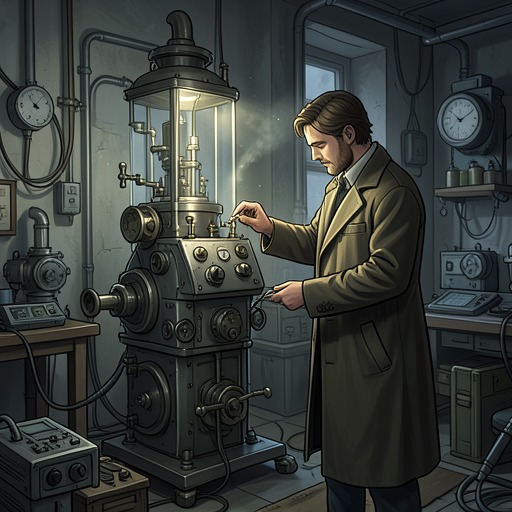
The rules originated in Dr. Leoh’s effort to address the tensions of civilized life. The Dueling machine combines an electroencephalograph with an autocomputer, amplifying a participant’s imagination until he can inhabit a world constructed by his own mind. Leoh first understood the device as a therapeutic instrument for hostility and tension, and psychiatrists and psychotechnicians used such machines to treat patients. He then developed the dueling application as a preventive measure, intending it to stop mental tensions from becoming disorders rather than merely treating their consequences afterward.
Under the intended system, two people with a sufficiently serious disagreement could enter the machine instead of submitting their dispute to ordinary courts. They could give their imaginations free rein and settle the argument as violently as they wished, but without injuring themselves or anyone else. On most civilized worlds, the results of properly monitored duels were accepted as legally binding. The machine thus did not merely provide entertainment or private catharsis: it supplied an alternative legal procedure, one in which a formally supervised imaginative contest could carry the force of a judgment.
The rules also impose a boundary on the machine’s proper subject matter. Major Massan explains that the machine may be used only for personal grievances and is strictly outside the realm of politics. That restriction is central to its legitimacy. The system is supposed to resolve conflicts between individuals, not allow governments to disguise coercion as a private quarrel or convert a scientific therapy into an instrument of state policy.
Formal Procedure of a Duel
A duel begins under the supervision of the chief meditech and the machine staff. The challenged party receives the first choice of weapon and environment, after which the staff asks whether any instructions or comments are necessary before the contest begins. This procedure gives the duel a recognizable legal structure: the parties are identified, the challenged participant exercises a defined procedural privilege, and the staff confirms that the conditions are sufficiently clear for the contest to proceed.
The environment and weapon are not decorative details. Because the machine projects the participants’ thoughts, knowledge, reflexes, and personalities into a shared dream, the selected setting determines which abilities become relevant. In one contest, Major Odal chooses a situation in which many warriors have won glory, treating the choice as a test of martial competence. In another stage, after the first part ends in a draw, Odal again receives the choice of environment and weapon and selects a ground-car setting after confirming that Dr. Leoh knows how to drive. The procedure therefore allows a duel to move through distinct tests while preserving an explicit rule about who controls each stage’s conditions.
The system also provides a formal pause between stages. After the first part of the duel is declared a draw, the chief meditech tells both participants that they may withdraw for a day or continue immediately. Major Odal chooses to continue without hesitation, and Leoh agrees. The rule recognizes that a duel can impose sustained psychological and physical strain even when its simulated injuries are not real, while leaving the decision to continue with the participants rather than forcing an immediate conclusion.
Limits of the Simulated Combat
The Dueling machine does not improve a participant’s actual skills. During Dr. Leoh and Hector’s experiments, the machine projects their existing knowledge and physical abilities into the shared dream; it does not make a person faster, more accurate, or more knowledgeable. Hector is trained with weapons and has quicker reflexes than Leoh, while Leoh knows little about fencing, yet their results reveal that the machine projects personality as well as thought. Leoh wins most of their bouts, including contests with foils, pistols, sonic beams, and grenades, even though Hector is the better-trained fighter in conventional terms.
The rules require participants to imagine protective equipment when using dangerous weapons. That precaution preserves the machine’s intended distinction between violent experience and physical harm. Participants may fire pistols, use sonic beams, or throw grenades within the dream, but the imagined protection is part of the containment that makes those actions harmless. The system’s promise depends on keeping the violence inside the artificial environment rather than allowing the projected conflict to reach the outside world.
The machine’s operation also depends on human supervision. Leoh and Hector test whether it can reproduce and amplify thought patterns with strict fidelity, while staff monitor and analyze their duels. The chief meditech can oversee the contest, determine whether rules have been broken, and announce results such as a draw. The rule system is therefore not simply a set of instructions issued to the duelists; it is an institutional arrangement involving scientists, meditechs, control consoles, recordings, and legally recognized outcomes.
Political Abuse and the Need for Enforcement
The boundary against political use is challenged when Chancellor Kanus turns the machine into a political weapon. Massan recounts that, more than a Terran year earlier, Kanus picked a quarrel with the Safad Federation while seeking an especially favorable trade agreement. A Safad trade minister objected, and Major Odal became involved in a personal argument with him. The disagreement was converted into a duel, which Odal won. The minister then resigned, saying that he was psychologically incapable of opposing the will of Odal and Kerak; two weeks later he was dead, apparently by suicide, though Massan doubts that explanation.
This episode exposes the gap between written rules and political reality. The law says that dueling machines are reserved for personal grievances, but Massan insists that laws are only one thing while people are another, because politics consists of people rather than recorded words. The violation is not merely technical. A supposedly private contest has altered a government’s policy, removed a trade minister, and possibly contributed to his death. The machine’s legal form becomes a mask through which political power can operate while pretending to remain within the rules.
The consequences reach back to Leoh himself. Once he understands the part his invention has played in these developments, he feels both personal and professional guilt. He responds by leaving physics and electronics for psychology, eventually becoming a professor of psychophysiology, and by seeking a way to restore balance to humanity’s collective mentality. The rules thus carry an implicit burden of scientific accountability: the inventor cannot treat misuse as someone else’s problem when the device was designed to reorganize how conflict is handled.
Safeguards, Testing, and Narrative Significance
Leoh attempts to reinforce the rules after Major Odal has actually killed people. He adds three new circuits to the machine. The first psychonically isolates the duelists while the machine is operating, making it impossible for Odal or anyone else to contact the outside world during the contest. The second monitors the entire duel and allows the chief meditech to review the recorded contest if either side requests an investigation. The recording makes it possible to determine whether rules were broken and, even if foul play occurred, to detect it afterward.
These safeguards change the rules from a general promise of harmlessness into an engineered system of containment, observation, and review. Isolation limits the machine’s reach; monitoring creates a record; adjudication gives the staff a role in enforcing the code. The need for such additions proves that the original rules were not self-executing. They require material circuits, trained personnel, and institutional authority to make their ideals credible.
The machine’s technical possibilities continue to test the distinction between rule and capability. In experiments with Hector, the participants initially teleport from one booth to another, a dozen times on the first day. Leoh measures an average transit time of four picoseconds and finds that the power drain is approximately equal to that of a starship’s drive engines pushing a mass equal to Hector’s weight. Although this experiment concerns teleportation rather than an ordinary duel, it demonstrates why the machine cannot be regulated solely through traditional assumptions about simulated combat: a system built to project thought can become a medium for new forms of action.
The Dueling Machine rules are consequently both a safeguard and a warning. They express the hope that violence can be redirected into a controlled arena, judged by recognized procedures and insulated from bodily injury. Yet the history of Kanus and Odal shows that political actors can exploit the gap between private grievance and public consequence, while Odal’s killings show that technological boundaries can fail in practice. The rules matter because they attempt to preserve civilization through procedure, but the story’s central tension lies in the fact that procedure is only as humane as the people, institutions, and machines entrusted to enforce it.