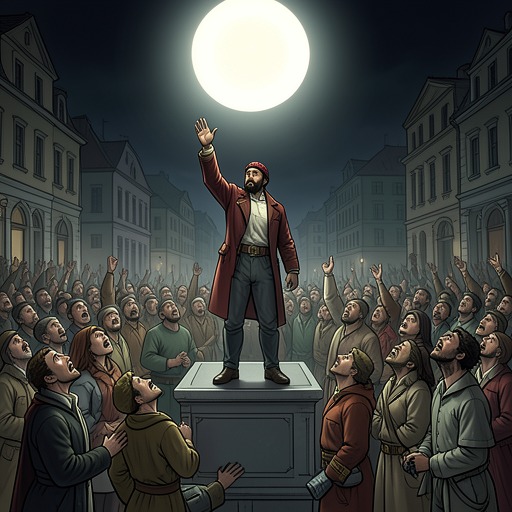
Leoh–newsman duel
WatchmenThe Leoh–newsman duel is the public proof-of-safety demonstration that Dr. Leoh accepts when a skeptical newsman challenges his confidence in the rebuilt dueling machine. Its decisive significance lies in the way a private scientific dispute becomes a planetary media event: the duel does not merely test equipment, but changes how the public understands the machine, Dr. Leoh’s authority, and the political threat posed by Major Par Odal and Chancellor Kanus.
Causes and Background
The challenge arises after the newsman seeks an interview with Dr. Leoh while Major Par Odal remains inside the Kerak embassy following his return. The reporter already knows the basic principles of the dueling machine and is less interested in a technical introduction than in exposing a possible contradiction: although the machine is supposed to prevent physical harm, Major Par Odal had previously killed opponents through it. The earlier public account of Emile Dulaq’s duel had established the machine as a political instrument as well as a scientific invention, reporting that Dulaq had failed in the first stage of his psychonic duel against Major Par Odal. The new interview therefore takes place under the shadow of both technological doubt and the fear of renewed Kerak coercion.
Dr. Leoh explains that he has installed three new safety circuits. The first psychonically isolates the duelists from the outside world, making it impossible for either participant to contact anyone beyond the machine while the duel is operating. The second records and monitors the entire contest, allowing the chief meditech to review the tape if either side requests an investigation into possible rule-breaking. Dr. Leoh also attempts to explain the remaining safety equipment, but the newsman dismisses the explanation as scientific jargon and insists that it offers no absolute guarantee. Dr. Leoh answers that the machine itself did not kill anyone; a man deliberately murdered his opponents inside it. The exchange exposes the central ambiguity of the device: it projects thoughts and personality with extraordinary fidelity, yet responsibility for violence still belongs to the human being who uses it.
The machine’s earlier operation makes the challenge especially meaningful. Dr. Leoh and Hector had tested it through hide-and-seek exercises in jungles, cities, glaciers, and interplanetary voids, then progressed to light duels with foils, pistols, sonic beams, and grenades while imagining protective equipment. The machine did not grant knowledge or physical ability; it projected each participant’s existing skills into a shared dream. Yet Dr. Leoh repeatedly defeated Hector even though Hector was faster and better trained with the weapons, leading Leoh to conclude that the machine projected personality as well as thought. The newsman’s challenge consequently tests more than circuitry. It places public trust, personal ingenuity, and the machine’s capacity to translate character into action on the same stage.
Acceptance and Conditions
When the newsman proposes an actual duel, Dr. Leoh initially presents the encounter as an irritating publicity stunt. Nevertheless, the challenge produces a sudden calm in him, and he accepts. He adds one binding condition: the tape of the duel must become public knowledge immediately after the contest ends. The condition changes the meaning of the event. The newsman is not being asked to accept Leoh’s assurances, and Leoh is not relying on professional reputation alone; both are committing themselves to a record that outsiders can inspect.
The demand for immediate publication also gives the duel a controlled form of transparency. The newsman is permitted to do whatever he wants during the contest in an attempt to prove his point, while the recorded duel supplies an external account of what actually occurs. The machine’s monitoring circuit makes the test auditable, and the public broadcast makes its consequences impossible to contain within the laboratory. Dr. Leoh’s scientific claim is thus converted into a performance whose evidence is not a verbal promise but an observable sequence of actions.
The duel is staged at the dueling machine with the chief meditech formally introducing the participants and their seconds. Dr. Leoh is accompanied only by Hector; the newsman brings his editor and a network vice president. The press gallery is empty, and the control panels hum in an otherwise silent room. This institutional setting gives the event the appearance of an experiment, a regulated match, and a media production at once. Its rules are technological, medical, and public rather than purely martial.
Course and Immediate Result
The contest ends after ten minutes, when every light on the control panels changes from green to amber. Hector immediately hurries toward Dr. Leoh’s booth, anxious to know whether the test has gone well. Dr. Leoh emerges smiling slightly, while the newsman’s performance has already supplied the answer. In the imagined environment, the reporter is run over by a bowling ball, becomes entangled in pulleys and inclined planes, and misjudges his strength so badly that he injures his back while attempting to lift something. Dr. Leoh, by contrast, repeatedly urges him to be careful, turning the supposed safety investigation into a comic demonstration of the reporter’s own vulnerability and poor judgment.
The vice president then asks whether the network may broadcast the recording on its tri-di services. Dr. Leoh responds that the newsman will look foolish, but the executive says that the outcome does not matter to him: he has decided to put the tape on the air if Dr. Leoh has no objection. The exchange confirms that the duel’s value has shifted from private verification to public circulation. Dr. Leoh’s condition has been fulfilled, but the network’s decision gives the evidence a reach and political force beyond what even the participants initially anticipate.
The result is not a lethal victory and does not depend on superior physical strength. Earlier experiments had shown that the machine does not improve a person’s abilities, and Dr. Leoh’s advantage over Hector came from the projection of personality rather than speed or weapons training. Against the newsman, the same principle becomes legible as comic intelligence: Dr. Leoh’s composure and inventiveness repeatedly outmaneuver the reporter’s suspicion, while the reporter’s confidence turns into a series of traps. The duel therefore demonstrates safety through harmless simulated danger while also revealing how temperament shapes the shared psychonic environment.
Broadcast and Political Consequences
The network broadcasts the duel across the planet that night. Within a week, it has been shown throughout the Acquataine Cluster and is being requested in the Commonwealth. It is the first duel ever seen by the general public, and Dr. Leoh’s participation makes it doubly compelling. The audience watches the inventor of the machine defeat the skeptical investigator without killing him, while the reporter’s blundering provides comic relief after months in which the Acquatainians have lived under the fear of war.
The broadcast produces an emotional release as well as an argument about engineering. People who have been surrounded by the threat of conflict see Dr. Leoh carefully guiding the newsman through absurd hazards and take pleasure in the spectacle. The machine, previously associated with the Kerak assassinations and Major Par Odal’s terror, is reframed as something that can be understood, controlled, and even made ridiculous. Public visibility becomes a form of political counterforce: fear depends on the machine’s mystery and apparent inevitability, while the broadcast exposes its operation through a familiar contest with a visible loser and no physical casualties.
The political interpretation follows quickly. During a later public discussion, a pundit argues that Chancellor Kanus can no longer use the dueling machine to frighten the population in the same way, because without fear Kanus is only half as threatening as people had believed. Dr. Leoh resists that conclusion, pointing instead to Kerak’s diplomatic isolation of Acquatainia and warning against treating a single successful demonstration as a complete political solution. The duel therefore weakens one instrument of intimidation without pretending to end the larger confrontation. Its success is real, but it is also limited: public confidence can neutralize terror as spectacle while diplomatic pressure and military danger continue elsewhere.
Narrative and Technological Significance
The Leoh–newsman duel makes the dueling machine a boundary object linking science, journalism, medicine, entertainment, and statecraft. Dr. Leoh’s circuits assign the device new responsibilities: isolation separates the duel from the outside world, recording creates an evidentiary trail, and medical review provides an institutional mechanism for judging violations. The machine no longer appears merely as a means of projecting aggressive thought. It becomes a regulated system whose design redistributes authority among inventor, meditech, contestants, network, and audience.
The event also clarifies the novel’s distinction between the machine and the murderer who previously exploited it. Dr. Leoh insists that the apparatus did not itself kill; a deliberate human act did. That defense is not accepted simply because he states it. The public duel gives it a visible test, and the test succeeds because the newsman is allowed to challenge the claim rather than being silenced. The same technology that once made violence seem remote and unstoppable is made to display its safeguards in front of a mass audience.
Finally, the duel prepares the machine for a still more consequential development. After the publicity surrounding the contest, Dr. Leoh and Hector return to systematic work and begin practicing teleportation between the machine’s booths. Hector completes the jump repeatedly, with an average transit time of four picoseconds and a power drain approximately equal to that required for a starship’s drive engines to push a mass equal to his weight. The public safety demonstration thus stands at a hinge in the technological narrative: it calms immediate fears and establishes confidence in the device just before the same experimental network begins opening the way toward psychonic teleportation.