Mobile Force breakout from Carmeer
WatchmenMobile Force breakout from Carmeer is the operation that turns an apparently fatal Komani encirclement into a living retreat. Its decisive significance lies not merely in the Mobile Force’s escape, but in the way Emil Vorgens transforms command from a contested authority into a distributed system of timing, terrain engineering, communications, and disciplined mutual dependence. The breakout also becomes the military proof behind his later political argument: survival against the Komani requires Terrans and Shinarians to act together rather than remain divided by imperial allegiance.
Command and Immediate Stakes
Brigadier Aikens was formally relieved of duty when Emil Vorgens entered his compartment and announced that he was assuming command of the Mobile Force. The transition was abrupt and humiliating for Aikens, who had been buckling ornate pistols across his full-dress uniform and had expected Vorgens to remain out of his sight. Vorgens’s assumption of command therefore preceded the escape plan, establishing the authority under which the trapped force would be reorganized.
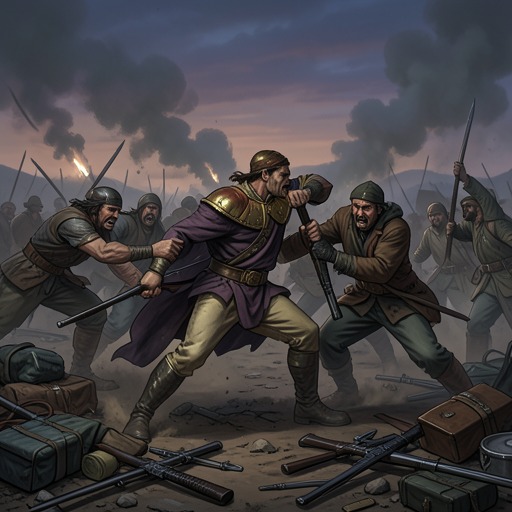
The situation demanded more than a conventional counterattack. The Mobile Force was caught in a Komani trap, while the Komani had thinned their forces in particular sectors of the surrounding slopes. Vorgens recognized that the force could not survive by moving slowly along the narrow, twisting trail previously used by his battle cruiser. If the entire formation filed out through that route, the vehicles would remain exposed and would not escape alive. The operation consequently treated the valley, its slopes, its roads, and its communications network as parts of one coordinated problem.
The Breakout Plan
Vorgens’s orders were transmitted to three hundred separate vehicles, including dreadnaughts, cruisers, scoutcars, troopcarriers, and supply vans. Receivers relayed the messages to computers, and the computers produced detailed instructions for the individual crews. The combined effect of those separate orders was the plan for breaking out of the Komani trap: a large, dispersed force would act as one formation without depending on a single congested movement route.
Scoutcars and troopcarriers were directed toward Sectors W5 and W6, where Komani forces were comparatively thin. The troopers were to seize and hold those sectors, while the scoutcars neutralized remaining pockets of resistance. Light cruisers, slower and less maneuverable than the smaller vehicles, would follow the initial assault and add firepower. The sequence placed the most mobile elements first, using them to open the route before committing the heavier vessels.
The engineers were assigned an equally important task. As soon as the troopers secured the slopes, engineering vans were to grade the terrain with force beams and explosives. Their objective was to gouge out a broad, unobstructed slope over which the larger vehicles could skim rapidly out of the valley. This was not a cosmetic improvement to the battlefield: it corrected the precise weakness that had made the earlier trail so dangerous. The route itself had to be remade before the main body could pass.
While the escape route was being seized and prepared, the remainder of the Mobile Force was ordered to fall back slowly toward the slopes. A special rear-guard task unit of ten dreadnaughts, including Vorgens’s flagship, would keep the Komani attack stalled and off balance until the final dash. The plan thus depended on controlled delay rather than panic: some units advanced, some repaired the passage, some withdrew, and the rear guard absorbed the pressure long enough for the rest to escape.
Execution and Escape
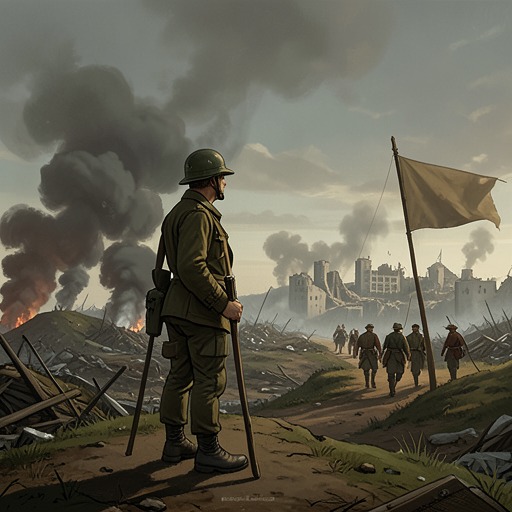
The operation’s success became visible first as a change in the valley’s movement. Approximately twenty Terran vehicles lay scattered across it, smoking and inert, evidence of the cost of the fighting and of the danger from which the survivors were withdrawing. Yet the rest of the Mobile Force streamed up the hillsides along paths of raw earth cut by the engineers and the Komani bombardment. The improvised roads led toward the crest and toward freedom, turning damaged ground into an avenue of escape.
A battle-scarred cruiser reached the trench while troopers climbed aboard its rear deck. Sergeant McIntyre understood the reversal in immediate, physical terms: the force that had seemed trapped was getting out alive. His recognition of Vorgens as the officer who had pulled them from the valley marks the operation’s central value shift, from encirclement and probable destruction to organized survival. Vorgens’s engineer, grimy and hollow-eyed in a one-man scoutcar, refused to treat the moment as complete; he warned that there was no time for celebration because the Komani might attack again.
The escape therefore did not erase the battle’s danger or the losses represented by the smoking vehicles. It established a narrow window in which the Mobile Force could withdraw before the Komani restored pressure. The operation succeeded because the force moved through that window as a coordinated network rather than as a disordered column.
Political and Strategic Consequences
The breakout strengthened Vorgens’s authority among both soldiers and Shinarians. His later appeal to the people of Shinar rested on the argument that the Mobile Force could defend itself but could not defeat the Komani on the planet by itself. Okatar Kang needed a quick, decisive victory; if he were frustrated and kept off balance, his coalition might fail before reinforcements arrived. The breakout supplies the military example underlying that reasoning: a superior or better-positioned enemy could be resisted through coordination, delay, local knowledge, and timely reinforcement even when immediate destruction of the enemy was impossible.
That argument confronted the Shinarians with a choice between fighting alongside the Terrans against the Komani or allowing the Komani to take over their world and use it as a springboard for a wider galactic war. Vorgens could not guarantee that cooperation would earn Shinar the right to govern itself, but he offered the possibility that shared resistance would make self-government politically attainable. The breakout therefore connects battlefield logistics with the larger struggle over imperial rule and Shinarian autonomy.
The alliance that emerged was not automatic. Merdon had initially challenged Vorgens to recruit the Komani and other available opponents of the Empire, reminding him that freedom required the courage to resist enslavement. Vorgens refused to abandon his oath as a Star Watch officer. Later, after Vorgens demonstrated that he could bring vans and troopcarriers to Katan within an hour, Merdon admitted that he had been wrong about him and agreed to direct his people according to Vorgens’s orders. He also asked to fight alongside him. Their handshake and descent together toward the waiting people convert suspicion into operational partnership, a political consequence made credible by Vorgens’s performance during the escape.
Meaning Within the Wider Conflict
The breakout is a rescue and a demonstration of method. Vorgens does not win by claiming that imperial power is inherently benevolent; the surrounding evidence shows that Shinarian discontent is real, and Clanthas recalls Geoffrey Knowland’s maxim that freedom depends on the intelligence and courage to stand independently and resist enslavement. Nor does Vorgens solve the conflict by simply rejecting the Empire: he insists that his oath and citizenship still bind him to the Star Watch. His solution is instead contingent cooperation, in which Terran forces and local leaders share an immediate enemy while leaving the question of self-government unresolved.
The operation also anticipates the book’s recurring interest in technology as an instrument whose meaning depends on its human organization. Computers, transmitters, vehicles, force beams, explosives, and engineered slopes do not independently produce victory. They become effective because Vorgens assigns each element a place in a temporal sequence and makes hundreds of crews act on the same design. The Mobile Force escapes Carmeer because command, machinery, and collective discipline briefly overcome the strategic advantage of the Komani encirclement.