Komani campaign of terror on Shinar
WatchmenThe Komani campaign of terror on Shinar is the decisive escalation of the Komani intervention from military partnership to open subjugation. Planned by Okatar Kang after he concluded that the Shinarians had betrayed him, it used raids, terror, looting, and systematic seizure of resources to make the planet ungovernable unless the Terrans accepted a major confrontation. Its central irony is that coercion, intended to isolate the Shinarians and weaken the Terran presence, encouraged cooperation between former opponents and gave Vorgens the conditions in which Shinarian self-defense could become an organized military strategy.
From Alliance to Conquest
Okatar Kang’s decision followed a political reversal among the Shinarians. Clanthas had first mobilized farmers and organized demonstrations after the Terran authorities interfered with the nutrient processors on which agricultural trade depended. The protests expanded through Katan and other major cities; some demonstrations became riots, troops fired on unarmed civilians, the Terran governor was murdered, and the Imperial Marines and Komani warriors arrived on Shinar. Clanthas consequently became the acting leader of a people caught between Terran attempts to restore a docile colony and Komani plans of their own.
The Shinarian resistance was not limited to Clanthas’s original protests. Merdon explained that some Shinarians had tried to oppose the Empire through words, protests, and street demonstrations, but that the Terrans had answered with force. The resistance therefore turned toward armed struggle, seeking to fight until the Terrans no longer considered Shinar worth the cost and left the planet in freedom. Merdon also invited Vorgens, whose people had once fought the Terrans, to join the struggle and help destroy the Empire. Vorgens refused because he was an Imperial citizen, a sworn officer of the Star Watch, and bound by the service he had chosen.
Vorgens later presented the Shinarians with a different calculation. The Mobile Force could defend itself but could not defeat the Komani on Shinar without reinforcements, while Okatar Kang could ravage the planet before those reinforcements arrived. The Shinarians could either fight alongside the Terrans against the Komani or allow the Komani to seize their world and use it as a springboard for a galactic war. The possibility that cooperation might lead the Empire to favor Shinarian self-government remained uncertain, but the threat of Komani conquest made neutrality increasingly untenable.
Okatar Kang’s Campaign Plan
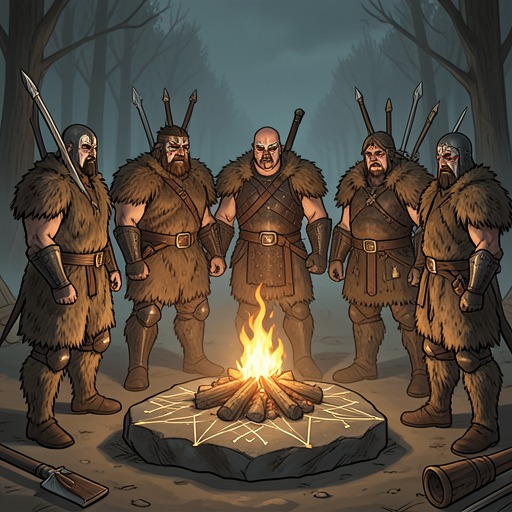
Okatar Kang’s change of policy was announced in the language of betrayal and ownership. Pacing before his council of nobles, he declared that the Komani had previously dealt with the Shinarians as allies, but that the Shinarians had now betrayed them. From that point forward, he intended to treat them as subjects. Shinar, in his view, was a planet to be taken, and the Komani would take what they wanted from it.
The campaign was designed to serve several purposes at once. Okatar Kang planned a campaign of terror and looting across Shinar, targeting the countryside and towns without Terran garrisons. Komani forces would seize whatever food, weapons, equipment, and ammunition they needed. The raids would spread fear among the Shinarians, gather material for the Komani war effort, and force the Terrans to stop retreating and offer battle. Okatar Kang expected that once the Terrans concentrated their forces, the Komani could concentrate theirs and destroy them.
The plan also treated terror as a method of strategic accumulation. Every day, Okatar Kang believed, Komani strength would grow while Shinarian dread of Komani power increased and Terran strength declined. His contempt extended to the Shinarian forces that remained allied with the Komani: he believed Merdon and the younger fighters had intended to let the Komani drive away the Terrans and then expel the weakened Komani themselves. The campaign therefore sought not merely to defeat the Empire but to eliminate any independent Shinarian political force capable of controlling the aftermath.
Raids Across Shinar
The campaign rapidly became visible as a pattern rather than a single battle. Reports reaching Vorgens in the deserted control center recorded strikes against the Mobile Force perimeter, raids on isolated villages and farms, and a hit-and-run attack on one of the larger cities. The Komani were spreading terror and destruction around Shinar while Vorgens also faced the uncertainty of Brigadier Aikens’s withdrawal from active command and the silence of the rebel leaders after their conference in Capital City.
The pressure eventually produced a political response. Clanthas appeared on the screen and admitted that the other Shinarian leaders had decided to accept Vorgens’s proposal: they would help the Terrans and work against the Komani in whatever way possible. The decision transformed an imposed military arrangement into a negotiated, if fragile, defensive partnership. Vorgens answered that because the Shinarians were trusting the Terrans, the Terrans would have to trust them as well. He ordered Aikens to contact the commanders of the four cities then held by the Terrans and release stocks from their arsenals to arm the native population, even though Aikens agreed only under protest.
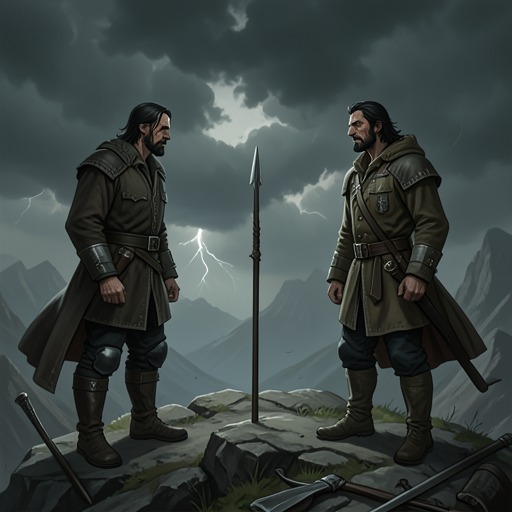
The alliance became operational during the fighting around Katan. When Merdon lacked enough groundcars to reach the city quickly, Vorgens promised a squadron of vans and troop carriers within the hour. Merdon, acknowledging that he had been wrong about Vorgens, told his people to follow the Watchman’s orders and offered to fight beside him. Vorgens answered not with an argument but by extending his hand; Merdon took it, and the two went down together to the waiting people. The scene gives the campaign’s political reversal a physical form: a Shinarian leader and an Imperial Watchman move from suspicion toward coordinated action because the Komani threat has made mutual dependence unavoidable.
The War of Attrition
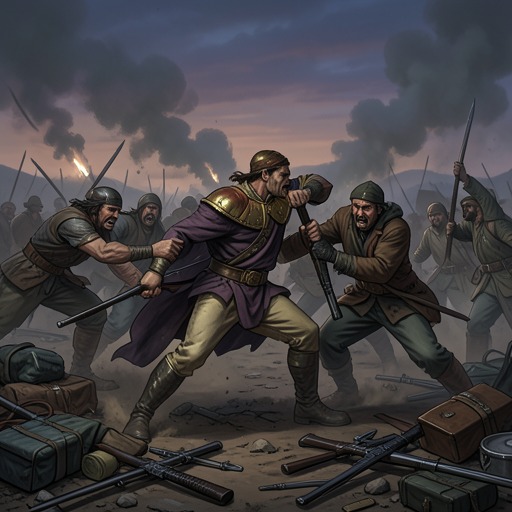
After the celebration at Katan, six weeks of virtually uninterrupted battle spread across the breadth of Shinar. Okatar Kang systematically raided districts and towns, taking food, weapons, equipment, and ammunition. Against this stood Vorgens’s concept of Shinarian self-defense, organized and supported by Terran forces, with Merdon’s fighters supplying reconnaissance and intelligence.
The resulting conflict differed from the decisive engagement Okatar Kang had hoped to force. Rather than massive formations colliding head-on, the fighting consisted of skirmishes, maneuvering, feints, sudden attacks, and ambushes; few individual actions involved more than a battalion. When a Komani raiding party moved toward a town, a fast squadron of battle cruisers intercepted it. Villages became small fortresses, sometimes with a Terran dreadnaught occupying the village square. Komani columns were ambushed, and when Okatar Kang massed his forces for a pitched battle, the Terrans dispersed and disappeared into the countryside.
The Komani still outnumbered the Imperial troops on Shinar, but the defenders repeatedly achieved local superiority at the point and moment of attack. The campaign thus became a war of attrition in which fatigue, hunger, and mechanical breakdown mattered as much as weapons. Okatar Kang’s strategy generated territorial devastation and material gain, but it failed to produce the quick, decisive victory on which his authority and wider ambitions depended. The dispersed defense made the Komani pay for movement, raiding, and concentration while allowing the Terrans and Shinarians to contest the planet without offering the single battle Okatar Kang wanted.
Consequences and Significance
The campaign’s immediate consequence was the destruction of the Komani-Shinarian alliance. Okatar Kang’s treatment of Shinar as a subject exposed the difference between Komani assistance against the Terrans and Komani recognition of Shinarian independence: once the Shinarians appeared politically unreliable, the Komani abandoned partnership and claimed the right to requisition their world. Terror and looting made that imperial logic unmistakable to the population the Komani had expected to intimidate into submission.
At the same time, the campaign altered the Terran relationship with Shinar. Vorgens did not promise that the Empire would grant self-government, but he helped the Shinarians arm themselves, coordinate with the Mobile Force, provide intelligence, and defend their own towns. The arrangement remained born of necessity rather than trust, yet the Komani attacks made cooperation materially meaningful. Shinarian self-defense ceased to be merely a political slogan and became the organizing principle of the resistance.
The campaign also widened the stakes beyond Shinar. Vorgens warned that a Komani takeover would give Okatar Kang the springboard for a galactic war. Okatar Kang’s own plan depended on turning the planet into proof of Komani strength: supplies would increase, fear would spread, and the Terrans would eventually be forced into a battle they could not survive. The defensive response denied him that narrative. Instead of collapsing into the docile colony the Empire wanted or the conquered possession the Komani imagined, Shinar became the terrain on which both external powers were checked by local participation, intelligence, and decentralized resistance.