Telepathy
WatchmenTelepathy is presented as an uncommon and difficult-to-control extrasensory ability whose importance depends less on its unaided strength than on the technology that magnifies it. In the dueling machine, a natural talent that might otherwise amount to little more than an erratic gift becomes a repeatable force capable of defeating opponents, recruiting other minds, and finally dissolving the boundary between Major Par Odal and Hector H. Hector.
Definition and Limits
Telepathy is first treated as a possibility rather than an established explanation. Dr. Leoh notes that well-documented cases exist among Terrans, but such talents are exceptional and unreliable. The Terran races have not developed telepathy as a normal faculty, since tri-di communications and starships made such adaptation unnecessary. Leoh therefore considers the possibility that the people of the Kerak Worlds may differ despite being human, giving the ability a cultural and biological dimension without making it universal among them.
The ability outside the machine is explicitly limited. Leoh describes a natural telepath as possessing an erratic talent that is difficult to control and not especially powerful, comparable to the sort of ability associated with a wandering fortune-teller. This limitation is crucial: telepathy alone does not explain Major Par Odal’s extraordinary record. The dueling machine supplies the amplification, fidelity, and reproducibility that the unaided mind lacks.
Amplification by the Dueling Machine
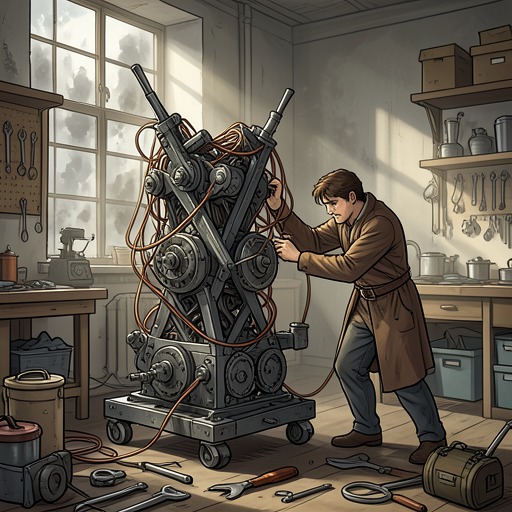
The dueling machine does not merely transmit thoughts. In Leoh and Hector’s experiments, it reproduces and amplifies thought patterns with strict fidelity, projecting the participants’ knowledge, abilities, and personalities into a shared dream. Their early contests show the distinction between ordinary skill and the machine’s deeper function. Hector is the better fencer and is trained with weapons, while Leoh is slower and less knowledgeable; nevertheless, Leoh wins most of their encounters when they confront one another directly. Leoh concludes that the machine projects personality as well as thought.
That discovery provides the framework for understanding telepathy. When Major Par Odal enters the machine, his natural ability is amplified rather than merely represented. The result is not just private mind-reading but an enhanced network of consciousness operating within the machine’s artificial environment. The technology thus acts as an active participant in the contest: it converts an unstable personal faculty into an organized tactical capability and redistributes power from bodily speed and weapons training toward mental access and personality.
Political and Military Use
The political consequences of this amplified telepathy are revealed through Major Par Odal’s earlier duels. More than a Terran year before the main investigation, he challenged the Safad Federation’s trade minister after a personal argument with him during negotiations. Major Par Odal won, and the minister declared himself psychologically incapable of continuing to oppose the will of Major Par Odal and the Kerak Worlds. Two weeks later, the minister died, apparently by suicide, though Fernd Massan doubted that explanation.
Three days before the conversation between Fernd Massan and Dr. Leoh, Major Par Odal had argued bitterly with Prime Minister Emile Dulaq at a Kerak embassy party. Because the confrontation occurred before a large gathering, Prime Minister Emile Dulaq had no practical alternative but to challenge him. Prime Minister Emile Dulaq then entered a state of shock, leaving the Acquatainian government unstable and threatening its alliances with smaller neighboring nations. The pattern suggests that the duel’s psychological effect extends beyond victory: it can disable a political opponent and alter the balance of power between states.
Dr. Leoh’s explanation also accounts for the apparent presence of several minds in Major Par Odal’s duels. Major Par Odal need not personally supply five additional helpers inside the machine. Five associates in the Kerak embassy can sit in on the duel and pool their minds with his; they may be telepaths themselves, but Leoh argues that they do not have to be. The machine amplifies Major Par Odal’s natural talent and allows the participating minds to function as a collective force. Telepathy therefore becomes not only an individual weapon but a mechanism for coordinated political coercion.
Fusion and Transformation
The most extreme manifestation of telepathy occurs when Major Par Odal and Hector H. Hector are fully exposed to one another through the machine. Major Par Odal is initially in the Acquatainian dueling machine, thinking about Geri Dulaq, when he suddenly knows that he is in the Kerak Worlds and that Hector H. Hector is in the machine with him. The machine’s circuits amplify and cross-link their open minds, producing an involuntary fusion rather than a controlled exchange of information.
The physical intensity of the event is described as a violent shock passing through both bodies, while the mental consequence is even more radical. Hector H. Hector can see into Major Par Odal’s mind as though it were his own; in a double-visioned experience, he is simultaneously himself and Major Par Odal, while Major Par Odal, sharing Hector H. Hector’s mind, becomes Hector H. Hector. Telepathy here ceases to mean communication between separate subjects. It becomes the collapse of separateness itself.
The fused consciousness contains the memories of two entire lives. Hector H. Hector’s departure from home, his father’s doubts about his joining the Star Watch, his difficult training, his success as the best student, athlete, and soldier, and his learning that the Star Watch exists to protect peace all become entangled with Major Par Odal’s history, including the hatred and desire for revenge directed toward Acquatainia. Their memories spiral together as brain synapses flash and chemical balances shift, until the two personalities melt together more completely than any two minds previously known to have done. The result is Hector/Major Par Odal, briefly one and the same.
Technological and Narrative Significance
Telepathy changes the meaning of the dueling machine’s rules and safeguards. The machine is designed to prevent physical injury by allowing aggressive feelings to be worked out within a shared simulation, but Major Par Odal’s use of amplified telepathy demonstrates that mental boundaries can be breached with consequences outside ordinary expectations. Dr. Leoh responds by adding circuits that psychonically isolate the duelists from the outside world and prevent Major Par Odal, or anyone else, from contacting external persons while the machine operates. Another circuit monitors the entire duel so that the chief meditech can review the record if either side alleges that the rules were broken.
The later experiments underline how much power the machine can mobilize. Hector H. Hector first teleports himself from one booth to another, doing so twelve times on the first day. Each jump takes an average of four picoseconds and consumes energy approximately equal to that used by a starship’s drive engines to propel a mass equal to his own weight. Although this experiment concerns a related psychonic capability rather than telepathy alone, it establishes the technological scale at which the machine operates: human mental powers are no longer private curiosities but forces measurable in time, energy, and military consequence.
Telepathy consequently serves as the book’s clearest example of technology transforming an uncertain human faculty into an instrument of institutional power. It allows Major Par Odal to turn argument into domination, permits the Kerak embassy to act through pooled consciousness, and finally produces the paradoxical victory of fusion in which knowing another mind destroys the distance necessary to oppose it. The concept’s decisive significance lies in that progression—from rare talent, to amplified weapon, to collective network, and at last to the disappearance of the individual boundary the weapon was meant to exploit.