Psychonic Teleportation
WatchmenPsychonic Teleportation is the breakthrough by which the dueling machine ceases to be merely a simulator of conflict and becomes a transporter of bodies, objects, and potentially armies. Its decisive significance lies in the union of a natural telepath’s amplified mind with a machine that can reproduce and intensify thought: the result is movement across physical distance without moving the vehicle that houses the machinery. The discovery opens a revolution in transport, but its military implications immediately place the technology under the shadow of conquest.
Definition and Discovery
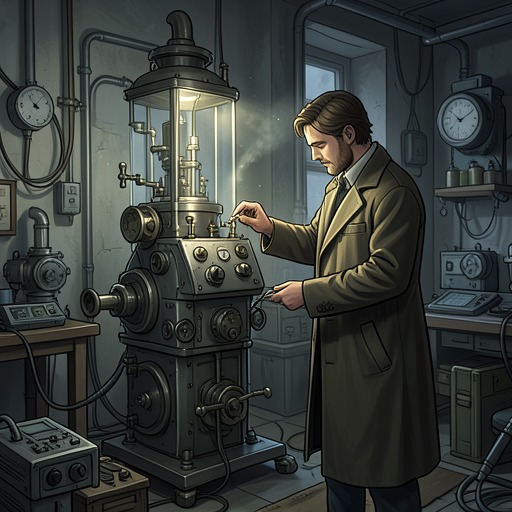
Psychonic Teleportation emerges from the dueling machine’s ability to amplify the powers of natural telepaths. Leoh had already established that the machine could reproduce and amplify thought patterns with strict fidelity, projecting the participants’ knowledge, reflexes, and personalities into a shared imagined environment. The machine did not improve a person’s physical abilities or supply knowledge that person lacked; it projected what was already present. Yet Leoh gradually realized that it projected personality as well as thought, a distinction that made the machine more than a neutral theatrical device. Its effects depended on the mental qualities of the people using it.
The crucial possibility appeared when Leoh tried to explain an abnormal power drain and an unexplained movement between booths. Natural telepaths had reportedly been able to move small objects without apparent physical force. Leoh therefore considered whether the dueling machine could amplify that talent too, even at the cost of draining all the power in the building. The idea initially seemed farfetched, and Leoh recognized that he had more theory than fact. The suspected phenomenon was teleportation: not an imagined journey inside the machine’s projected environment, but an actual transfer from one location to another.
Demonstration and Operating Limits
The first controlled tests used Hector himself. After Hector and Leoh resumed their work, Hector teleported from one booth of the dueling machine to the other twelve times during the first day. Leoh measured both the transit time and the power consumption. The jump took an average of four picoseconds, while the energy drain was approximately equal to that required by a starship’s drive engines to push a mass equal to Hector’s weight. The speed was therefore not simply a dramatic illusion; it was a measurable physical event with a substantial energetic cost.
The experiment also clarified what the machine transported. Leoh distinguished between moving a complete starship and moving its payload: the dueling machine could remain on the ground while only the person or object inside the transfer was carried. In principle, this made the system more efficient than ordinary starship travel, because the transport mechanism did not have to lift a ship’s structure or drive engines. Leoh could not yet say whether Hector traveled through subspace or by some entirely different process. He admitted that the researchers did not know how the phenomenon worked, how fast it could ultimately become, how far it could reach, or what limits governed it.
The following days supplied further evidence while also imposing a strict boundary. Hector moved inanimate objects from inside one booth, lifting weights without touching them, and then transported Geri from one booth to the other. Every successful transfer remained confined within the dueling machine. That restriction prevented the discovery from immediately becoming a universal transporter, but it also suggested the condition for future expansion: a compatible dueling machine, or something similar, would be required at the destination. Leoh consequently described the invention as a possible interstellar transport mechanism rather than a completed system.
From Transport Mechanism to Strategic Weapon
The scientific potential of Psychonic Teleportation quickly became inseparable from its military value. Kor informed Chancellor Kanus that scientists believed a telepath such as Major Par Odal could be used with the dueling machine to transport objects from one place to another over almost any distance, nearly instantaneously. The qualification was that the destination must contain a dueling machine. Within that condition, the strategic consequences were enormous: a force would not need to travel through intervening space if a machine had already been installed at its target.
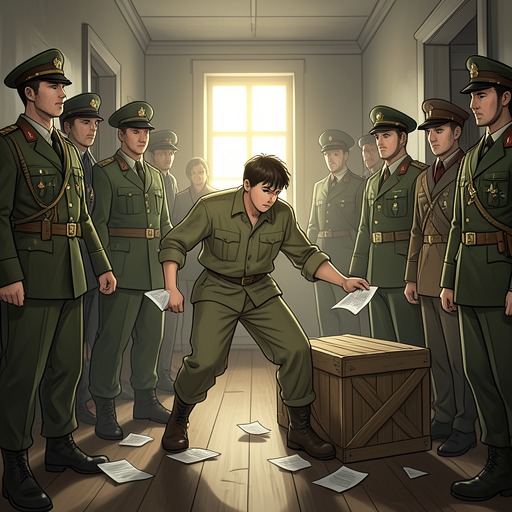
Chancellor Kanus immediately extended the possibility from objects to armies and from local experiments to the galaxy. His response treated the breakthrough not as a scientific curiosity but as a weapon for unrestricted surprise. If a receiving machine existed, an attack could arrive anywhere in the galaxy without warning. The fixed network of machines would function as a hidden infrastructure for projection of power, allowing the military to bypass conventional distance, warning systems, and the visible movement of fleets. Psychonic Teleportation thus changes the meaning of geography: distance remains a problem for building and maintaining the machines, but no longer necessarily protects a location from attack.
Relation to the Dueling Machine
The technology also reveals the ambivalence of the dueling machine itself. Earlier, the machine’s attraction lay in its ability to settle scores and discharge aggression without mental or physical harm. Its constructed environments allowed opponents to fight in cities, jungles, glaciers, or interplanetary voids while remaining in booths, and its rules and safeguards sought to preserve the separation between simulated violence and real-world injury. Later safeguards psychonically isolated duelists from the outside world and recorded the entire duel so that possible rule violations could be reviewed.
Psychonic Teleportation overturns that reassuring separation. The same apparatus that projected imagined weapons and environments can carry an actual person or object. The booth is no longer merely a boundary enclosing a dream; it becomes the source point of a material transfer. The machine’s power lies precisely in the continuity between mind and world: what first appears to be a shared projection can, under the right psychonic conditions, produce a change in physical location. The discovery makes the machine an active participant in events rather than a passive instrument, redistributing the ability to act among Leoh’s scientific knowledge, Hector’s or Odal’s psychonic capacity, and the machine’s amplification and control circuits.
Consequences and Narrative Significance
The breakthrough is confirmed on an interstellar scale when Sir Harold Spencer asks whether a person actually jumped from Kerak to Acquatainia. Leoh answers that the transfer occurred in less than a second across four hundred and fifty light-years. This report converts the earlier booth-to-booth tests into evidence of a phenomenon with galactic reach. Spencer’s reaction supplies the moral and political counterweight to Leoh’s scientific excitement: he recognizes the military potential of the teleportation and warns that Chancellor Kanus must also know about it.
Psychonic Teleportation therefore carries two opposing futures. As transport, it could move people and payloads with an efficiency and apparent speed beyond that of a starship, while leaving the heavy drive system on the ground. As a weapon, it could place forces or objects at any prepared destination and make the attack seem to come from nowhere. The condition that a dueling machine must exist at the far end is a real limitation, but it is also the basis of a strategic network. The concept’s importance lies in this reversal: a machine designed to contain aggression without harm becomes capable of relocating the material world, and the scientific triumph that promises to defeat distance simultaneously threatens to make every connected location vulnerable.