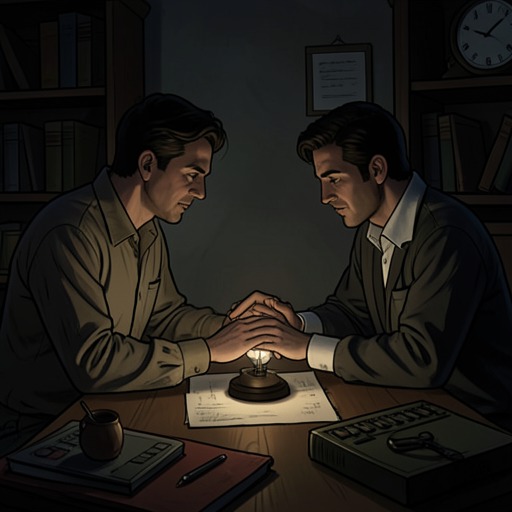
Henry and Lydia meet at a poetry reading
WomenHenry and Lydia meet at a poetry reading, an encounter that places a new possibility for intimacy beside Henry’s self-imposed isolation and uncertain emergence as a writer. Their first exchange falters, but a later visit to his home turns that missed connection into a tentative kiss and gives their acquaintance a beginning shaped by performance, embarrassment, and hesitation.
Background and Setting
At the time of their first meeting, Henry is fifty and has not been with a woman for four years. He has no women friends and regards even a nonsexual relationship as beyond his imagination. His history includes a marriage that ended in divorce, a six-year-old daughter who lives with her mother, and the death of the one woman he recalls having loved. The recollection establishes how firmly he has come to expect solitude, making his response to Lydia a departure from his ordinary stance rather than the continuation of an active courtship.
Several years earlier, Henry had left a twelve-year job as a postal clerk and was trying to establish himself as a writer. During the period in which he first saw Lydia, he was working on his first novel and drinking heavily as he wrote through the night. His writing routine retained the clock of his former employment: he began at 6:18 p.m., the time he had once punched in at the Terminal Annex Post Office. The reading and the later visit therefore take place within a life newly redirected toward writing but still governed by old habits of time and sustained drinking.
The First Meeting
Henry thinks he met Lydia at his first poetry reading, held at The Drawbridge, a bookstore on Kenmore Avenue. The event unsettles him: he describes himself as terrified even while feeling superior, and finds the store packed, with standing room only. When he enters, the audience applauds. The store’s proprietor, Peter, is counting money and jokes that a crowd like this would pay for another trip to India. Henry reads for thirty minutes, calls a break, and remains sober while people watch from the darkened room.
During the break, Lydia approaches the table where Henry is drinking beer. She leans toward him with both hands on its edge. He notices her long brown hair, prominent nose, and mismatched eyes, but also registers her vitality and the charged, partly confused feeling between them. Her suede cowgirl jacket has fringe around the neck. Henry responds with a sexual overture, telling her, "I'd like to rip that fringe off your jacket--we could begin there!" Lydia walks away. The line does not produce the connection he wants, and Henry watches her leave before finishing the second half of the reading.
After the performance, he turns his attention elsewhere: he takes his money, signs napkins and pieces of paper, then drives home. He says he forgets Lydia as he forgets the women he passes on the sidewalk. The contrast between the intense physical impression she makes and his quick return to indifference marks the encounter as a failed beginning, not an immediate romance.
A Second Encounter at Home
The connection resumes when Peter and Lydia arrive at Henry’s home at six in the evening. Peter presents what he has brought, and Lydia jumps onto the coffee table, her jeans fitting tightly, and recites her own poetry. Peter objects to the rhyming verse, but Henry tells him to let her continue. Henry is drawn to her movement and presence even as he judges the poems to be poor. His reaction separates the quality of the writing from the force of its performance: the poetry does not impress him, but Lydia’s body and unruly energy do.
Once Peter has left, Lydia sits on the couch near the door and Henry sits about a foot away. He looks at her, feels afraid, touches her long hair, and asks whether it is really hers. After she confirms that it is, he awkwardly turns her face toward him and kisses her lightly. The movement from the failed remark at the reading to this hesitant contact is the event’s central reversal: attraction has not become ease, but Henry acts on a possibility he had previously considered unimaginable.
The moment remains limited. Lydia says she must leave because she is paying a babysitter. Henry asks her to stay and offers to pay, but she says she cannot. At the door, he reaches for her once more; she lifts her face and gives him a very small kiss before pulling away. She places typed papers in his hand, closes the door, and drives off. The poems are a tangible remainder of the visit, but the exchange ends with separation rather than a settled commitment.
Poems, Writing, and the Event’s Significance
The papers Lydia leaves are mimeographed, stapled poems collected under the title HERRRR and written by Lydia and her three sisters. Henry reads some of them and finds humor and sexuality in them, though he considers the writing bad. He throws the pages away and opens his whiskey. This ending returns him to his familiar routine even after the evening has interrupted his isolation: the encounter has produced a kiss and an exchange of work, but not an immediate transformation of his habits.
The event joins two forms of performance. At the bookstore, Henry reads before a crowded audience and struggles with the exposed, public situation; at home, Lydia takes over the coffee table to perform her own poetry for him and Peter. In both settings, writing is inseparable from the body and from the risk of being seen. Yet the first meeting shows the limits of Henry’s practiced bluntness: his overture sends Lydia away, while the later contact becomes possible only after she returns in a different setting and he approaches her awkwardly rather than through another show of bravado. Their meeting thus begins not with a polished declaration but with a failed line, a second invitation created by circumstance, and a brief kiss that leaves the relationship unresolved.