Henry meets Laura Stanley after the Houston reading
WomenHenry meets Laura Stanley after the Houston poetry reading, in an episode that brings together his dependence on alcohol, his public identity as a poet, and his surprise at attracting a woman he regards as exceptional. Laura, whom he insists on calling Katherine, accepts his invitation to share a bed after the event. The encounter is intimate but provisional: Henry later reaches out to her in Austin, yet the evidence presents no settled relationship or lasting resolution.
Background and Houston Reading
By the time of the Houston appearance, Henry had been trying to establish himself as a writer after leaving a twelve-year job as a postal clerk. He describes that transition as frightening. While working on his first novel, he drank heavily each night, smoked inexpensive cigars, typed until dawn, and set himself a target of ten pages. He often discovered only the following morning how much he had produced; the raw pages then had to be revised or discarded. The novel took twenty-one nights to write. This earlier account makes the Houston reading part of a larger pattern: literary work and alcohol are closely entangled in his life, rather than being separate public and private activities.
In Houston, Henry arrives with a heavily bandaged leg and is taking antibiotics for an infection. His doctor has warned that drinking would undermine the medication. Henry initially goes on stage sober, and after he reads several poems, an audience member asks why he is not drunk. He answers that Henry Chinaski could not make it and that he is his brother Efram. The joke turns his familiar drinking persona into part of the performance, while also momentarily presenting a version of the poet who can appear without alcohol.
That brief abstention does not last. Henry explains the antibiotics and the museum's no-drinking rule; someone brings him a beer, and another follows. As the drinks arrive, he continues reading, and he says the poems improve. The reading therefore shifts from an attempt at sobriety to a performance in which the audience helps restore the drinking routine that the medical warning was meant to interrupt. The episode supplies a concrete contrast between the demands of his treatment and the social identity he has built around drinking and poetry.
Meeting Laura, Called Katherine
At the dinner and party after the reading, Henry notices a young woman seated almost directly across from him. He calls her the most beautiful girl he has ever seen and compares her appearance to a young Katharine Hepburn. She is about twenty-two and has come with a female friend. Henry keeps making jokes by calling her Katherine, and she seems to enjoy them. He does not expect the attention to lead anywhere; as the gathering ends, he tells Nana, the museum director whose home is hosting him, that he will miss the young woman and that she seemed too good to be real. Nana replies that the woman is coming home with them, a turn Henry says he had not believed possible.
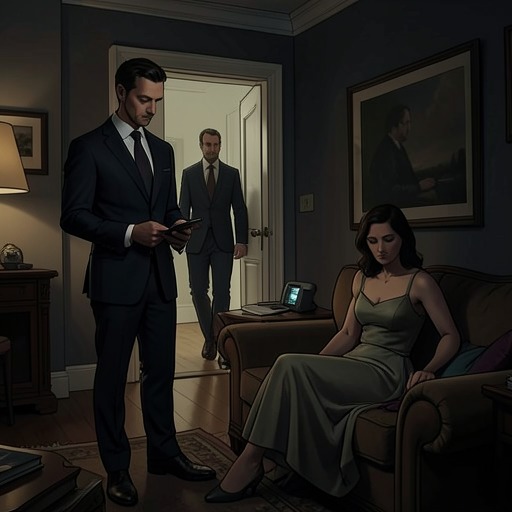
Later, Laura is in the bedroom at Nana's home. She sits on the edge of the bed in a sheer nightgown, combing her very long hair and smiling. When Henry asks her name, she says Laura; he tells her he will call her Katherine, and she agrees. He describes her as small and well proportioned, with reddish-brown hair and a face he finds especially beautiful. The nickname begins as Henry's playful response to the resemblance that caught his attention, but her acceptance allows the private encounter to continue on terms he has initiated.
Laura tells him that she does not drink and dislikes alcohol when he offers her a drink. Her refusal sets her apart from the drinking-centered social world Henry has just enacted at the reading. It also underscores the imbalance between their habits and expectations: she does not share his stated routine, yet she has accompanied him to the bedroom and remains there with him.
Intimacy and Henry's Response
Henry says that Laura frightens him because he cannot understand why she is with him and does not think she seems like a groupie. His response is not confidence but disbelief at his own good fortune. He wonders what his books of poems could have brought about and what right he has to this attention, then decides not to reject it. After he returns from the bathroom and turns out the light, Laura gets into bed beside him; they kiss and embrace. The scene marks a change from Henry's initial uncertainty to participation in an intimacy he had not expected.
The episode is narrated through Henry's astonishment at being chosen. He frames Laura's presence as almost inexplicable, connecting her interest to his poems while doubting that the poems could account for it. That emphasis makes the encounter significant less as the beginning of a clearly established romance than as a moment when his self-image as an isolated, unlikely object of desire is briefly contradicted. The account does not establish that Laura shares his interpretation or that the encounter creates a durable commitment.
Return to Lydia and Later Contact
The Houston encounter sits within Henry's unsettled relationship with Lydia Vance. On the return from another reading, Lydia meets him at the airport and immediately expresses sexual desire. They later argue, and Lydia tells him she is finished, plans to sell her house, and will move to Phoenix, where Glendoline lives. At his home Henry takes out his suitcase and says goodbye; Lydia drives away crying. The separation supplies the immediate context for his later claim to Katherine that he has no girlfriend, but it does not erase the instability that has characterized his connection with Lydia.
After checking the mail, Henry phones Katherine, who lives in Austin, Texas. She sounds genuinely pleased to hear from him, and he says he is glad to hear her Texas accent and laughter. He invites her to visit and offers to pay for her air travel both ways, proposing the racetrack and Malibu as possible outings, as well as whatever else she wants. Katherine asks whether he does not have a girlfriend. Henry says there is none and describes himself as a recluse; she points out that he is always writing about women in his poems. When she worries that Lydia might attack her, Henry assures her that Lydia has moved to Phoenix and calls Katherine the exceptional woman he has been looking for. Katherine says she will need to arrange care for her cat. Henry answers that everything is clear on his end.
This later call shows that the Houston meeting continues to matter to Henry, but it also exposes the gap between his declarations and the unsettled circumstances around them. He presents himself as unattached and ready to welcome Katherine, while the story has just shown a painful departure from Lydia and a history of volatile relations. Katherine's request for reassurance and the practical condition about her cat make the proposed visit a real possibility, not a completed outcome. The evidence ends with arrangements still to be made, leaving the connection open rather than confirming a renewed relationship or a shared future.