Horses
WomenHorses are a recurring presence in Henry Chinaski’s life, drawing him to harness meets and Hollywood Park as both a gambler and an observer. The track offers him a ritual of figures, programs, windows, and races, but also a volatile promise: winning can briefly turn a day into a windfall, while a favored horse can lose by a narrow margin. Through those reversals, the horses become the center of an improvised dream of wealth and a persistent setting for Chinaski’s drinking, solitude, and relationships.
The Track as Routine and Escape
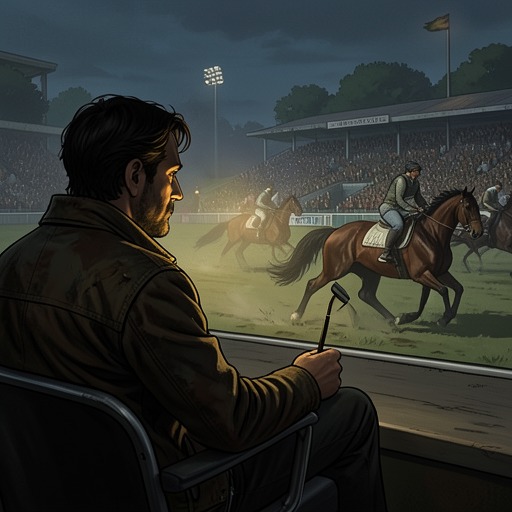
After a fight, Chinaski finds that he does not want to spend the evening alone drinking at home, so he takes a pint to a night harness meet. He arrives early, assembles his figures, and mixes liquor with hot coffee as the first race passes. The track is not simply a place to place bets: it gives his evening a sequence and a task, converting private restlessness into attention to the program and the results.
His visits also answer his dislike of crowded weekends. After several weeks have passed, he notes that Saturday brings people outdoors and makes Monday preferable because everyone is back at work and out of sight. He nevertheless chooses the racetrack to help kill the day, leaving home after a beer and a hard-boiled egg. Seeing Lydia Vance outside with Bugbutt, he waves goodbye and drives to Hollywood Park, where he has devised another system and imagines that each new one brings him closer to wealth. The confidence is part of the ritual: success is treated not as a possibility but as a matter of time.
Systems, Odds, and Reversals
At one harness meet, Chinaski wins three of the first four races, then wins an exacta and is nearly $200 ahead after the fifth. He goes to the bar and bets from the toteboard, pleased with what he calls a good toteboard. His gains matter in the presence of Lydia, who dislikes seeing him win when she is losing. By the end of the ninth race, he has continued both drinking and betting until he is $950 ahead and very drunk; he puts his wallet in a side pocket and walks slowly to his car. The sequence makes the attraction plain: the wagers can produce striking gains, but those gains arrive alongside escalating drinking rather than a stable change in his circumstances.
When Katherine visits, Chinaski takes her to Hollywood Park in a rental car paid for by his auto insurance. She initially says she does not want to bet, but he brings her inside and shows her the toteboard and betting windows. He favors a horse with early speed, wagering five dollars to win on a 7-to-2 shot. The horse leads from start to finish and pays $9.40, leaving Chinaski $17.50 ahead. The small gain is enough to affirm his chosen approach, which values a horse that can lead early even when defeat remains possible.
The next results complicate that confidence. In the second race, Chinaski’s 8-to-5 favorite finishes second after a longshot noses past him at the wire; the winner pays $45.80. Later, an even-money horse wins by six lengths and pays $4.00. Chinaski tells Katherine that he had put $100 on it, then claims another winner after the fourth race, saying he had ten dollars across. His talk makes the racecourse a stage for projecting command as well as a place to gamble: the audience sees a narrator who speaks as if he anticipated the result, even when the sequence has included a loss.
Companions and the Racetrack Dream
The track’s appeal is not confined to solitary betting. Chinaski takes Tammie to a harness meet, brings her a program with past-performance charts, and bets five dollars to win on the 7 horse. It comes in at five to one, putting him $25 ahead. When Tammie is not back for the next race, he decides not to bet and goes to look for her. By the eighth race he is $132 ahead and preparing to wager $50 on the final race when he sees her standing in a maintenance-room doorway with two men. The interrupted bet shows how the track’s numerical momentum can be checked by the demands of a companion and by events outside the racing form.
With Katherine, the betting talk expands into an account of what draws people to the course. Chinaski explains that the horses considered best generally go off at the shortest odds, but that even a horse priced below three to one wins only about a third of the time. The explanation sets calculation beside uncertainty: the odds rank the field without guaranteeing the outcome. He calls the shared attraction a dream, and Katherine later connects him with the racetrack and boxing crowds. Chinaski accepts that he belongs among them, while describing himself as drawn to drinking and disorder and wanting a quiet, hazy space in which to be left alone. The track thus gives him both a public identity among bettors and an escape from the kind of purposeful, respectable life Katherine associates with being wholesome.
Betting Knowledge and the Limits of Control
Chinaski’s language of systems persists even as individual outcomes resist it. At Santa Anita, he takes Tanya to a comfortable, isolated place to sit, though children have found it too and run about nearby. He explains the relation between odds and the presumed quality of a horse, then bets five dollars to win on a 6 horse he classifies as a quitter. He prefers early speed, especially in a horse that failed in its previous race, because bettors offer a better price than they would for a comparable closer. The horse wins by two and a half lengths and pays $10.20 for each two dollars, putting him $25.50 ahead. A concrete win rewards his interpretation of the form, but it does not establish that the system can reliably master chance.
The counterexample comes with Zag-Zig, a 6-to-5 shot that approaches the gate weakly, breaks poorly, and beats only one horse. Chinaski and Tanya return to the bar afterward. The contrast between a successful long-priced choice and a disappointing favorite leaves the track’s promise intact but unsettled: knowledge can shape the wager, not command the race.
Recurrence and Significance
Horses and tracks recur across Chinaski’s life alongside drinking, writing, relationships, and solitude. A later reflection on sentimental attachments includes racetracks among the places and experiences associated with shared life, placing them beside parks, picnics, cars, arguments, and the ordinary objects left behind by lovers. That recollection gives the racecourse a meaning beyond betting: it becomes part of the landscape of intimacy and its aftermath.
The horses themselves are usually encountered through the bettor’s perspective—odds, past performances, position, and payout—yet the race’s motion repeatedly exceeds that perspective. A favored runner can be beaten at the wire; a supposedly unreliable horse can win; a strong bet can yield money without resolving the larger uncertainty of Chinaski’s life. The track therefore sustains a recurring tension between calculation and chance, and between the dream of wealth and the immediate habits that accompany it.