Transformation and Second Form
WoodwalkersTransformation and Second Form is the defining ability of Woodwalkers, who can move between human and animal bodies. In Carag’s experience, it is at once an expression of identity, a difficult skill to master, and a practical means of survival. The change does not erase the demands of either form: it brings different perceptions and abilities, and its use is shaped by training, danger, and rules.
Two Forms and a Divided Identity
Carag’s changing body makes the idea of a single, settled identity difficult. While leaving his birth family, he looks at them with human eyes and struggles to explain why being only a puma is not enough for him. His mother remains in puma form rather than transforming to meet him in a human body; instead, she sends him a mental warning to stay safe. Carag embraces Mia, his father, and his mother before leaving, but his father does not return the embrace or look at him. The scene ties the choice of a human life to separation: Carag can carry his animal identity with him, but changing worlds does not resolve the distance between him and his family.
At the same time, animal form is not merely an idea or an ancestry. It changes what Carag can sense and do. One night, he changes into a puma in his bedroom, balances on the windowsill, and jumps from the second floor into the garden. In the moonless dark, his feline eyes pick out the starlight, while the call of wapiti alerts him to nearby prey. His body gives him access to a world of movement, scent, and hunting that his human form does not offer in the same way. The freedom of that night is exhilarating, but his first approach to hunting also exposes how much he still has to learn.
Learning Control
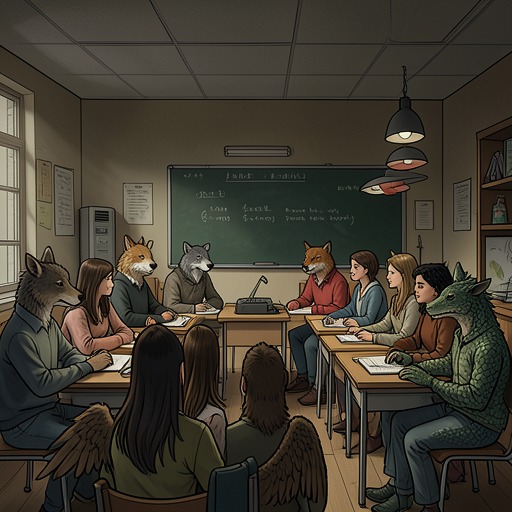
A second form must be controlled, not simply summoned. At Clearwater High, Carag’s early attempts reveal the gap between intention and execution: when Lou Ellwood’s father asks the class to transform only their hands, Carag is the sole student to grow a pair of furry ears instead. The mistake becomes especially consequential when Carag learns that midyear exams are approaching and that he must improve to advance with his class. Transformation is taught as a precise practice with standards, not an effortless ability.
Training with James Bridger makes control physical as well as mental. Carag first learns to regulate his breathing and, after three lessons, can perform the exercise. They then repeat it in his animal form. After five or six more lessons, he can control his heartbeat even when Bridger attacks him in coyote form, teeth bared. Bridger’s next assignment—changing back and forth ten times without stopping—shows that basic composure is only a beginning. The work tests endurance and the ability to repeat a change deliberately rather than rely on instinct.
Carag’s transformation also depends on focused visualization. During the midyear examination, with Lissa Clearwater waiting for him to act, he imagines himself as a puma and pictures his fur; he then feels his body change. The episode presents concentration as part of the technique: when pressure makes hesitation dangerous, forming a clear image of the desired body helps him cross between forms. Later, after being shot, Carag finds a juniper bush and again uses the word Timbuctù while imagining himself seated in class in human form. The change brings him back to a body with hands and a face, and the relief is immediate, although the wound remains painful. The return to human form is not a cure; it is a crucial change in his circumstances.
Rules, Knowledge, and Social Boundaries
At school, transformation is governed by a specific permission rule: students may change during school hours only with a teacher’s authorization. James Bridger reminds Carag of this rule after restraining him during a confrontation with Jeffrey and the other wolves. Bridger also warns that student fights are permitted only in the class devoted to fighting and survival. The rules place the ability within a shared institution, where an individual’s power can threaten other students and must be managed alongside conflict.
The school’s protections are tested when Jeffrey partly transforms to show his teeth at Nimble, a rabbit Woodwalker. Nimble invokes the rule that predators must not mistreat prey, but Jeffrey’s threat still sends him retreating. The episode makes clear that knowing the rules does not automatically make every student safe; the rules require enforcement, and transformation can magnify an existing imbalance between predator and prey. Questions about transformation also belong to the curriculum. During an exam, Carag answers that another Woodwalker should not be photographed with a flash, while the test asks about whether Woodwalkers can transform from birth and about itching during a change. The ability is both embodied experience and learned knowledge.
Secrecy extends beyond the school’s internal regulations. When Donald Ralston sees a bison inside Clearwater High, he challenges the school’s safety and asks what an animal is doing there. Lissa Clearwater explains that live animals are sometimes used for biology lessons. The exchange shows how the school presents animal forms to human visitors without revealing the Woodwalkers’ existence. Transformation therefore has a public risk as well as a personal and physical one: what is ordinary within the school community must remain concealed from outsiders.
The Second Form as Survival Skill
Outside the classroom, animal form can turn knowledge of the body into an advantage. While escaping a pack of hunting dogs, Carag uses the balance and agility of a puma to cross a fallen pine trunk over a deep, muddy ditch, then hides and watches the dogs struggle to follow. The lead dog and its companions slip into the mud, buying Carag time. The maneuver is neither a display of strength nor a simple change of shape; it depends on understanding how a feline body moves and choosing terrain suited to it.
Carag also applies what he has learned about tracks. He turns back over his own footprints, placing his hind paws where his forepaws had landed, then leaves the doubled trail by leaping onto a tree and from there onto a rock. The dogs are left with a misleading route that seems to end. Bridger’s advice that an escaping Woodwalker should lead dogs toward a river supplies another part of the strategy: Carag reaches the water and enters it so that the current can disrupt his scent trail. These acts show transformation as practical intelligence, where anatomy, memory, and deliberate misdirection work together.
The danger is sharpened by the hunting season for pumas, which Carag has learned runs from October through March; a license to kill one is easy to obtain. Far from the school’s protected territory, he realizes that a human change would leave him naked and barefoot in the snow, while remaining a puma leaves him exposed to hunters and dogs. The two forms do not offer a universally safe choice. Their value depends on the terrain, weather, pursuit, and what each body can endure.
Significance
Across Carag’s departure from his family, his schooling, examinations, and flight from hunters, transformation marks a series of thresholds. He leaves one community in human form, enters a school where his animal abilities must be disciplined, and later relies on those same abilities to survive beyond its safe territory. Each change is consequential because it alters what he can perceive and do, but none alone settles where he belongs.
The concept is therefore more demanding than a magical switch between species. Carag must learn to make the change accurately, regulate himself under pressure, respect the limits imposed by school rules, and adapt each form to immediate circumstances. His uneven early control and increasingly resourceful escape place transformation between vulnerability and agency: the body can expose him to danger, but knowledge of its capacities can also create a way through it.