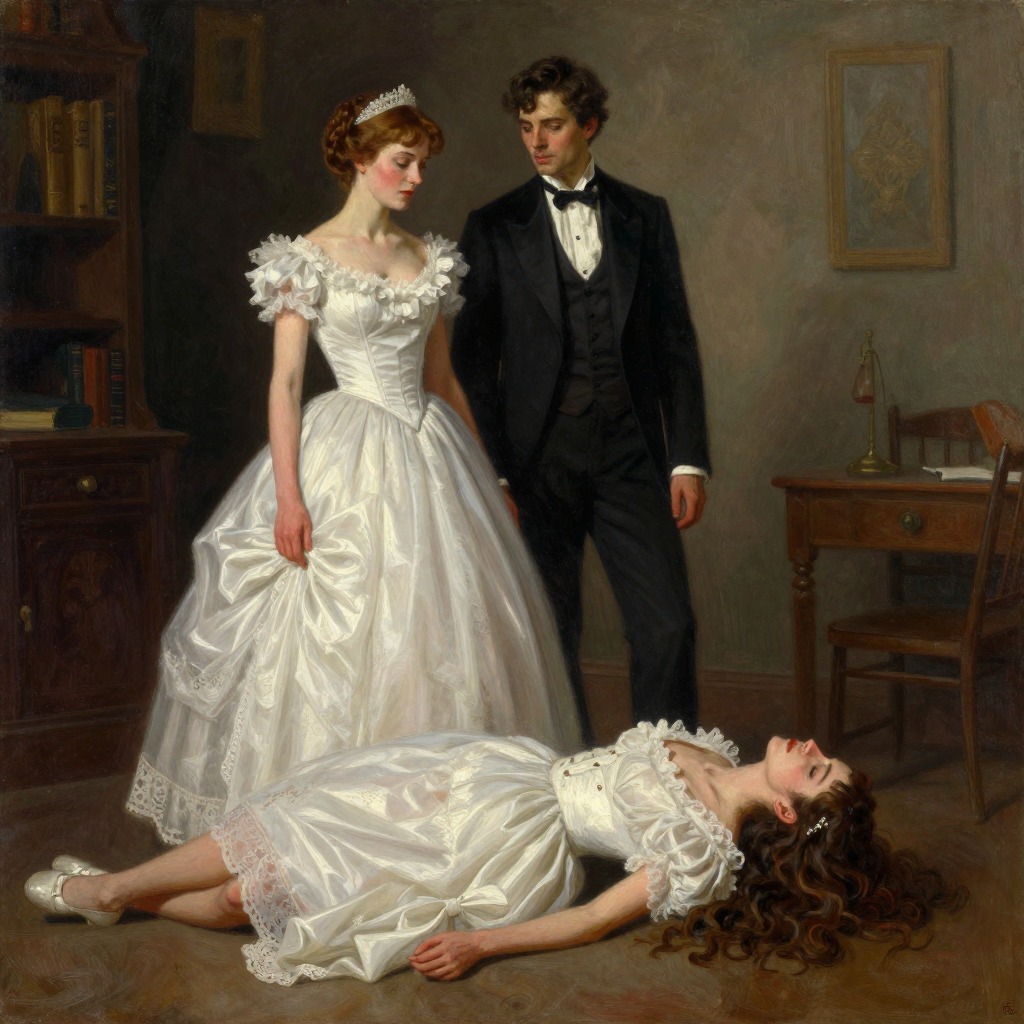
Jean Farlow
Jean Farlow is a minor but significant character in Vladimir Nabokov's Lolita, the young wife of John Farlow and a neighbor of the Humberts in Ramsdale. A painter and a neurotic, she becomes a confidante and helper to Humbert after Charlotte's death, and her brief, intense attraction to him underscores the novel's themes of misplaced desire and the deceptive surfaces of suburban life.
Identity and Introduction
Jean Farlow is introduced as the wife of John Farlow, a middle-aged, quiet, and quietly successful dealer in sporting goods who also works as a part-time lawyer. She is described as a "long-limbed girl in harlequin glasses" with "two boxer dogs, two pointed breasts and a big red mouth." She paints landscapes and portraits, and is characterized by her nervous energy and a certain neuroticism. She is thirty-one years old and, as Humbert notes, "absolutely neurotic." Her appearance is striking: she is handsome in a "carved-Indian sort of way, with a burnt sienna complexion," and her lips are like "large crimson polyps." When she laughs, she shows "large dull teeth and pale gums." She is tall, wears either slacks with sandals or billowing skirts with ballet slippers, drinks any strong liquor in any amount, has had two miscarriages, writes stories about animals, and paints lakescapes. She is already nursing the cancer that will kill her at thirty-three.
Role in the Ramsdale Community
Jean and John Farlow are the only couple with whom Charlotte Haze has relations of "real cordiality, devoid of any arrière-pensée or practical foresight." They attend Humbert and Charlotte's wedding. Jean is a frequent presence at the Humbert home, and she and Charlotte share a somewhat competitive friendship. Jean is also a source of local gossip and observation. She tells Charlotte and Humbert about seeing Leslie Tomson taking a dip in Hourglass Lake at five in the morning, and she later mentions seeing two children making love at the lake at sunset. She also comments on the eccentricities of Dr. Ivor Quilty, calling him "a freak." Her artistic eye is noted when she points out that Humbert was wearing his wristwatch while swimming in Hourglass Lake, a detail that could have been incriminating.
Response to Charlotte's Death
After Charlotte Humbert is killed in a car accident, Jean and John Farlow are the first to arrive on the scene and take charge. They put the widower to bed in Dolly's room and, to be near, retire to the Humberts' bedroom for the night. Humbert speculates, with characteristic cynicism, that they may not have spent the night as innocently as the solemnity of the occasion required. The next day, Jean and John are afraid Humbert might commit suicide if left alone, so they commission Leslie and Louise to keep him company. When Humbert fabricates a story about being unable to reach Lolita at Camp Q, Jean passionately supports John's offer to drive to the camp to find her. It is Jean who, looking at a photograph of a young Charlotte Becker that Humbert has produced, declares, "Humbert is Dolly's real father," a lie that simplifies matters for John and allows Humbert to maintain his custody of Lolita.
Attraction to Humbert and Departure
Jean Farlow develops a strong, unreciprocated liking for Humbert. He notes that she is "hopelessly unattractive to me." Just before Humbert leaves Ramsdale to retrieve Lolita from Camp Q, Jean, with her "always trembling fingers," takes him by the temples and, with tears in her bright blue eyes, attempts to kiss him. She says, "Take care of yourself," and adds, "Perhaps, somewhere, some day, at a less miserable time, we may see each other again." Humbert, in a parenthetical aside, addresses her directly: "Jean, whatever, wherever you are, in minus time-space or plus soul-time, forgive me all this, parenthesis included." This moment, occurring just after Charlotte's death and on the cusp of Humbert's new life with Lolita, highlights the pervasive, misplaced desires that surround him and the way his own obsession renders him oblivious to the affections of others. Jean Farlow, with her artistic pretensions, her neuroticism, and her doomed vitality, remains a poignant figure, a brief, bright presence in the grim landscape of Humbert's narrative.