Miss Opposite
Miss Opposite is the nameless, invalid neighbor who lives in the ivied brick house directly across from 342 Lawn Street in Ramsdale. She never speaks a word in the narrative, yet her fixed position on her screened porch and her sloping lawn become the stage for the novel's most decisive act of chance. She functions as a silent, almost choric witness whose property and person mark the boundary where Humbert Humbert's carefully laid plans collide with blind, annihilating coincidence.
Identity and Fixed Position
Miss Opposite is defined entirely by her location and her immobility. She is an old invalid, permanently confined to her vined verandah, where she is regularly attended by a nurse who comes every afternoon to give her a massage. Her house, with its high-sloping lawn much trimmer than the Haze's, stands opposite the Haze residence at the corner of the avenue, and her property includes a mailbox at the edge of her lawn. The narrative never supplies her real name; she is known only by her spatial relation to the Haze household, a designation that reduces her to a function of the street's geography. She is cared for by a gardener and chauffeur named Leslie Tomson, a very amiable and athletic Negro, and by a nurse who trips down the narrow sidewalk in white stockings and shoes. Her world is the porch, the lawn, and the window from which she observes the street.
The Witness to Charlotte's Death
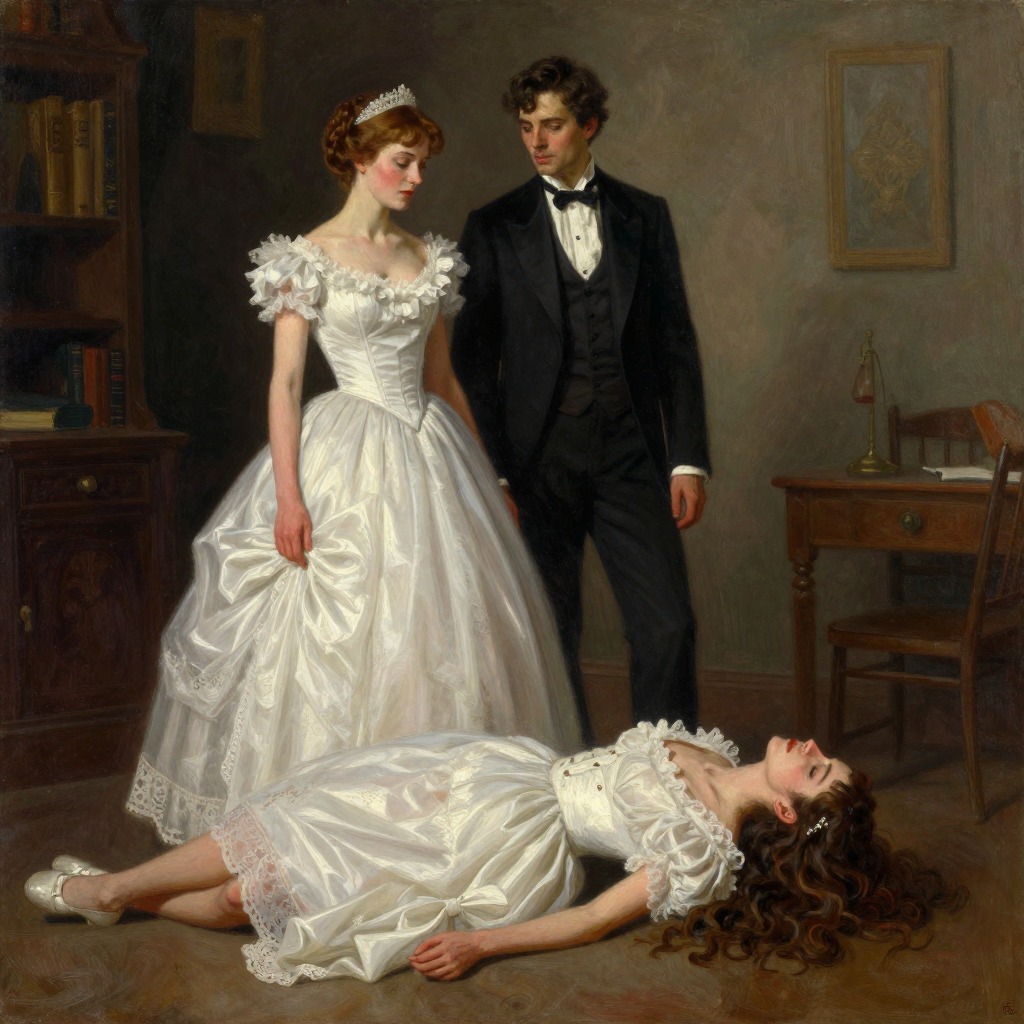
Miss Opposite's property is the site of Charlotte Haze's death. On the day of the accident, Charlotte hurries across the steep little street to drop three letters in the mailbox at the corner of Miss Opposite's lawn. A big black glossy Packard, driven by Frederick Beale, Jr., has climbed Miss Opposite's sloping lawn at an angle from the sidewalk, its front wheels deep in evergreen shrubbery. The old gentleman with a white mustache, well-dressed in a double-breasted gray suit and polka-dotted bow-tie, lies supine on the trim turn of the lawn-slope, recovering from a mild heart attack. The laprobe on the sidewalk conceals the mangled remains of Charlotte Humbert, who has been knocked down and dragged several feet by the Beale car. Miss Opposite herself is propped up, imprisoned, and decrepit on her screened porch, screeching but not loud enough to drown the rhythmical yaps of the junk dealer's dog. She signs the accident diagram as a witness, alongside Leslie Tomson and others, her name affixed to the official record of the event that frees Humbert to pursue Lolita.
The Rhythmic Wave and the Return
On the morning Lolita is driven away to Camp Q, Miss Opposite performs a curious, almost ritualistic gesture. As Humbert watches from his window, Lolita runs back into the house to kiss him goodbye, then clatters downstairs and is driven off by Charlotte. Unnoticed by them or by Louise, old Miss Opposite, an invalid, feebly but rhythmically waves from her vined verandah. This wave, directed at no one in particular, seems to mark the departure as a scene observed by a force beyond the characters' awareness. Years later, when Humbert returns to Ramsdale to kill Clare Quilty, he finds the house across the street changed. The white shutters of the Junk mansion are closed, and a black velvet hair ribbon has been attached to the white FOR SALE sign. But Miss Opposite is quietly resurrected: she is being wheeled out by her twin nieces onto her porch, as if it were a stage and Humbert the star performer. He prays she will not call to him, and hurries to his car, the sight of her a reminder that the street's silent witness has outlasted the drama.
Narrative Significance
Miss Opposite embodies the novel's theme of passive observation and the arbitrariness of fate. She is the neighbor who sees everything but can act on nothing, confined to her porch as Humbert is confined to his obsessions. Her property becomes the accidental stage for Charlotte's death, the event that removes the final obstacle to Humbert's possession of Lolita. Her rhythmic wave, directed at the departing car, suggests a benediction or a curse that the characters cannot interpret. She is a figure of the ordinary world that surrounds Humbert's extraordinary crimes, a world that goes on waving, watching, and signing documents long after the central actors have left the stage. Her persistence into the final chapters, when Humbert returns to find her still on her porch, underscores the futility of his quest for closure: the witness remains, but she has nothing to say.