Gustave Trapp
Gustave Trapp is a minor but recurring figure in Humbert Humbert's narrative, a Swiss relative of Humbert's father who appears in memory and hallucination, and whose name and appearance Humbert later projects onto the mysterious pursuer he believes is following him and Lolita across America. Trapp serves as a psychological touchstone for Humbert's paranoia, guilt, and self-deception, blurring the line between real memory and delusional obsession.
Identity and Background
Gustave Trapp is introduced as a cousin of Humbert's father, living in Switzerland. Humbert recalls him as a "harmless old rascal" with a "cheery and rather repulsive" demeanor, known for his "dumbbells and stinking tricot, and fat hairy arms, and bald patch, and pig-faced servant-concubine." Trapp is associated with weight-lifting, a habit Humbert remembers him performing on a lake beach, "tottering and grunting" while wearing a bathing suit with one shoulder strap jauntily stripped down. This image of Trapp—coarse, physically vigorous, and faintly absurd—lodges in Humbert's memory and later becomes a template for the face of the man he believes is stalking him.
Role in Humbert's Psyche
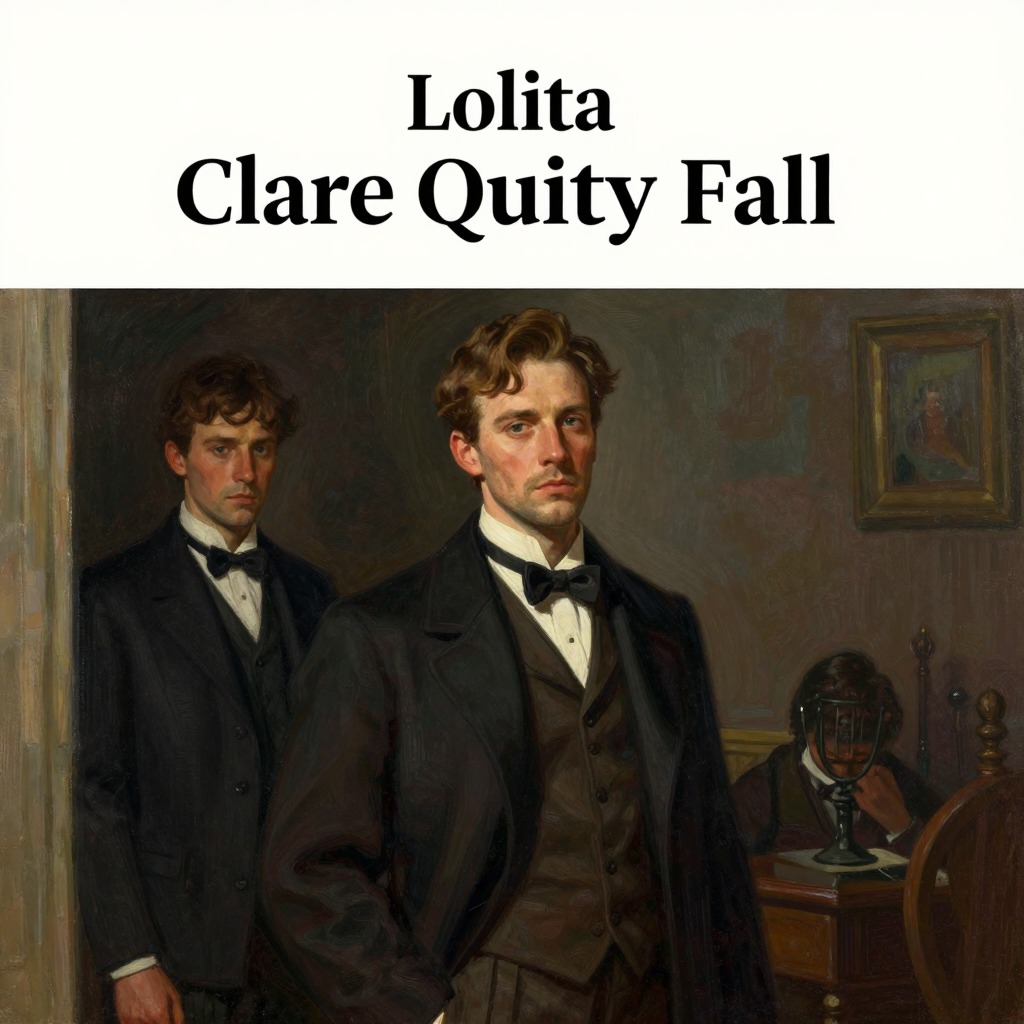
Trapp surfaces in Humbert's consciousness at moments of extreme stress and dissociation. During the cross-country journey with Lolita, when Humbert first clearly sees the driver of the Aztec Red Convertible that has been following them, he notes that the man "somewhat resembled Gustave Trapp, a cousin of my father's in Switzerland—same smoothly tanned face, fuller than mine, with a small dark mustache and a rosebud degenerate mouth." Humbert explicitly tells Lolita, "He looks exactly like a relative of mine called Trapp," and later, when the pursuer vanishes and reappears in different cars, Humbert refers to him as "Detective Paramour Trapp" or simply "Trapp," conflating the real relative with the imagined persecutor.
This conflation deepens as Humbert's mental state deteriorates. At the Champion hotel, when Humbert sees a man watching Lolita by the swimming pool, he initially describes him as a satyr, then immediately performs "a marvelous transformation" in his mind: "He was no longer the satyr but a very good-natured and foolish Swiss cousin, the Gustave Trapp I have mentioned more than once." The real Trapp's habits—drinking beer with milk, weight-lifting—are recalled in the same breath as the imagined pursuer's lechery, showing how Humbert's memory of a harmless relative becomes a psychological crutch to rationalize or domesticate the threat he perceives.
The Name as a Clue
In the elaborate pseudonym game that Humbert later deciphers from motel registers, the name "G. Trapp, Geneva, NY" appears as one of the entries left by Clare Quilty. Humbert interprets this as "the sign of treachery on Lolita's part," a mocking reference to his own paranoid fixation. The name Trapp thus becomes a double-edged clue: it points to Humbert's real relative, but also to the fictional pursuer Humbert has constructed, and Quilty uses it to taunt Humbert's obsession. By the time Humbert confronts Quilty, he admits that "in the state of mind I now found myself, I had lost contact with Trapp's image. It had become completely engulfed by the face of Clare Quilty." The real Trapp has been fully absorbed into the delusional system.
Thematic Significance
Gustave Trapp exemplifies Humbert's tendency to project his own guilt and fear onto external figures. The harmless Swiss relative, remembered for his vulgar physicality, becomes the face of the persecutor Humbert both dreads and needs to believe in. Trapp's name and image serve as a kind of psychic shorthand, allowing Humbert to transform an amorphous threat into a recognizable, almost familiar shape. In the end, Trapp is not a character with any independent agency in the story; he exists only as a fragment of Humbert's memory, distorted and repurposed by a mind unraveling under the weight of its own crimes.