Allamah Syed al-Fadl
Allamah Syed al-Fadl is a prominent Islamic scholar and one of the three religious leaders who privately met with Edmond Kirsch at the Abbey of Montserrat to preview his world-changing scientific discovery. His brutal murder, staged as a suicide in the desert outside Dubai, marks him as an early casualty in the escalating conspiracy to silence Kirsch's revelation, and his death becomes a key piece of evidence in the night's unfolding mystery.
Identity and Background
Allamah Syed al-Fadl is introduced as a revered Islamic scholar from Sharjah, the ultraconservative Islamic cultural capital of the United Arab Emirates. He is described as short and squat with a jovial face that seems a mismatch with his dark, penetrating eyes, and he is dressed in an unassuming white thawb. He is a respected allamah, a high-ranking title in Islamic scholarship, and his family, upon his disappearance, gathers to hold a vigil, praying for his return. The local press notes that a colleague reported al-Fadl seemed "strangely agitated" upon his return from the Parliament of the World's Religions, and that he had been overheard in a rare, heated phone argument in English, repeatedly mentioning the name "Edmond Kirsch."
The Montserrat Meeting and Its Aftermath
Al-Fadl is one of the three clerics—alongside Bishop Antonio Valdespino and Rabbi Yehuda Köves—who meet with Kirsch in the secret library of the Abbey of Montserrat. During the meeting, Kirsch presents his discovery, which al-Fadl later describes as challenging "the very core—the fundamental root of everything we believe." In a subsequent phone conversation with Valdespino and Köves, al-Fadl argues forcefully that they cannot sit idly by. He insists they must be proactive, announcing Kirsch's discovery themselves to "cast it in the proper light" and soften its impact on believers. When Valdespino suggests praying that Kirsch will reconsider, al-Fadl scoffs, saying, "Unless you're praying that God strikes Kirsch dead before he can announce—" before Köves intervenes to calm the tension. The three agree to speak again in two days, but that call never happens.
Death and Discovery
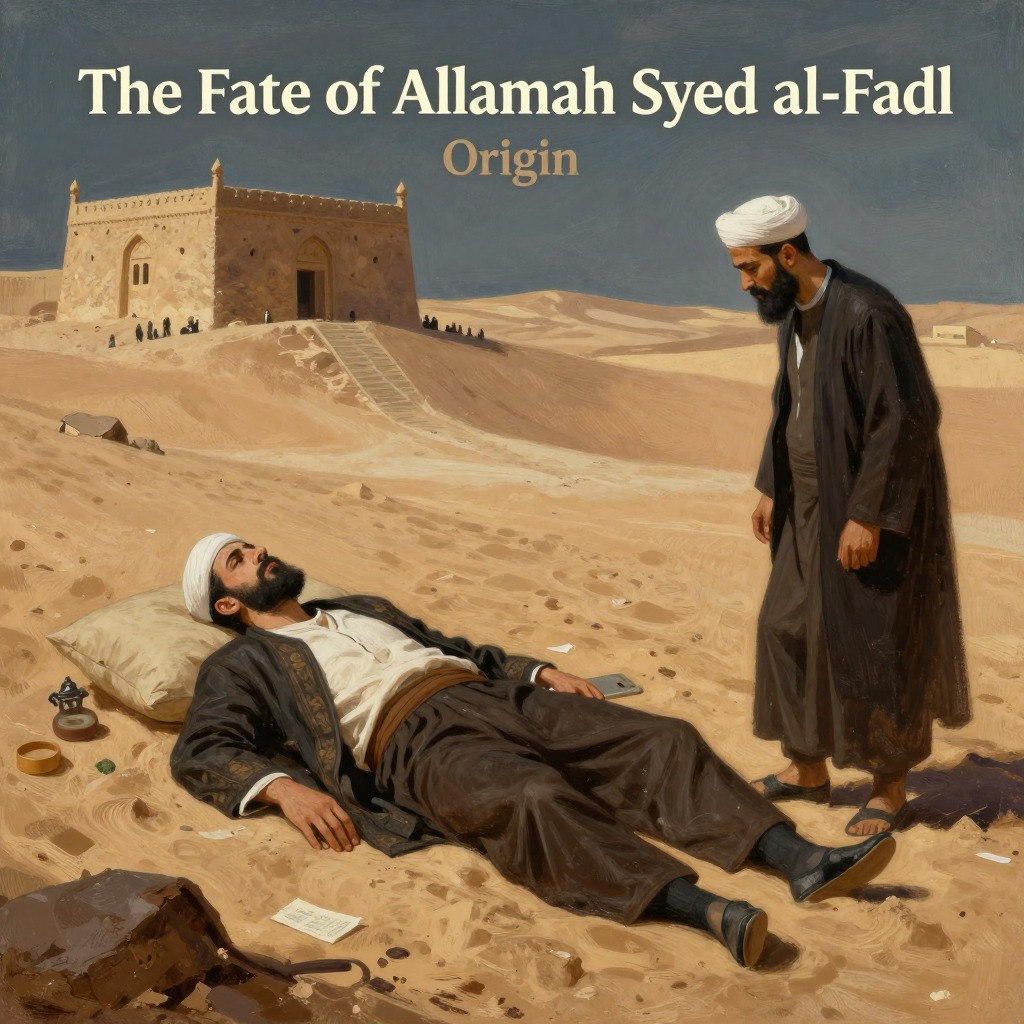
Al-Fadl is found dead in the moonlit desert east of Dubai, his body discovered by a teenager driving a dune buggy. The boy finds him sprawled facedown on the sand, his body already desiccated by the wind and sun. The allamah's skin is blistered and burned, his throat raw, and he has been blinded by sand-laden winds. His captor, a tall Spaniard who carjacked him the previous night, drove him deep into the desert, left him with no food or water, and provided no explanation for his actions. The only clue al-Fadl glimpsed was a strange marking on the man's right palm—a symbol he did not recognize. As the severely dehydrated cleric collapses and his heart gives out, his final thought is a chilling question: "Who could possibly want me dead?" He can come up with only one logical answer. The authorities initially speculate suicide, but Bishop Valdespino later admits to Rabbi Köves that he finds it "quite difficult to accept that this was a suicide," suggesting that al-Fadl may have been murdered by someone who wanted Kirsch's discovery to remain a secret.
Narrative Role and Significance
Al-Fadl's death serves as a critical accelerant in the novel's plot, transforming the theoretical threat to Kirsch's discovery into a tangible, violent reality. His murder, along with the subsequent killing of Rabbi Köves, establishes a pattern of elimination targeting everyone who knew Kirsch's secret, leaving Bishop Valdespino as the sole surviving witness. The allamah's fate also deepens the mystery surrounding the conspiracy, introducing the symbol on his captor's palm—later revealed to be the Francoist "Victor" tattoo—as a key clue linking the assassin to a broader, ultraconservative network. His death is a stark demonstration that the forces opposing Kirsch are willing to kill to keep his discovery buried.