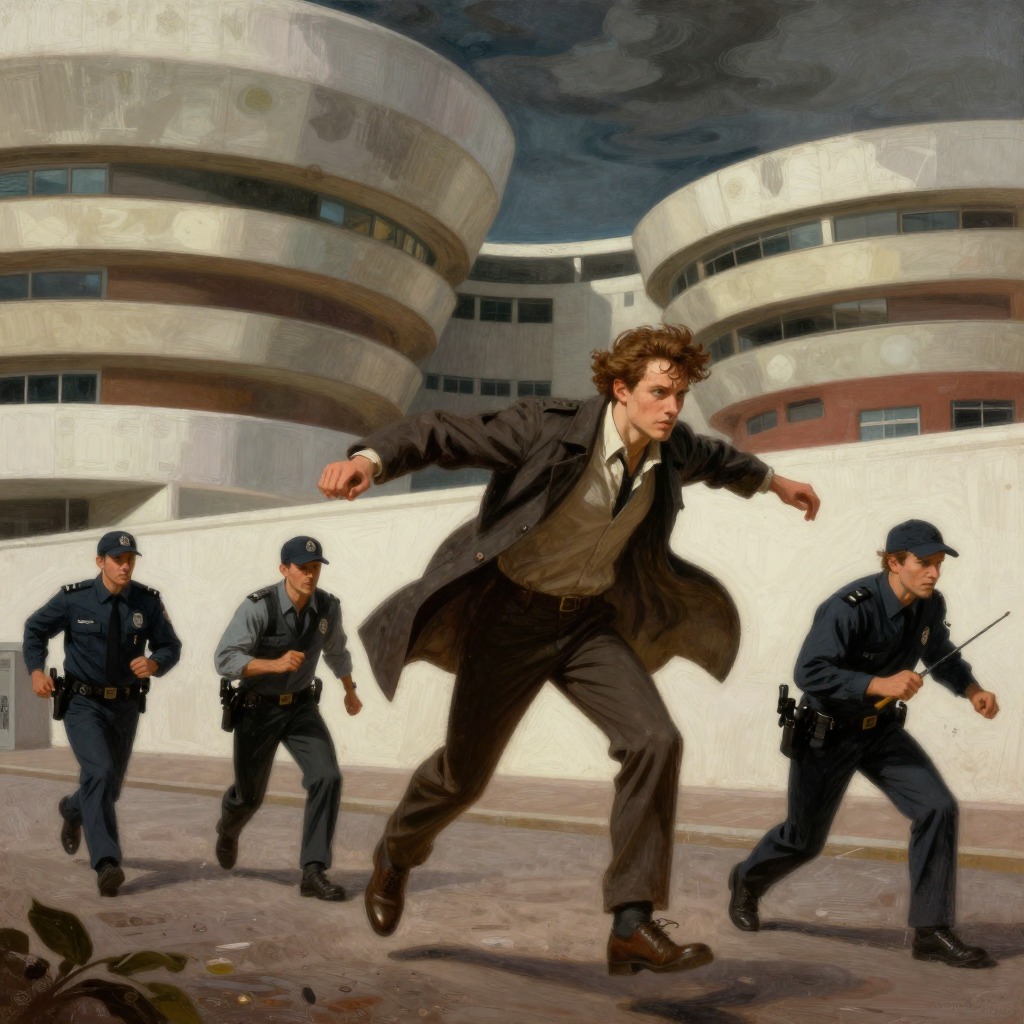
Captain Josh Siegel
Captain Josh Siegel is Edmond Kirsch's personal pilot, a man whose professional composure is shattered by the live assassination of his boss and who is then drawn into an audacious, technically illegal rescue operation orchestrated by Kirsch's synthetic intelligence, Winston.
Identity and Role
Siegel has piloted private jets for Edmond Kirsch for many years. He and his copilot were sitting in the airport lounge at Bilbao Airport watching the live feed from the Guggenheim Museum when the evening went horribly wrong. Siegel found the broadcast gripping, leaning forward with curiosity as Kirsch's presentation built toward its climax, until in a flash the evening turned into a nightmare. In the aftermath, Siegel and his copilot sat in a daze, watching the television coverage and wondering what they should do next.
The Unusual Orders from Winston
Ten minutes after the assassination, Siegel's phone rang. The caller was Edmond's personal assistant, Winston, a British-sounding man Siegel had never met but with whom he had become quite accustomed to coordinating flights. Winston's tone was eerily businesslike considering what had just transpired. He ordered Siegel to return the plane to Barcelona, prepare for takeoff, and wait for further instructions. Siegel was thankful for any kind of guidance. On Winston's orders, Siegel and his copilot filed a flight manifest to Barcelona with zero passengers—a "deadhead" flight—and pushed back out of the hangar. Thirty minutes later, Winston called back and gave a baffling command: taxi out to the far end of the airfield but do not pull onto the runway. Siegel found the request nonsensical and knew the tower would have something to say about it, but he complied, guiding the jet to the end of the access road. When the tower cleared him for takeoff, Siegel lied, claiming a warning light needed checking, and held his position.
The Rescue at the Fence
While waiting, Siegel saw two spectral silhouettes materializing out of the blackness on the other side of the high chain-link security fence: Ambra Vidal and Robert Langdon. Winston's voice returned, explaining that the same people who murdered Kirsch were now trying to kill them and that Siegel's assistance was required. When Siegel protested that a ten-foot-high security fence surrounded the airport, Winston calmly outlined a plan that Siegel initially declared impossible. Winston argued that the jet's nose cone was designed to endure seven-hundred-mile-per-hour forces and that the physics of the maneuver were feasible. Siegel worried about the legality and about having his pilot's license revoked, but Winston countered that the future queen consort of Spain was in grave danger and that Siegel would be receiving a royal medal, not a reprimand. Reluctantly, Siegel guided the jet forward, and the massive nose cone connected with a heavy steel fence post. With a metallic groan, the post tipped over, pulling a huge mound of asphalt with it. Langdon and Vidal scrambled across the fallen fence and boarded the jet. As they hurried up the staircase, the copilot calmly lied to the tower, claiming their ground radar must be miscalibrated and that they were still squarely on the access ramp. The jet then engaged reverse thrust, inched backward, and began its wide turn onto the runway. Seconds later, the plane was shooting skyward and banking hard to the southeast, plunging through the night toward Barcelona.
Aftermath and Significance
Siegel's actions were a direct result of Winston's manipulation, placing him in a position of extreme professional risk. He was a loyal employee who, in the chaos following his boss's murder, chose to trust an unseen voice on the phone and execute a plan that could have ended his career. His role was instrumental in the escape of Langdon and Vidal, enabling them to continue their quest to find Kirsch's password and release his discovery to the world. Siegel's story highlights the extraordinary reach and persuasive power of Winston, who could command human actions from a distance with chilling efficiency.