Auvergne
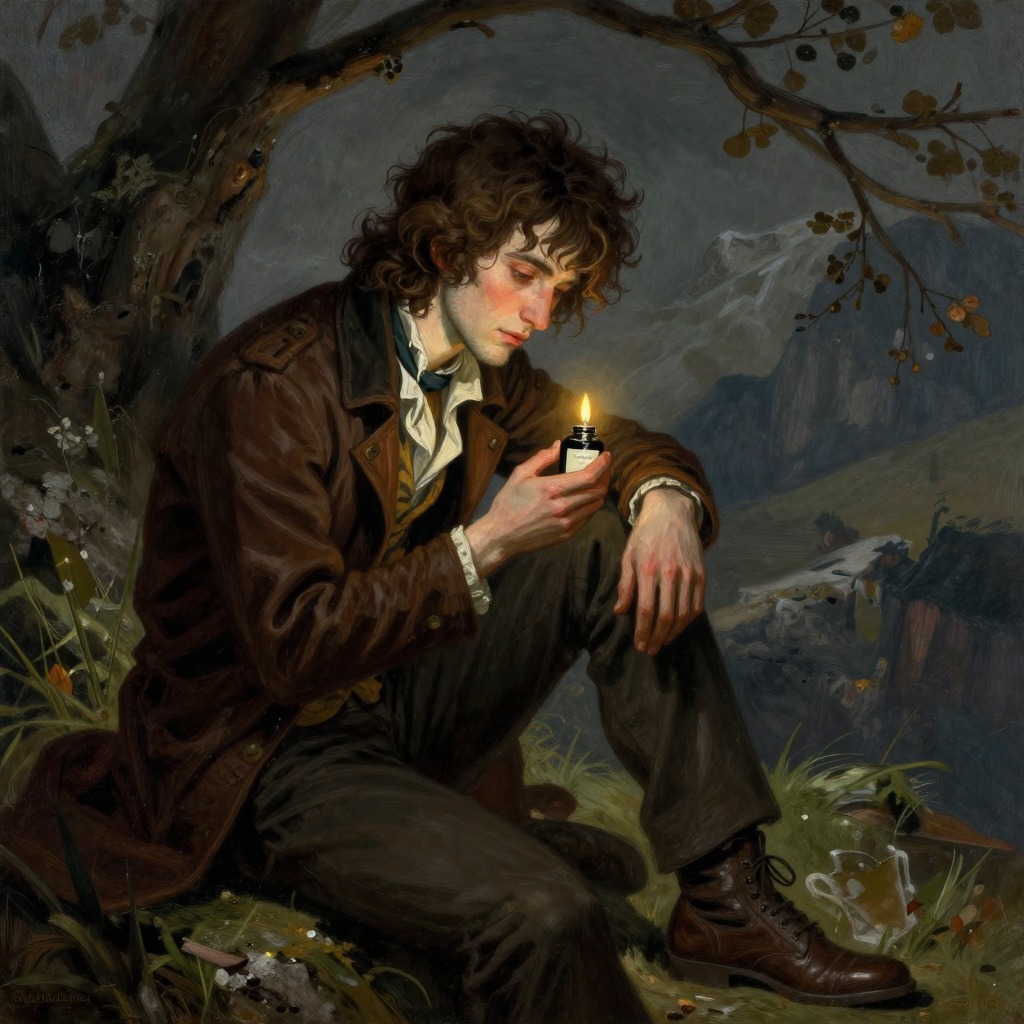
Auvergne, a rugged and sparsely populated province in the Massif Central of France, serves as the setting for the most radical withdrawal in Jean-Baptiste Grenouille's life. It is here, on the peak of the six-thousand-foot volcano Plomb du Cantal, that Grenouille finds the point of the kingdom most distant from humankind, a god-forsaken wilderness of blue-grey rock, grey moss, and brown boulders where even the bandit Lebrun preferred capture and execution over a solitary living death. For seven years, from August 1756 onward, this mountain becomes his entire world, a place where he can escape the abhorrent taint of human beings and live encapsulated within himself like the tick he has always resembled.
Geography and Isolation
The Auvergne that Grenouille penetrates is a landscape of extreme desolation. The Plomb du Cantal is a giant cone of blue-grey rock surrounded by an endless, barren highland studded with a few trees charred by fire and overgrown with grey moss and grey brush, out of which brown boulders jut up like rotten teeth. Even by day the region is so dismal that the poorest shepherd would not drive his animals here; by moonlight it seems not of this world. For miles around the mountain, no human being lives, nor any respectable mammal — only a few bats, beetles, and adders. No one had scaled the peak for decades before Grenouille arrived. When he reaches the summit one August night in 1756, he turns full circle and lets his nose move across the vast panorama: to the east, the broad high plain of Saint-Flour and the marshes of the Riou River; to the north, the pitted limestone mountains from which he has come; to the west, the soft wind of morning bringing nothing but the smells of stone and tough grass; to the south, the foothills stretching for miles to the dark gorges of the Truyère. Everywhere, humanity lies equally remote, and his compass of scent spins about, no longer providing orientation. He is at his goal, and at the same time taken captive.
Life in the Cave
Grenouille settles into a natural tunnel leading back into the mountain by many twists and turns, ending after a hundred feet in a rock slide. The back of the tunnel is so narrow that his shoulders touch the rock and so low that he can walk only hunched down, but he can sit and, curled up, lie down. He smells at once that no living creature has ever entered the place, and as he takes possession he is overcome by a sense of sacred awe. He spreads his horse-blanket on the ground as if dressing an altar. He is lying a hundred and fifty feet below the earth, inside the loneliest mountain in France, as if in his own grave, and never in his life has he felt so secure — certainly not in his mother's belly. He begins to cry softly, not knowing whom to thank for such good fortune. He survives on water he licks from a crevasse, small salamanders and ring snakes, dry lichen, grass, and mossberries. During the first weeks he climbs back to the peak a few times to sniff the horizon, but soon gives up these excursions, concerned only with getting back into his crypt as quickly as possible once he has taken care of the most basic chores necessary for simple survival. For well over twenty hours a day in total darkness and total silence and total immobility, he sits on his horse blanket at the end of the stony corridor and enjoys himself.
The Inner Empire
Inside the cave, Grenouille does not do penance or wait for divine inspiration. He has withdrawn solely for his own personal pleasure, only to be nearer to himself. No longer distracted by anything external, he basks in his own existence and finds it splendid. He lies in his stony crypt like his own corpse, hardly breathing, his heart hardly beating, yet lives as intensively and dissolutely as ever a rake had lived in the world outside. The setting for these debaucheries is the innermost empire where he has buried the husks of every odour encountered since birth. He conjures up the earliest and most remote: the hostile, steaming vapours of Madame Gaillard's bedroom, the bone-dry leathery bouquet of her hands, the vinegary breath of Father Terrier, the hysterical maternal sweat of the wet nurse Jeanne Bussie, the carrion stench of the Cimetière des Innocents, the homicidal odour of his mother. He wallows in disgust and loathing, his hair standing on end at the delicious horror. Then, with orgasmic force, he erupts like a thunderstorm across these odours that have dared offend his patrician nose, thrashing them like hail thrashes a grain field, scattering the rabble and drowning them in a grand purifying deluge. He becomes Grenouille the Great, the frantic gardener, sowing fragrance of all kinds across the fallow fields of his soul, commanding a shower of rectified spirit to fall so that the seeds germinate and sprout, and causing the wind of his breath to blow across the land so that the blossoms spill over with scent in universal homage to him. He builds a purple castle with a thousand private rooms and a thousand underground chambers, where the best scents of his life are stored in casks and drawn off into bottles arranged by vintage and estate. He drinks the odour of hope — the fresh odour of the first daybreak he had ever known in freedom, from the end of his first night roaming about Paris without Grimal's permission — and the scent of the red-haired girl from the Rue des Marais, growing sadder and sadder as he drinks, until he topples sideways into a numbed sleep.
The Crisis and Departure
After seven years, catastrophe strikes — not an earthquake or forest fire, but an internal one. In a dream, Grenouille lies on his sofa in the purple salon and finds himself standing in the middle of a moor from which fog is rising. The fog is his own body odour, and the awful thing is that although he knows this odour is his, he cannot smell it. Virtually drowning in himself, he cannot for the life of him smell himself. He gives a scream as dreadful as if he were being burned alive, and the scream smashes through the walls of the purple castle, hurtles across the nocturnal landscape of his soul, howls out of his mouth, down the winding tunnel, out into the world, and far across the high plains of Saint-Flour — as if the mountain itself is screaming. He awakens at his own scream, deathly afraid, his whole body shaking with the raw fear of death. He knows one thing for sure: he will change his life, if only because he does not want to dream such a frightening dream a second time. He creeps out into the open on a late February morning, squats before his cave, and begins to test himself. He sniffs his fingers, his palm, the crook of his elbow, his armpits, his feet, his genitals — and can smell nothing. He strips off his rags, saturated with seven years of his own odour, and climbs to the peak to air himself, holding his nose closed and then lowering it to the pile of clothes. There are a thousand other odours — stone, sand, moss, resin, raven's blood, even the sausage he had bought years before near Sully — but not his own. He goes back into the tunnel, squats at the end where he has lain for seven years, and smells. The spot smells exactly as it had seven years before: stony and moist, salty, cool, and so pure that no living creature could ever have entered the place. He nods gently, turns around, and that same night leaves the Plomb du Cantal, heading south. The Auvergne has given him his greatest solitude and his most devastating knowledge: that he, who can smell other people miles away, is himself odourless.
Narrative Significance
Auvergne functions as the geographical and psychological antipode to the human world that Grenouille both despises and needs. It is the place where his tick-like strategy of hibernation reaches its logical extreme — a complete retreat from human contact that allows him to cultivate his inner olfactory empire to its fullest, most megalomaniacal extent. Yet it is also the place where the fundamental flaw in his being is exposed: his own odourlessness, which he cannot smell and which therefore cannot be incorporated into his self-constructed identity. The seven years in Auvergne are both the apotheosis of his solitary genius and the prelude to his final, desperate attempt to acquire what he lacks. When he later returns to the Auvergne during his final journey to Paris, he sees the Plomb du Cantal lying huge and silver grey in the moonlight and smells the cool wind that comes from it, but feels no urge to visit it. He has experienced that life once and it has proved unliveable, just as life among human beings has proved unliveable. The Auvergne remains the purest expression of his impossible desire: to exist entirely without others, and entirely without himself.