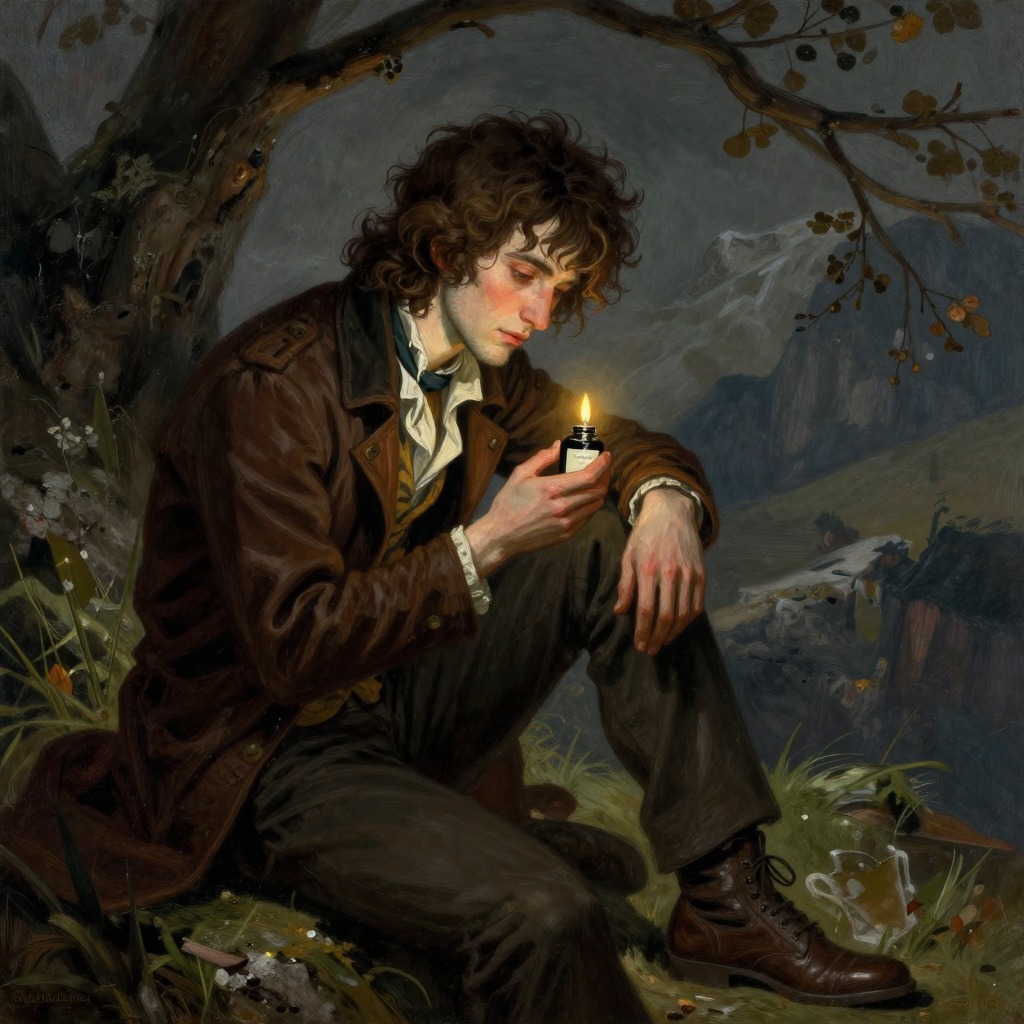
Massif Central
The Massif Central, a vast and desolate highland in south-central France, becomes the stage for Jean-Baptiste Grenouille's most radical withdrawal from humanity. After years of suffocating in the stench of eighteenth-century France—where the streets stank of manure, the courtyards of urine, and the very air was a foul gruel of decomposition—Grenouille finds in this remote region a deliverance from the olfactory assault of human civilization. The region's defining feature, the six-thousand-foot-high volcano Plomb du Cantal, represents the kingdom's point most distant from humankind, a god-forsaken wilderness of blue-grey rock, grey moss, and brown boulders that even the most desperate bandits avoided.
Retreat and Inner Empire
Grenouille reaches the Plomb du Cantal in August 1756, and upon its peak, he experiences a euphoric liberation: for the first time, he smells no trace of human odour. He discovers a natural tunnel leading deep into the mountain, a pitch-black, deathly quiet crypt where no living creature has ever entered. Here, a hundred and fifty feet below the earth, he lives for seven years, encapsulated like a tick in perpetual hibernation. In this stony dungeon, he constructs an elaborate inner universe, an "Empire of Grenouille" where he is the sole creator and ruler. He conjures up the odours of his past—the hostile vapours of Madame Gaillard's bedroom, the carrion stench of the Cimetière des Innocents—only to annihilate them in orgasmic fits of rage. He then sows new fragrances across the fallow fields of his soul, creating a vast, fragrant landscape that culminates in a purple castle where he drinks from bottled scents of hope and memory, most reverently the scent of the red-haired girl from the Rue des Marais.
The Catastrophe of Self-Knowledge
This idyllic inner life is shattered by an internal catastrophe. In a dream, Grenouille finds himself drowning in a fog that he recognizes as his own body odour, yet he cannot smell it. The horror of this odorlessness—the terrifying knowledge that he, who can smell everything, has no scent of his own—drives him from his mountain. He emerges from the cave after seven years, a ragged, animalistic figure, and conducts a desperate experiment: he airs himself on the peak, then sniffs his own clothes, but finds no trace of his personal odour. The Massif Central, which had been his sanctuary, becomes the site of his most profound existential crisis, forcing him to re-enter the human world not in search of solitude, but in pursuit of the scent he lacks.
Narrative and Thematic Significance
The Massif Central functions as a chronotope of radical solitude and self-confrontation. It is the physical space where Grenouille's tick-like survival strategy reaches its logical extreme: complete withdrawal from the world. Yet it is also the place where his inner empire, built on the mastery of scent, reveals its fatal flaw. The mountain's pure, human-free air, which initially felt like a deliverance, ultimately becomes the medium of his terror. His retreat to the Massif Central is not a spiritual pilgrimage but a narcissistic fantasy of omnipotence, and its failure marks the beginning of his final, desperate phase: the quest to manufacture a human odour that will allow him to dominate the world he despises. The region thus embodies the novel's central paradox: the pursuit of absolute solitude leads not to peace, but to a confrontation with the void at the core of the self.