Plomb du Cantal
The Plomb du Cantal is the remote, six-thousand-foot volcanic peak in the Massif Central of the Auvergne where Jean-Baptiste Grenouille retreats for seven years of self-imposed solitude, the most extreme point of his flight from humanity and the site of his most intense inner life. It is the place where he achieves total olfactory peace, builds an elaborate inner empire of scent, and confronts the terrifying discovery that he himself has no odour—a revelation that drives him back into the world.
Location and Setting
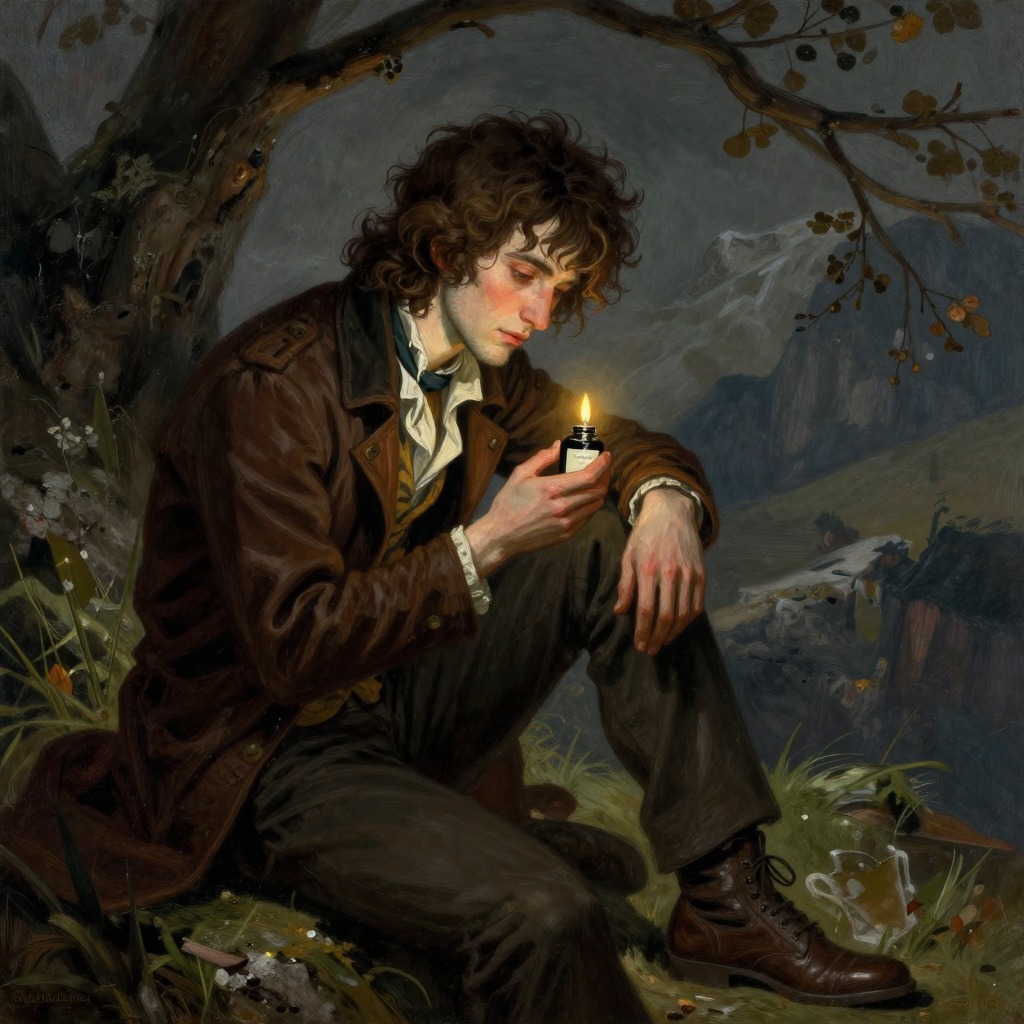
The Plomb du Cantal rises as a giant cone of blue-grey rock, surrounded by an endless, barren highland studded with a few trees charred by fire and overgrown with grey moss and grey brush, out of which brown boulders jut up like rotten teeth. Even by daylight the region is so dismal and dreary that the poorest shepherd would not drive his animals there; by moonlight it appears a god-forsaken wilderness not of this world. For miles around the mountain, not a single human being lives, nor even a respectable mammal—only a few bats, beetles, and adders. No one had scaled the peak for decades. Grenouille reaches the mountain one August night in 1756. As dawn breaks he stands on the peak, turning full circle and letting his nose move across the vast panorama of the volcanic wilderness: to the east, the broad high plain of Saint-Flour and the marshes of the Riou River; to the north, the region from which he has come; to the west, the soft wind of morning bringing him nothing but the smells of stone and tough grass; to the south, the foothills stretching for miles to the dark gorges of the Truyère. Everywhere, in every direction, humanity lies equally remote from him, and a step in any direction would mean closer proximity to human beings. His compass spins about; it no longer provides orientation. Grenouille is at his goal.
Retreat and Inner Empire
Grenouille spends the next seven years living in a natural tunnel near the peak, a hundred and fifty feet below the earth, inside the loneliest mountain in France—as if in his own grave. He finds water in a crevasse, licking it from the rock for an hour to quench his daily need. He eats small salamanders, ring snakes, dry lichen, grass, and mossberries. He never feels disgust at such a diet. For well over twenty hours a day in total darkness and total silence and total immobility, he sits on his horse blanket at the end of the stony corridor, his back resting on a rock slide, his shoulders wedged between the rocks, and enjoys himself. He conjures up the innermost empire where he has buried the husks of every odour encountered since birth. He wallows in disgust and loathing at the earliest and most remote vapours—the hostile, steaming vapours of Madame Gaillard's bedroom, the bone-dry leathery bouquet of her hands, the vinegary breath of Father Terrier, the hysterical maternal sweat of the wet nurse Jeanne Bussie, the carrion stench of the Cimetière des Innocents, the homicidal odour of his mother. Then, with orgasmic force, he thrashes at these odours like a thunderstorm, scattering the rabble and drowning them in a grand purifying deluge. He then sows fragrance of all kinds across the fallow fields of his soul, creating plantations of endless dimension and small, intimate parcels, until the whole earth is saturated with his divine seeds. He lets a shower of rectified spirit descend, and the seeds germinate and sprout, bringing forth shoots. He commands the rain to stop and sends the gentle sun of his smile upon the land; the hosts of blossoms unfold their glory, creating a single rainbowed carpet woven from myriad precious capsules of fragrance. He causes the wind of his breath to blow, and the blossoms spill over with scent, intermingling into one constantly changing scent that merges into the odour of universal homage to him, Grenouille the Great. After these Herculean deeds, he returns to his heart, a purple castle with a thousand private rooms and a thousand underground chambers and a thousand elegant salons, where he drinks from the cellars of his heart—the scent of hope from a morning on the Pont-Royal, the warm scent of wood from outside Madame Gaillard's house, the scent of a summer evening from Saint-Germain-des-Prés, and finally the most precious scent of all, the scent of the girl from the Rue des Marais—until he topples sideways into a numbed sleep.
The Crisis of Odourlessness
After seven years, catastrophe strikes from within. In a dream, Grenouille lies on his sofa in the purple salon, having drunk an enormous amount, and ghostly wisps of dreams appear as scraps of odours. The fog slowly climbs higher until he is completely wrapped in it, saturated with it, and he knows that the fog is his own body odour—yet he cannot smell it. He gives a scream as dreadful as if he were being burned alive, and awakens at his own scream, deathly afraid. He knows he must change his life. He climbs to the peak, strips off his rags, and lets the wind whistle around his naked body for several hours, intending to air himself so thoroughly that he can smell his own odour when he returns to his clothes. But when he sniffs the pile of rags, he finds a thousand other odours—stone, sand, moss, resin, raven's blood, even the sausage he bought years before near Sully—but not his own odour. He goes back into the tunnel, squats at the end where he has lain for seven years, and smells. The spot smells exactly as it did seven years before: stony and moist, salty, cool, and so pure that no living creature could ever have entered the place. He has no odour. That same night he leaves the Plomb du Cantal, heading south.
Narrative Significance
The Plomb du Cantal functions as the novel's most extreme symbol of Grenouille's alienation from humanity and his paradoxical need for it. It is the only place where he experiences olfactory peace—a world of dead stones, grey lichen, and withered grasses, with no human taint. Yet it is also the site of his most devastating self-knowledge: that he is odourless, a nonentity in the very medium through which he understands the world. The mountain is both his sanctuary and his prison, the place where he becomes a god of his own inner universe and the place where that universe collapses. When he later passes near the Plomb du Cantal on his final journey to Paris, he sees it lying huge and silver grey in the moonlight and smells the cool wind that comes from it, but feels no urge to visit it. He no longer yearns for his life in the cave; he has experienced that life and it proved unliveable, just as life among human beings proved unliveable. He wants only to go to Paris and die.