Mitri Menshoff
Mitri Menshoff is a young peasant from the village of Panovo, imprisoned for allegedly setting fire to the public house of a man who had seduced his wife. His story, which Nekhludoff hears directly from him in prison, becomes one of the most poignant illustrations of the arbitrary cruelty of the Russian legal system and a catalyst for Nekhludoff's deepening commitment to fight injustice.
Identity and Background
Menshoff is a peasant with a long neck, well-developed muscles, a small head, and kind, round eyes that Nekhludoff finds particularly striking. When Nekhludoff first sees him in his cell, Menshoff is hastily putting on his prison cloak, looking at the newcomers with a frightened face. His speech is that of a most ordinary, good-natured peasant lad, which makes his presence in the degrading prison clothing and squalid cell seem especially incongruous and tragic. He is imprisoned together with his mother, the old woman Menshova, who is also accused of the same crime.
The Crime and Its Cause
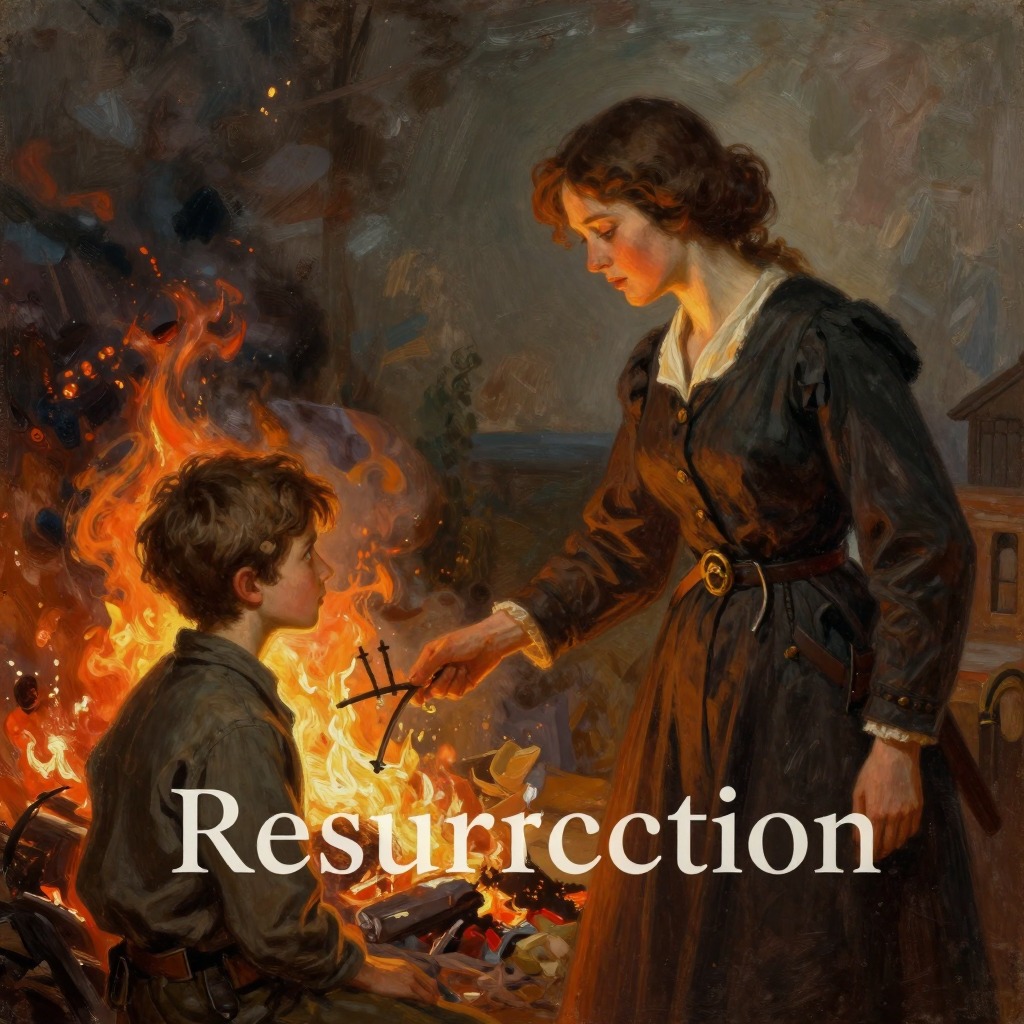
The root of Menshoff's tragedy lies in the seduction of his wife by the village publican. Menshoff tried to obtain justice through all available means, but the publican managed to bribe the officials at every turn and was acquitted. Once, Menshoff forcibly took his wife back, but she ran away the next day. When he went to the public house to demand her return, he saw her inside, but the publican told him she was not there and ordered him to leave. When Menshoff refused, the publican and his servant beat him until he bled. The very next day, a fire broke out at the public house, and Menshoff and his mother were immediately accused of arson. Menshoff insists he did not set the fire, stating that he was visiting a friend at the time. He believes the publican himself started the blaze, noting that the man had only recently insured the property. The only threat Menshoff admits to making was against the publican, saying, "my heart couldn't stand it any longer."
Imprisonment and Nekhludoff's Intervention
Menshoff is held in cell No. 21, a cramped, dirty space with a low bedstead, a straw mattress, a grated window, and damp, filthy walls. When Nekhludoff visits him, Menshoff immediately begins telling his story, at first shyly in the presence of the inspector's assistant, but growing bolder once the official steps away. He speaks with such good-natured sincerity that Nekhludoff finds it difficult to believe such a man could be a criminal, yet the alternative—that an innocent man is being held in these horrific conditions—is even more dreadful. Nekhludoff promises to consult a good lawyer and do what he can. As Nekhludoff leaves, Menshoff stands close to the door, and after the jailer locks it, he remains looking out through the small hole, a gesture that underscores his helplessness and desperate hope.
Significance and Thematic Role
Menshoff's case is one of the clearest examples of judicial error in the novel. Nekhludoff later discusses it with the advocate Fanarin, who is immediately indignant at the inconsistency of the accusation and agrees to take the case, charging nothing if it is tried locally. The advocate notes that the publican likely set the fire himself to collect insurance money and that there is no real evidence against Menshoff. Nekhludoff reflects on the "terrible" suffering of the evidently innocent Menshoff, emphasizing not just his physical confinement but the "perplexity, the distrust in the good and in God which he must feel, seeing the cruelty of the people who tormented him without any reason." The case thus serves as a powerful indictment of a system that punishes the innocent while the guilty go free, and it strengthens Nekhludoff's resolve to fight against such injustice.