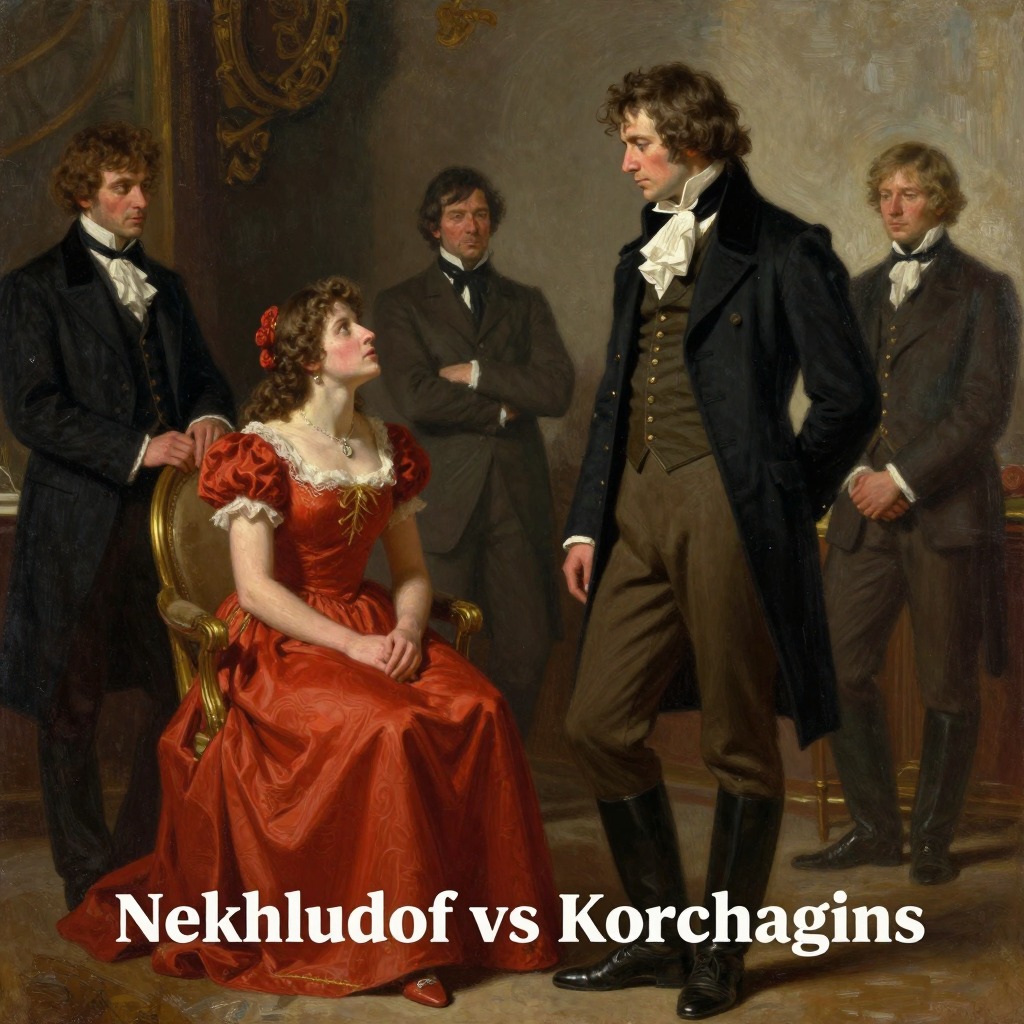
Princess Sophia Vasilievna Korchagin
Princess Sophia Vasilievna Korchagin is the mother of Princess Mary Korchagin (Missy) and the wife of Prince Ivan Korchagin, a wealthy and aristocratic family into which Nekhludoff is expected to marry. She is a long-term invalid who receives visitors while reclining on a couch, and her character embodies the falseness, hypocrisy, and moral decay of the high society that Nekhludoff comes to reject.
Identity and Domestic Life
Princess Sophia Vasilievna is a long, thin woman with dark hair, large black eyes, and long teeth, who still pretends to be young. For eight years, when visitors are present, she has lain in lace and ribbons, surrounded with velvet, gilding, ivory, bronze, lacquer, and flowers, never going out, and only receiving intimate friends—those who, according to her idea, stand out from the common herd. She has her very elaborate and nourishing dinner always alone, so that no one should see her performing this unpoetical function. By her couch stands a small table with her coffee, and she smokes pachitos. Her intimacy with the doctor is being talked about; Nekhludoff has known this for some time, and when he sees the doctor sitting by her couch, his oily, glistening beard parted in the middle, he not only remembers the rumors about them but feels greatly disgusted.
Social Performance and Flattery
Sophia Vasilievna is in the habit of artfully flattering all those with whom she converses. When Nekhludoff visits after the trial, she greets him with an affected but very naturally-acted smile, showing her fine, long teeth—a splendid imitation of what her own had once been. She tells him she hears he has come from the Law Courts very much depressed, and that it must be very trying to a person with a heart. When Nekhludoff replies that one often feels one has no right to judge, she cries "Comme, c'est vrai," as if struck by the truth of this remark. She then asks about his picture, claiming it interests her so, and that if she were not such a sad invalid she would have seen it long ago. When Nekhludoff replies drily that he has given it up, she turns to Kolosoff and says, "Why, he has a real talent for art; I have it from Repin's own lips." Nekhludoff thinks, "Why is she not ashamed of lying so?"
Manipulation and Control
Sophia Vasilievna's control over her environment is exercised through a series of petty, tyrannical commands. During a conversation with Kolosoff about mysticism, she keeps glancing uneasily at the window, through which a slanting ray of sunshine, which might vividly light up her aged face, is beginning to creep up. She touches the button of an electric bell by the side of her couch, and when the handsome footman Philip enters, she says, "Please, Philip, draw these curtains," pointing to the window. When Philip draws the wrong curtain, she exclaims in a suffering tone, "Philip, not that curtain; the one on the large window." The broad-chested, muscular, handsome Philip bows slightly, as if begging pardon, and stepping lightly across the carpet with his broad-calved, strong legs, obediently and silently goes to the other window, and, looking at the princess, carefully begins to arrange the curtain so that not a single ray dares fall on her. But again he does not satisfy her, and she has to interrupt the conversation about mysticism and correct in a martyred tone the unintelligent Philip, who is tormenting her so pitilessly. For a moment a light flashes in Philip's eyes; Nekhludoff thinks, "'The devil take you! What do you want?' was probably what he said to himself."
Relationship with Missy and Nekhludoff
Nekhludoff is admitted into the number of Sophia Vasilievna's intimate friends because he is considered clever, because his mother had been an intimate friend of the family, and because it is desirable that Missy should marry him. When Nekhludoff is in a bad temper and cannot be drawn into agreeable and clever conversation, she turns to Kolosoff, asking his opinion of a new play in a tone as if Kolosoff's opinion would decide all doubts. She then tries to draw Nekhludoff out by asking if he believes in heredity, but he replies, "No, I don't." She then tells him that Missy is waiting for him to play a new piece by Grieg, though Nekhludoff thinks, "She did not mean to play anything; the woman is simply lying, for some reason or other." When he rises and presses her transparent and bony, ringed hand, she has succeeded in making him feel the falseness of her entire world.
Thematic Significance
Princess Sophia Vasilievna represents the apex of aristocratic hypocrisy and moral decay that Nekhludoff must reject in order to pursue his spiritual awakening. Her invalidism is a performance of fragility that masks a steely will to control her environment and manipulate those around her. Her flattery is a tool of social power, her lies are casual and habitual, and her domestic tyranny over servants like Philip reveals the cruelty that underlies the velvet and lace of her world. Nekhludoff's disgust at her—at her false teeth, her dyed hair, her rumored affair with the doctor, and her petty commands—is a measure of how far he has traveled from the values of her circle.