Vasiliev
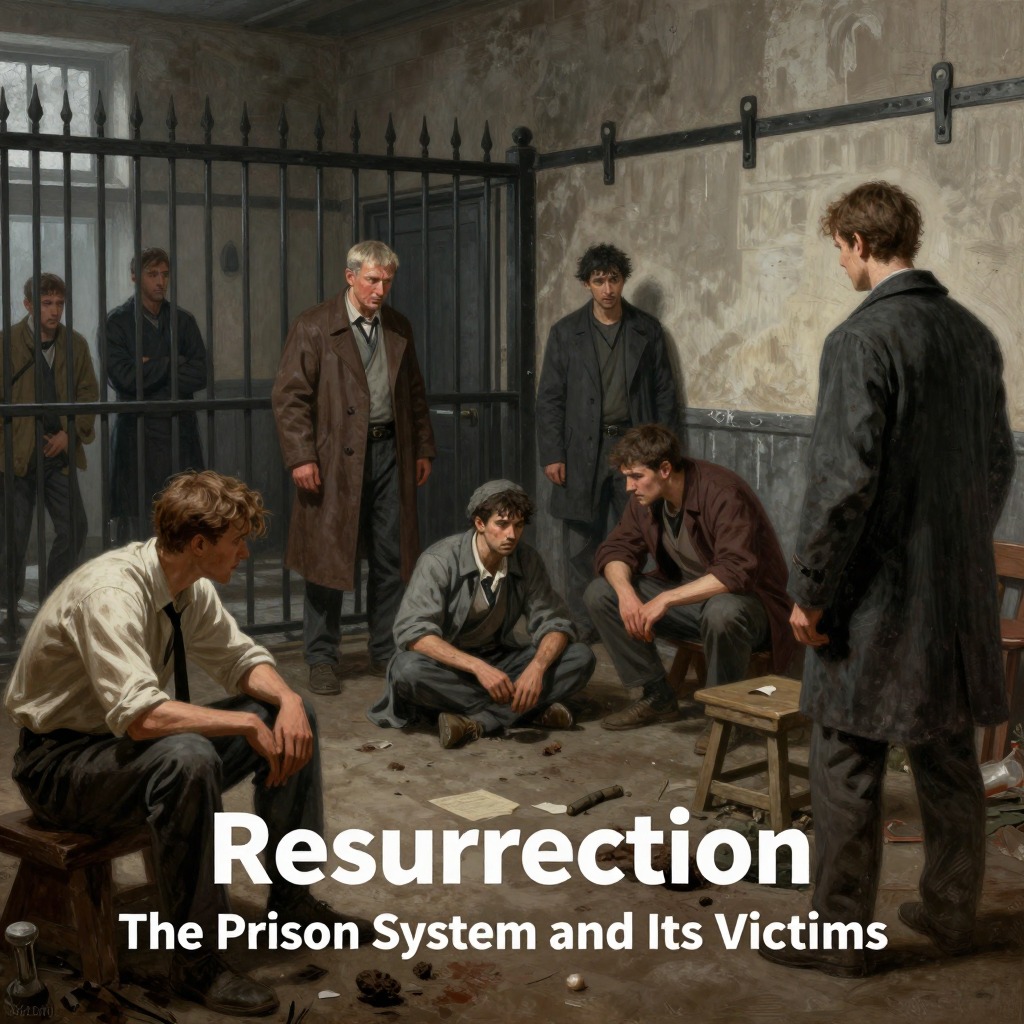
Vasiliev was a young man of some education, a clerk by occupation, who had killed his mistress in a fit of jealousy. Within the prison, he was liked by his fellow inmates for his merry and generous nature and for his firm, principled behavior with the authorities. He knew the laws and insisted on their being carried out, a stance that made him disliked by the prison administration.
The Incident and the Flogging
Three weeks before the flogging, a jailer struck one of the prisoner-scavengers who had spilled soup over his new uniform. Vasiliev took the scavenger's part, arguing that it was not lawful to strike a prisoner. The jailer responded by scolding Vasiliev, and when he attempted to hit him, Vasiliev seized the jailer's hands, held them fast for about three minutes, twisted them, and pushed the jailer out of the door. The inspector ordered Vasiliev put into a solitary cell—a dark closet with no bed, chair, or table, where the inmate had to sit or lie on the dirty floor while rats ran across him and even stole bread from the prisoners. Vasiliev refused to go, saying he had done nothing wrong, and when force was used, he struggled, assisted by two other prisoners. All the jailers assembled, including Petrov, who was distinguished for his strength, and the prisoners were thrown down and pushed into the solitary cells. The governor was immediately informed that something like a rebellion had taken place, and he sent back an order to flog the two chief offenders, Vasiliev and the tramp Nepomnishy, giving each thirty strokes with a birch rod. The flogging was appointed to take place in the women's interviewing-room.
The Prisoners' Response
The flogging was known in the prison since the evening before, and it was being talked about with animation in all the cells. In the women's cell, Korableva, Khoroshavka, Theodosia, and Maslova sat together drinking tea, all flushed and animated by the vodka Maslova freely shared. Korableva remarked that Vasiliev had not been rioting but had only stuck up for a comrade because it was not lawful to strike prisoners nowadays. Theodosia, who had heard he was a fine fellow, expressed her horror at the impending punishment, saying, "It is terrible." Khoroshavka noted that the jailers were especially enraged with him because he never would give in to them. The women listened to the sounds of voices and steps in the corridor above them, and Khoroshavka said, "There they are, hauling him along, the devils! They'll do him to death, they will." The watchman's wife began a long story about having once seen a peasant flogged in the village, but the narrative was interrupted by the sounds from above.
Significance
Vasiliev's flogging is a pivotal event that exposes the arbitrary cruelty of the prison system and the complete powerlessness of inmates before the authorities. His principled stand—insisting on the law even when it was against the jailers—marks him as a figure of resistance, and the solidarity he inspires among the prisoners, including the women who discuss his fate with concern, highlights the shared suffering and the moral lines drawn within the prison community. The incident also serves as a direct contrast to the official pretense of justice and reform, showing that the system's response to any assertion of rights is brute force, not legal process.