Vladimir Vasilievitch Wolf
Vladimir Vasilievitch Wolf is a senator in the Appeal Department of the Senate, a man who prizes his reputation as un homme tres comme il faut above all else, and whose career has been built on a foundation of moral complacency, financial dishonesty, and a rigid adherence to the forms of law that masks a profound indifference to justice.
Identity and Background
Wolf is a man who has made a brilliant career, the very career he desired, by marrying a fortune that brings him 18,000 roubles a year and by his own exertions attaining the post of senator. He considers himself not only un homme tres comme il faut but also a man of knightly honour. By honour he understands not accepting secret bribes from private persons, yet he does not consider it dishonest to beg money for payment of fares and all sorts of travelling expenses from the Crown, and to do anything the Government might require of him in return. To ruin hundreds of innocent people, to cause them to be imprisoned, to be exiled because of their love for their people and the religion of their fathers, as he had done in one of the governments of Poland when he was governor there, he did not consider dishonourable, but even thought it a noble, manly and patriotic action. Nor did he consider it dishonest to rob his wife and sister-in-law, as he had done, but thought it a wise way of arranging his family life. His family consists of his commonplace wife, his sister-in-law, whose fortune he had appropriated by selling her estate and putting the money to his account, and his meek, frightened, plain daughter, who lives a lonely, weary life, from which she has lately begun to look for relaxation in evangelicism, attending meetings at Aline's and the Countess Katerina Ivanovna's. Wolf's son, who had grown a beard at the age of fifteen, had at that age begun to drink and lead a depraved life, which he continued to do until the age of twenty, when he was turned out by his father because he never finished his studies, moved in a low set and made debts which committed the father. The father had once paid a debt of 250 roubles for his son, then another of 600 roubles, but warned the son that he did it for the last time, and that if the son did not reform he would be turned out of the house and all further intercourse between him and his family would be put a stop to. The son did not reform, but made a debt of a thousand roubles, and took the liberty of telling his father that life at home was a torment anyhow. Then Wolf declared to his son that he might go where he pleased—that he was no son of his any longer. Since then Wolf pretended he had no son, and no one at home dared speak to him about his son, and Vladimir Vasilievitch Wolf was firmly convinced that he had arranged his family life in the best way.
Role in the Senate and the Maslova Case
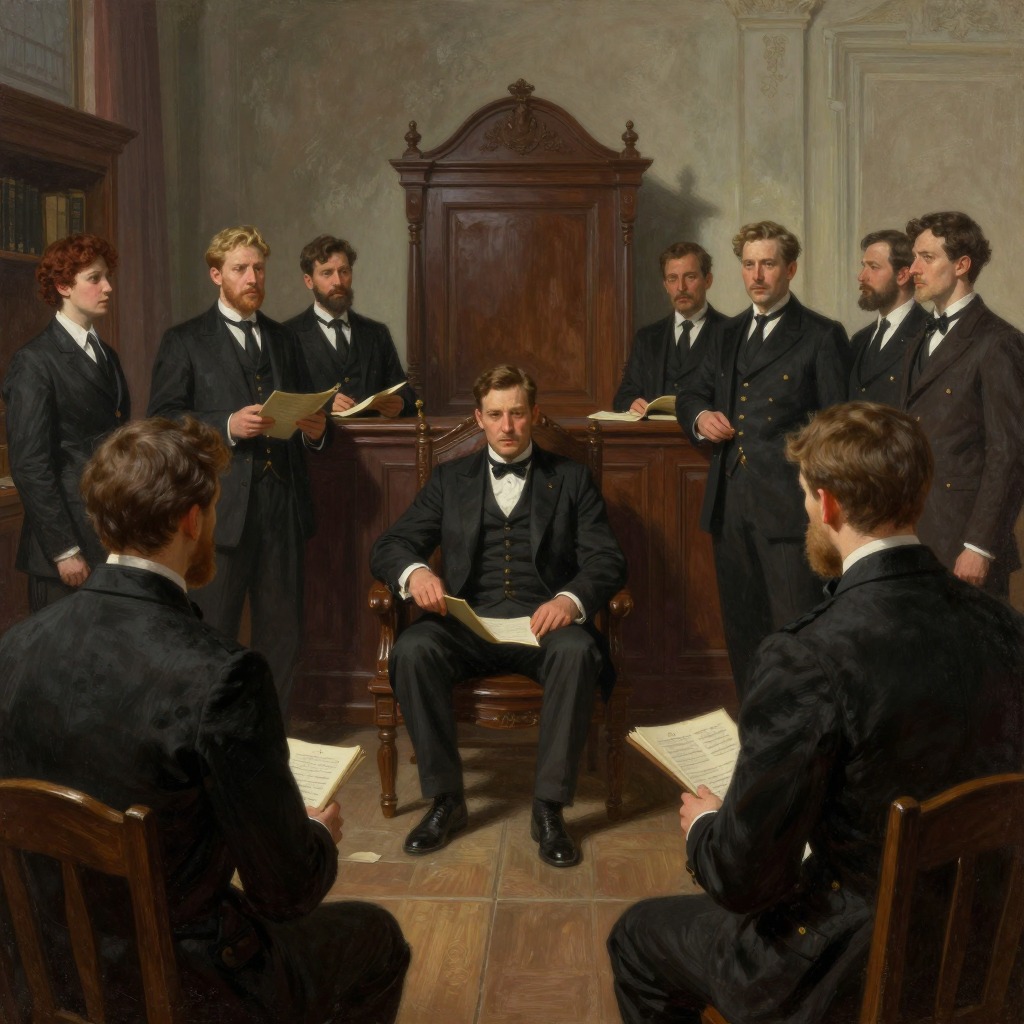
Wolf is one of the four senators who hear Maslova's appeal. He is described as having significantly compressed lips and little white hands, with which he keeps turning over the pages of the business papers. When Nekhludoff visits him to ask that Maslova's case might come on soon, Wolf receives him with a friendly though slightly ironical smile, his way of showing how comme il faut he is, and how superior to the majority of men. He reads the note from Count Ivan Michaelovitch, and, blowing the fragrant blue smoke out of his mouth and removing his cigar carefully so as not to drop the ash, he patronisingly tells Nekhludoff that he will ask the others and that the case will be heard on Wednesday. When Nekhludoff suggests that the sentence was passed owing to a misunderstanding, Wolf looks seriously at the ash of his cigar and replies that the Senate cannot decide the case on its merits, only the exactness of the application of the laws and their right interpretation. He invites Nekhludoff to dine on Wednesday, promising a decisive answer. During the Senate hearing, Wolf reports Maslova's appeal very fully, but again not without some bias and an evident wish for the repeal of the sentence. In the subsequent debate among the senators, Wolf brings forward with great animation all the motives in favour of a repeal. When the appeal is rejected, Wolf is dissatisfied, especially because it was like being caught acting with dishonest partiality; so he pretends to be indifferent, and, unfolding the document which contains Maslova's case, he becomes engrossed in it. After the decision, he approaches Nekhludoff in the waiting-room, shrugging his narrow shoulders and closing his eyes, and says, "It could not be helped, dear Prince. The reasons for an appeal were not sufficient."
Moral Character and Thematic Significance
Wolf embodies the moral bankruptcy of the Russian legal and aristocratic establishment. His entire self-conception as a man of honour is a carefully maintained facade that allows him to commit acts of profound cruelty and dishonesty without a pang of conscience. He can ruin hundreds of innocent people in Poland, rob his own wife and sister-in-law, and disown his son, all while believing he has arranged his life in the best way. His obsession with being un homme tres comme il faut is the key to his character: it is a social performance that substitutes for any genuine moral compass. In the Senate, he is willing to bend the rules to favour a repeal in Maslova's case, but only because he has been asked by a well-connected count; when the repeal fails, he is troubled not by the injustice done to an innocent woman, but by the appearance of his own dishonest partiality. He is a perfect product of a system that rewards form over substance, connections over justice, and self-regard over conscience.