Valdemar Simonson
Valdemar Simonson is a political exile whose principled, ascetic, and deeply moral character leads him to offer a platonic marriage to Katerina Maslova, an act that decisively reshapes the novel's central relationship and underscores the theme of self-sacrificing love.
Identity and Background
Simonson is a young man with a dark, dishevelled appearance, deep-lying eyes, and a frowning brow that gives him a stern look, yet his expression is marked by a childlike kindness and innocence. He is a vegetarian who refuses to wear the skin of slaughtered animals, wearing a rubber jacket and rubber overshoes fastened with string over worsted stockings. He is a man of the people in origin, but his intellectual and moral development sets him apart. As a schoolboy, he concluded that his father's income as a government paymaster was dishonestly gained and left home rather than use it. After university, he became a village schoolmaster, teaching and explaining what he considered just and openly blaming what he thought unjust. Arrested and tried, he decided to tell his judges that his cause was just and, when they paid no heed, kept resolutely silent. He was exiled to the Government of Archangel. There he formulated a religious teaching founded on the theory that everything in the world is alive, that nothing is lifeless, and that all objects considered inorganic are parts of an enormous organic body which humans cannot compass. A man's task, he believes, is to sustain the life of that huge organism and all its animate parts. He is therefore against war, capital punishment, and every kind of killing, not only of human beings but also of animals. He considers increase a lower function of man, the highest function being to serve already existing lives, and he finds confirmation for this theory in the existence of phagocytes in the blood, which he likens to celibates whose function is to help the weak and sickly particles of the organism. From the moment he came to this conclusion, he began to consider himself and Mary Pavlovna Schetinina as phagocytes and to live accordingly, though as a youth he had been addicted to vice.
Life and Plot Trajectory
Simonson is among the political prisoners traveling with the gang to Siberia, sentenced to the Yakutsk district. He marches with the criminal convicts, not daring to avail himself of a class privilege. He is often seen walking with the gang, jotting down thoughts in a notebook, such as a reflection on bacteria and a human nail. He is a man who settles and verifies everything according to his own reason and acts on the decisions he arrives at. He applies a theory of his own to all practical business, having rules relating to the number of hours for rest and for work, the kind of food to eat, the way to dress, and how to heat and light rooms. With all this, he is very shy and modest, yet when he has once made up his mind, nothing can make him waver. He is seen heating a stove according to a theory of his own to lose as little heat energy as possible. He protests against the convoy officer's brutal treatment of a prisoner carrying a child, telling the officer directly, "You have behaved badly." He is also the one who, after the incident, carries the child's plaid and cloaks to dry.
Key Actions and Objectives
Simonson's most significant action is his decision to propose marriage to Katerina Maslova. He approaches Nekhludoff privately to explain his intentions, stating that he loves Maslova as a splendid, unique human being who has suffered much, and that he wants nothing from her but only an awful longing to help her and lighten her position. He asks Nekhludoff if he would consider it good for her to marry him, and upon receiving Nekhludoff's assent, he says he will tell her. He later informs Maslova of his proposal, and she ultimately decides to go with him, telling Nekhludoff, "Where Valdemar Simonson goes, there I shall follow." Simonson's love for Maslova is platonic; he does not infringe his conception of himself as a phagocyte, believing such love acts as an inspiration. He is also the one who, when Maslova is in the hospital, asks her about the plaid and cloaks, showing his practical care for her.
Relationships and Conflict
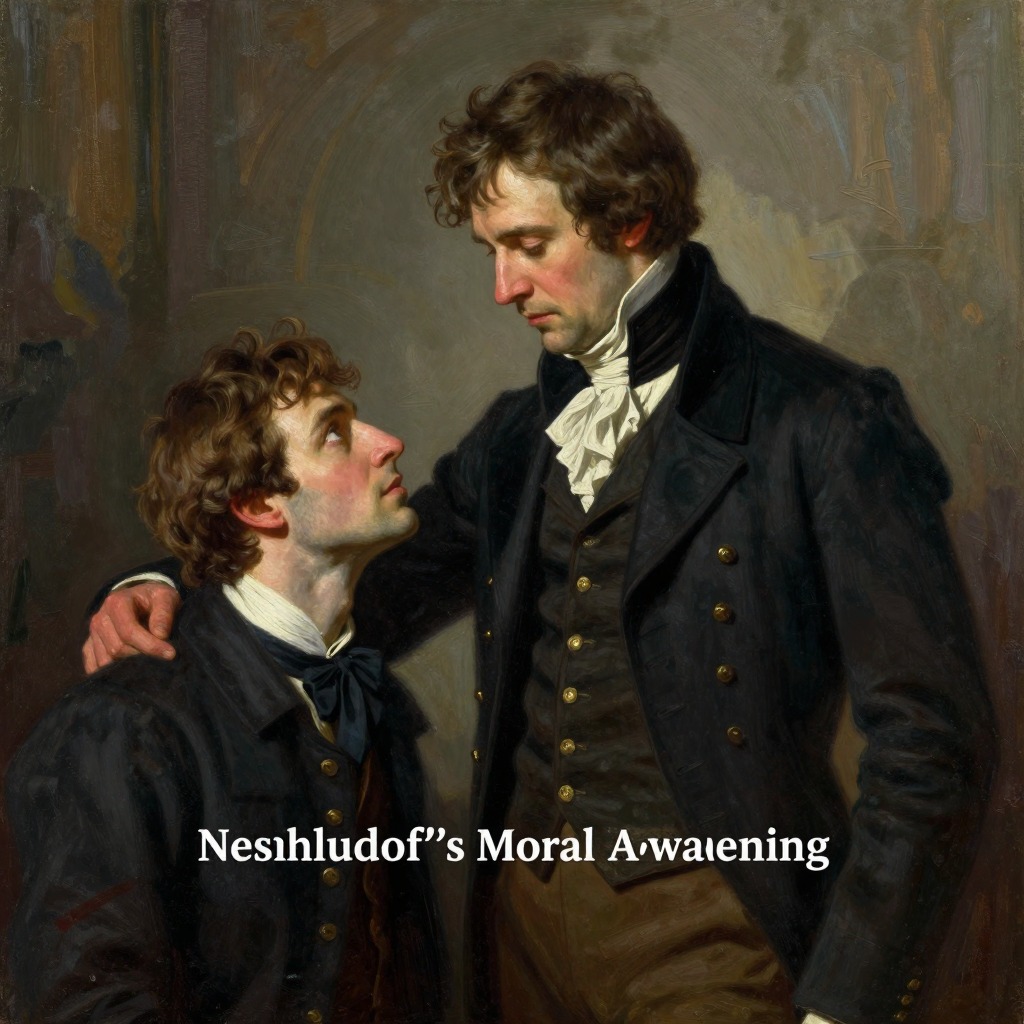
Simonson's relationship with Nekhludoff is one of respectful but direct confrontation. He seeks Nekhludoff's consent to marry Maslova, acknowledging that she will not come to any decision without Nekhludoff's input. Nekhludoff, though initially feeling a pang of jealousy, ultimately approves, recognizing Simonson's genuine love and selflessness. Simonson's relationship with Maslova is one of profound, non-possessive love. He loves her for who she is, not for what she can do for him, and his love raises her in her own estimation. He is also a friend and fellow traveler to Mary Pavlovna, with whom he shares the role of a "phagocyte." He is respected by the other political prisoners, though his intense moral seriousness sometimes sets him apart. He is notably different from Novodvoroff, whom he does not engage in the latter's disputes.
Change and Ending
Simonson's proposal to Maslova is the culmination of his moral journey. He does not change his character but rather acts in perfect consistency with his principles. His love for Maslova, though platonic, is a powerful force that helps her find a new path. He is willing to be sent to the place where she will be imprisoned, planning to live near her and lighten her fate. His offer is a practical expression of his belief in serving the already existing lives. The novel ends with Maslova's decision to go with him, a choice that frees Nekhludoff from his self-imposed duty and allows him to pursue his own spiritual awakening. Simonson's presence in the narrative is a quiet but powerful testament to the possibility of a love that is entirely selfless and principled.
Narrative Role and Evaluation
Simonson serves as a foil to Nekhludoff, representing a different kind of moral awakening. While Nekhludoff's journey is one of guilt, repentance, and a desire to atone, Simonson's is one of innate, principled goodness. He is a character who has already achieved a state of moral clarity and lives by it without struggle. His love for Maslova is not a sacrifice but a natural expression of his being. He is also a representative of the revolutionary spirit, but one that is grounded in a personal, almost mystical philosophy rather than political ideology. His presence in the story provides a counterpoint to the cynicism and corruption of the legal and social systems, offering a vision of a life lived in accordance with a higher law. He is, in many ways, the novel's most consistently admirable character, a man who has already found the "Kingdom of Heaven on Earth" within himself.