The Committee for the Disposal of Dangerous Creatures is a bureaucratic body within the British Ministry of Magic that adjudicates cases involving magical beasts deemed hazardous, most notably presiding over the trial and sentencing of the Hippogriff Buckbeak. Its proceedings, heavily influenced by Lucius Malfoy's political pressure, result in a death sentence that drives a significant portion of the novel's climactic action, ultimately exposing the committee's vulnerability to corruption and its role as an instrument of institutional power rather than impartial justice.
The International Federation of Warlocks is a global governing body of the magical community, mentioned in Harry Potter and the Prisoner of Azkaban primarily as an institution that criticizes the Minister of Magic for informing the Muggle Prime Minister about Sirius Black's escape.
The Magical Law Enforcement Squad is the elite force within the British Ministry of Magic responsible for apprehending dangerous wizards and maintaining order in the wizarding world. They are the operational arm of the Magical Law Enforcement Patrol, tasked with capturing high-profile criminals like Sirius Black and intervening in magical catastrophes.
The Fidelius Charm Secrecy Rule is a foundational magical principle in the wizarding world, governing how a secret is concealed within a single living soul, known as the Secret-Keeper, making it impossible for anyone else to discover the hidden information unless the Keeper chooses to divulge it. This rule is the central mechanism behind the tragedy of James and Lily Potter, whose choice of Secret-Keeper led directly to their deaths and set the entire plot of Harry Potter and the Prisoner of Azkaban in motion.
The Hogsmeade Permission Form Requirement is a school rule at Hogwarts School of Witchcraft and Wizardry that mandates third-year and above students must obtain a signed permission form from a parent or guardian to visit the all-wizarding village of Hogsmeade on designated weekends. This rule becomes a central source of frustration and conflict for Harry Potter, who is unable to secure a signature from his Muggle guardians, the Dursleys, and is denied permission even by the Minister of Magic himself, Cornelius Fudge. The requirement underscores Harry's isolation from his peers and the limitations placed on him by both his family and the wizarding authorities, and it is ultimately circumvented through a special letter from his godfather, Sirius Black.
Christmas at Hogwarts in Harry Potter and the Prisoner of Azkaban is a time of both celebration and profound emotional complexity, serving as a backdrop for the revelation of the Firebolt, the deepening of Harry's personal conflicts, and the quiet resolution of the Buckbeak crisis through the solidarity of his friends.
The Night of the Shrieking Shack is the climactic sequence of Harry Potter and the Prisoner of Azkaban, during which the true identities of Sirius Black, Peter Pettigrew, and Remus Lupin are revealed, the Marauders' history is exposed, and the central conflict of the novel is resolved through confrontation, betrayal, and a narrow escape.
The twelve years that Sirius Black spent imprisoned in Azkaban form the temporal and emotional foundation of the novel's central mystery, shaping his physical and psychological state, the narrative's suspense, and the eventual revelation of his innocence.
Black is a fireman in the dystopian firehouse of Fahrenheit 451, a silent enforcer who participates in the burning of books and the old woman's house, and who is later knocked unconscious by Montag during his escape.
Mildred Montag is the wife of protagonist Guy Montag in Ray Bradbury's Fahrenheit 451, a woman so thoroughly immersed in the shallow, media-saturated culture of her dystopian society that she becomes a symbol of emotional emptiness and the failure of human connection. Her attempted suicide by overdose, her obsession with the interactive television "family," and her ultimate betrayal of her husband reveal the dehumanizing consequences of a world that has traded genuine feeling for constant, mindless entertainment.
Mrs. Black is a minor but symbolically significant character in Fahrenheit 451, the neighbor who reports the old woman with books to the firemen, and later becomes the unwitting recipient of Montag's retaliatory act of planting books in her home.
The biblical verse from Revelation, 'And on either side of the river was there a tree of life, which bare twelve manner of fruits, and yielded her fruit every month; And the leaves of the tree were for the healing of the nations,' becomes the final, salvific text that Guy Montag chooses to carry forward after the destruction of the city, representing the novel's ultimate turn from burning to healing and from destruction to preservation.
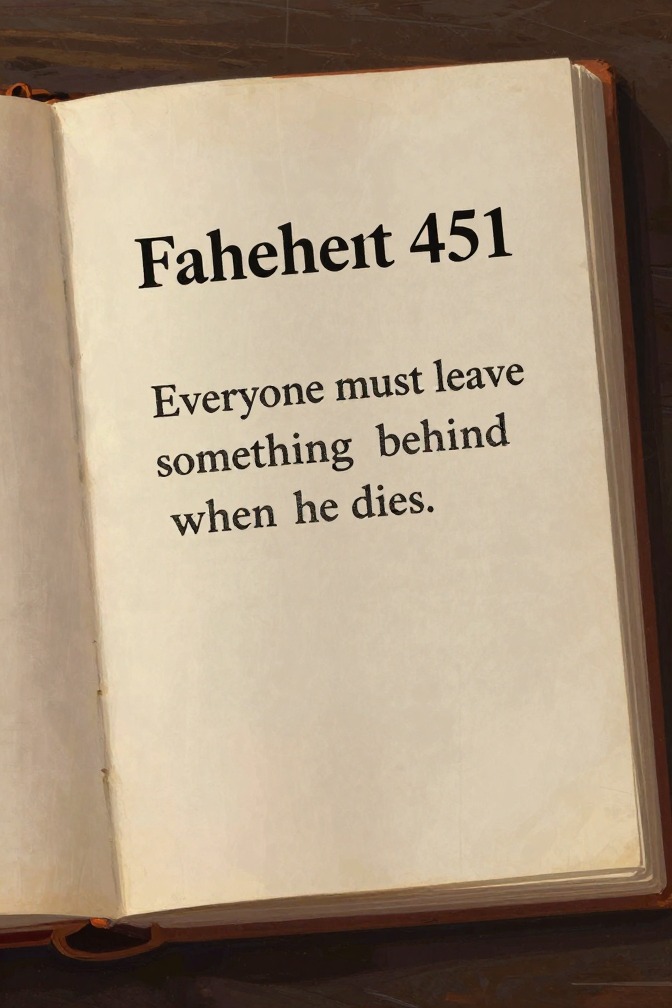
Granger's grandfather's saying, 'Everyone must leave something behind when he dies,' is the philosophical core of Fahrenheit 451, articulating the novel's central argument that a meaningful life is measured by the tangible, lasting impact one has on the world, a principle that directly counters the society's culture of disposability and emptiness.
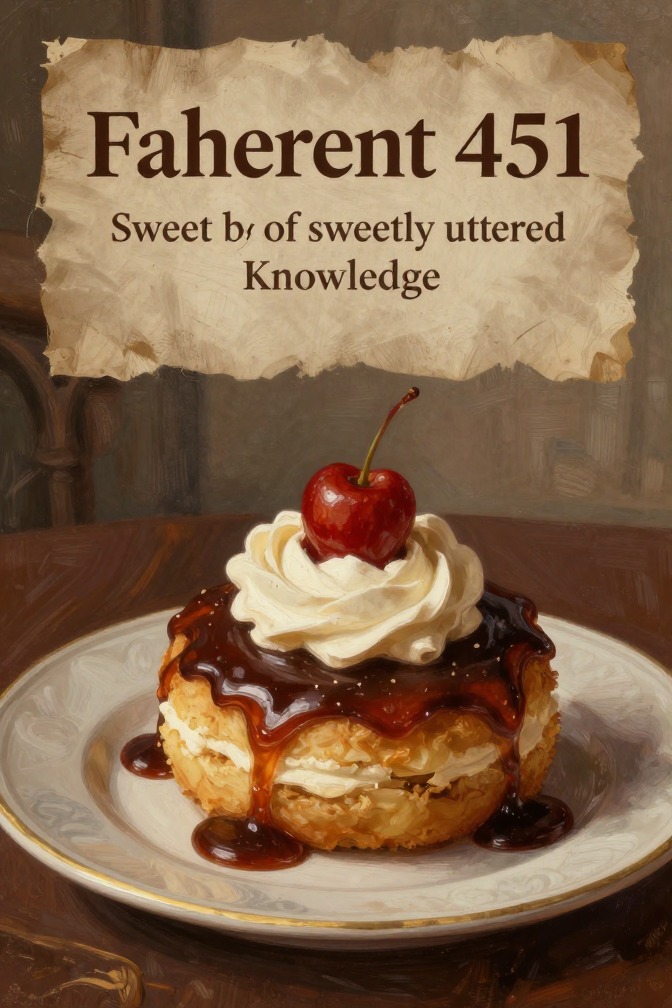
Captain Beatty quotes Sir Philip Sidney's line "Sweet food of sweetly uttered knowledge" during a poker game at the firehouse, using it as part of a rhetorical barrage meant to confuse and demoralize Montag after his return from sick leave.
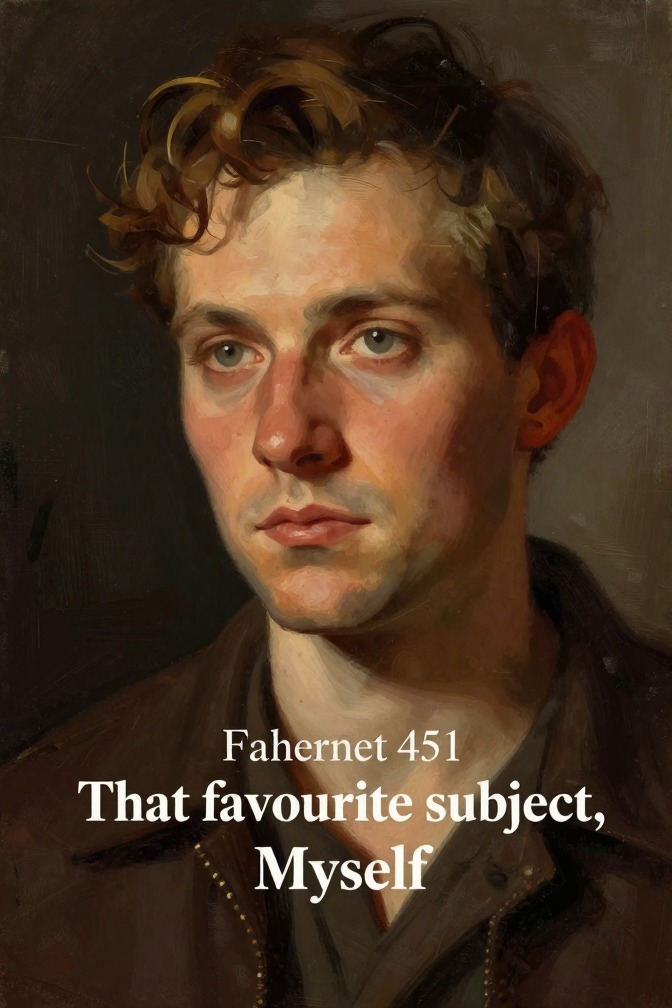
The phrase "That favourite subject, Myself" appears in Fahrenheit 451 as a line from a book Montag reads aloud to Mildred during their secret reading session, and it crystallizes the novel's critique of a society that has replaced genuine self-reflection with hollow entertainment and conformity.
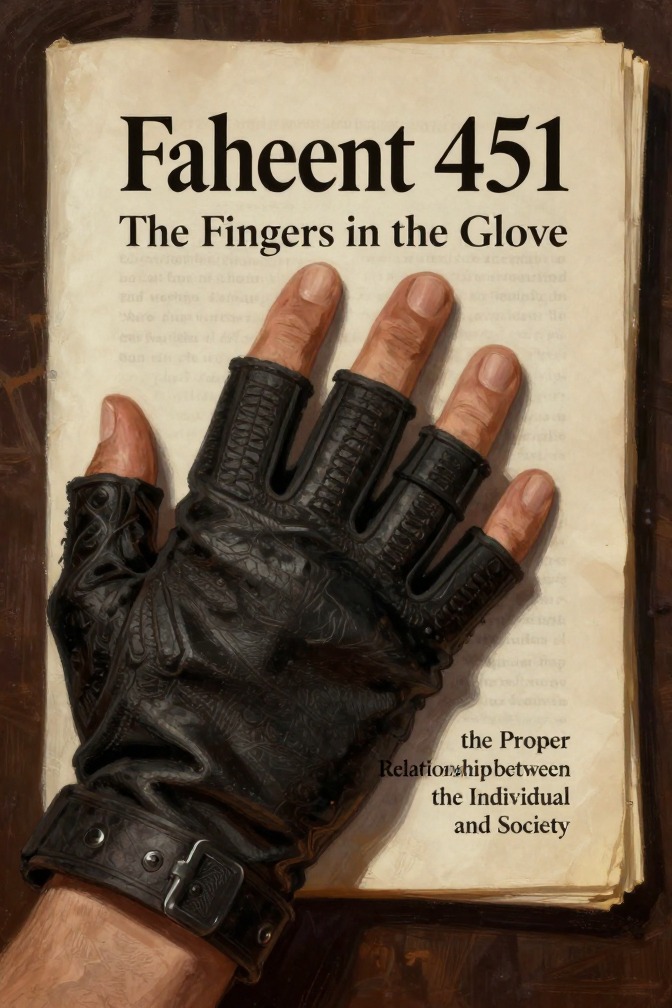
The Fingers in the Glove; the Proper Relationship between the Individual and Society is a book written by Granger, the leader of the wandering book people, and its title encapsulates the group's core philosophy: the individual is not a self-sufficient entity but a finger that finds its meaning and function only within the larger social body, the glove. The work represents the intellectual and moral framework that Granger and his fellow exiles carry as a living alternative to the firemen's culture of enforced happiness and uniformity.
The proverb "Truth will come to light, murder will not be hid long" is a key quotation deployed by Captain Beatty in his psychological duel with Guy Montag, serving as a weapon of intellectual intimidation rather than a statement of moral conviction. Its appearance crystallizes the novel's central conflict between the oppressive regime's cynical manipulation of knowledge and the protagonist's desperate search for authentic meaning.
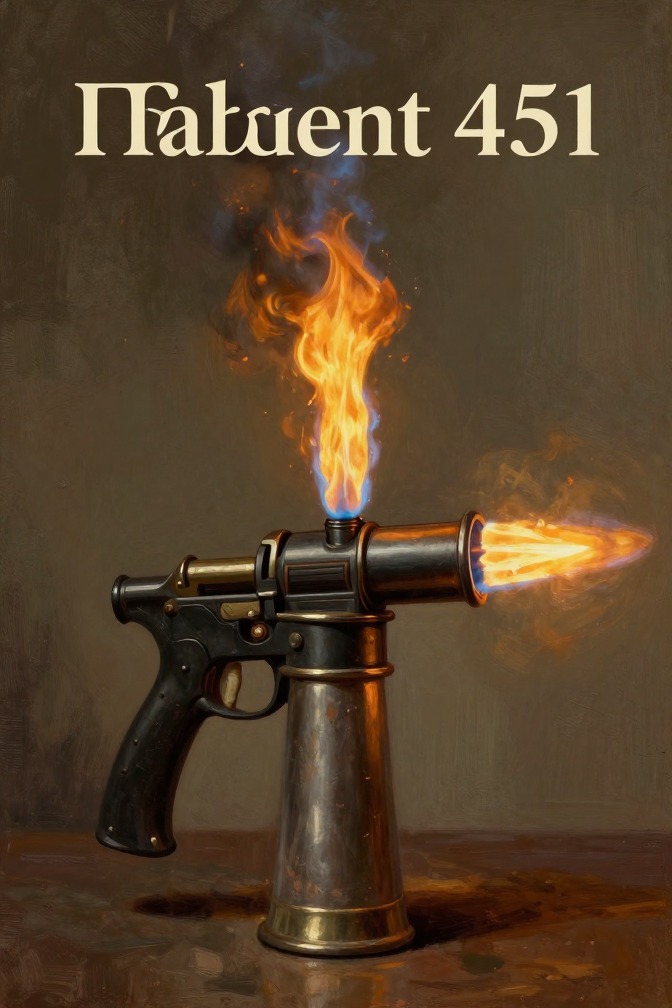
The Flamethrower is the primary tool of the Firemen in Fahrenheit 451, used to burn books and houses. It transforms from a symbol of professional pride and destructive pleasure into an instrument of personal rebellion and murder, marking the climax of Guy Montag's transformation.
The marriage of Guy Montag and Mildred Montag is a central relationship in Fahrenheit 451, embodying the emotional emptiness and societal dysfunction of their world. Their union is characterized by profound disconnection, a lack of genuine communication, and the absence of love or shared meaning, serving as a personal catalyst for Montag's rebellion against a repressive society.
The Book Prohibition Law is the foundational legal and social mechanism in the dystopian world of Fahrenheit 451, which criminalizes the possession and reading of books and mandates their destruction by firemen. This law is not an act of top-down censorship but the culmination of a society-wide pursuit of happiness through the elimination of intellectual complexity, enforced by a specialized fire department that burns books and, when necessary, their owners.
Louis Creed's sleepwalking to the Pet Sematary is the pivotal supernatural event that transforms a nightmare into an undeniable physical reality, shattering his rational worldview and binding him to the forbidden power of the Micmac burying ground.
Massachusetts appears in *Pet Sematary* as a place of origin for tourists who, according to Jud Crandall, are uniquely targeted by moose in the Maine woods, and as the home state of the fictional town of Haven, from which the driver Tremont Withers comes. The state is also the source of the author's own cultural reference point for the region's folklore and landscape.
The Crandalls' kitchen is the domestic heart of Jud and Norma Crandall's home in Ludlow, Maine, and the site of several of the novel's most pivotal and emotionally charged scenes, including Norma's heart attack, Jud's confession about the Micmac burying ground, and the final confrontation with the resurrected Gage.
Gage Creed's headstone, a simple marker bearing his name and dates, stands as the final, inadequate monument to a life cut short, a focal point for his father's grief and the site of his desperate, forbidden act of resurrection.
Ylajali is a mysterious young woman who becomes the object of the narrator's obsessive fascination and romantic longing in Knut Hamsun's *Hunger*. She first appears as a stranger on the street, and their brief, intense encounters—marked by the narrator's poverty, hunger, and delirium—transform her into a symbol of unattainable beauty, desire, and the possibility of salvation, while also exposing the depths of his degradation.
Christiania, the Norwegian capital where the novel is set, is not merely a backdrop but an active, oppressive force that shapes the protagonist's psychological and physical deterioration. The city's streets, parks, and institutions become a labyrinth of humiliation and despair, mirroring his internal chaos and relentless hunger.
Hans Pauli's Blanket is a borrowed object that becomes a central symbol of the narrator's moral struggle and physical survival in Knut Hamsun's *Hunger*. Loaned by the student Hans Pauli Pettersen, the blanket is the narrator's only source of warmth in his barren attic and later in a tinker's workshop, and its repeated near-pawning and eventual preservation mark the narrator's wavering commitment to honor amid extreme poverty.
The execution of Eduard Delacroix on the night of October 25, 1932, was a catastrophic failure caused by Percy Wetmore's deliberate sabotage of the electric chair's brine-soaked sponge, resulting in the condemned man being slowly burned alive in front of horrified witnesses.
Arthur Flanders, nicknamed "The President" or "The Pres" by the E Block guards, is a condemned prisoner on the Green Mile at Cold Mountain Penitentiary in 1932. A former regional head of Mid-South Realty Associates, he was convicted of murdering his half-senile father by pushing him out a third-story window to collect on a double-indemnity life insurance policy. His brief stay on death row is marked by his natty demeanor, his eventual commutation to life in prison, and his violent death twelve years later in the prison laundry, a fate that underscores the novel's themes of delayed but inescapable justice.
Brother Schuster is the Baptist minister who provides spiritual comfort to condemned prisoners on E Block at Cold Mountain Penitentiary, most notably officiating at the executions of Arlen Bitterbuck and Eduard Delacroix. His calm, efficient manner and willingness to accommodate the prisoners' specific religious needs—including praying in Cajun French—make him a trusted figure in the death house, though his role is ultimately that of a gentle facilitator for men about to die.